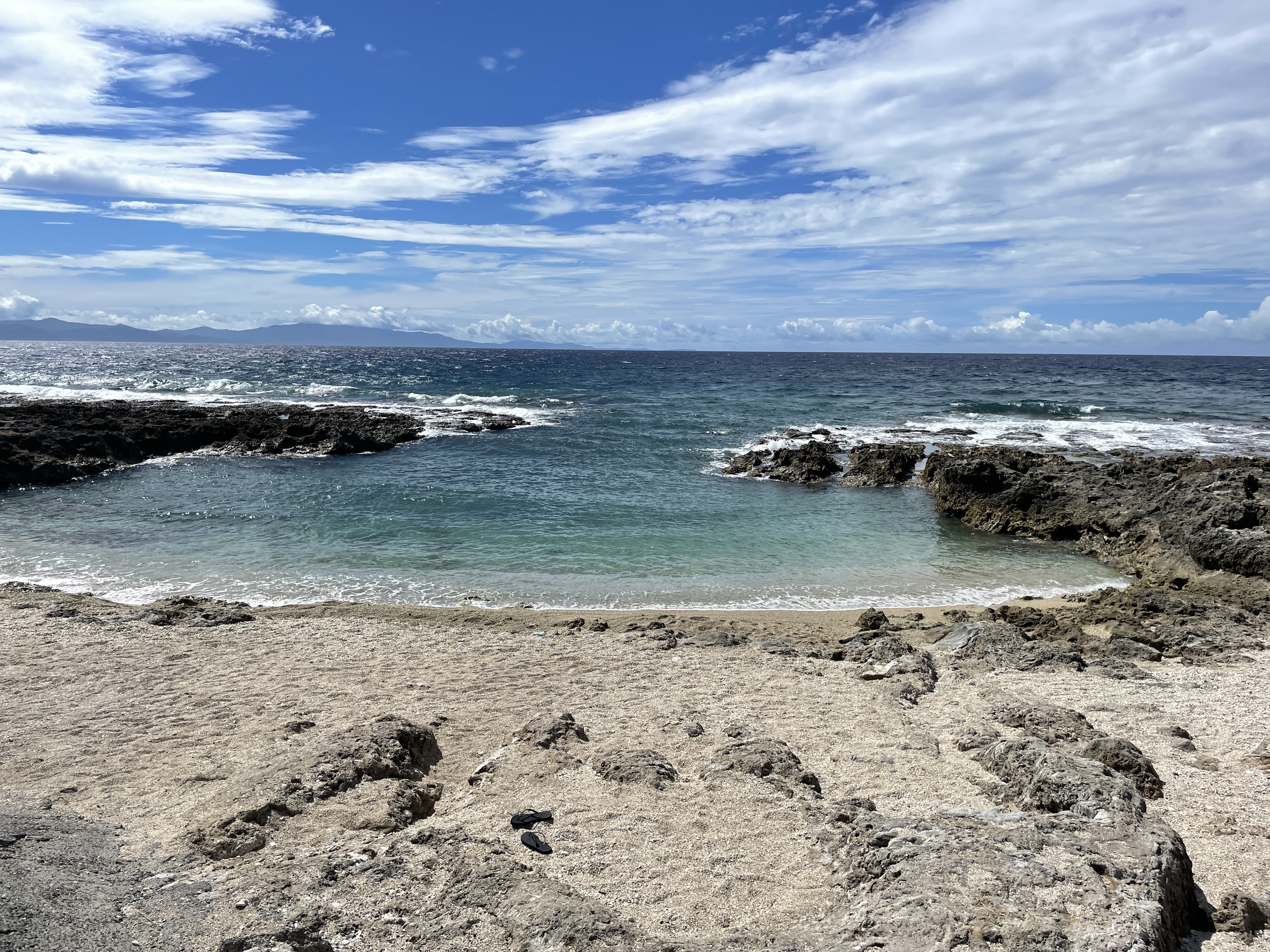
The third morning, we decided to give up swimming and instead went out for breakfast and took one last drive around the island to enjoy the view. Our scooter rental was scheduled for 10AM, so even though we didn't have enough time to catch the 9:30 boat, we went there after 10AM. If you return the scooter late, you are charged an extra 50NT per hour. We visited Lobster Cave to watch the ocean and spotted several turtles in the waters! Unfortunately, we couldn't stay longer as we had to return to Tainan for a dentist appointment, and my husband still had to drive to Hsinchu for work. It was sad to leave such a beautiful place, and upon arriving back on the main island of Taiwan, my mood became a bit gloomy again 😂


See also: Traveling to XiaoLiuqiu
See also: Swimming with Sea Turtles


Staying in a hotel where the owner can take you out and introduce you to local stories and wildlife is a fantastic experience! We didn't have the chance to do that when we visited two years ago, so I'm really happy that I got to learn more about this place now. On the first day, the weather was nice, and we went out around 9PM to a nearby location. It was a new place for us, and I think only the local people know about it. The owner brought a flashlight to find sea creatures. The second day wasn't as lucky as a thunderstorm arrived in the evening just as we were about to go out for dinner. Fortunately, after an hour, the weather improved, but it was already close to 8PM, so we had to delay our meeting with the owner for our night trip. In the end, we still went out at 9PM and returned after an hour-long trip around the island.
We learned about the importance of sea caves from 50 years ago. These small caves would accumulate salty water and were used to pickle fish when there was no electricity or refrigeration available on the island in the past. Nowadays, people don't do that anymore. The owner also explained the story of Guanyin Stone, a stone that used to have a nose and resembled Buddha. However, due to its falling apart, people don't usually visit it anymore. Guanyin is the most important deity on this island, and religion still plays a significant role in the lives of the locals. In fact, there are 70 temples built in Xiaoliuqiu. Guanyin has also helped the local people by guiding them to the best location for digging a well. People would carry the Guanyin statue around the island, seeking her guidance. That's how the first well in Xiaoliuqiu was built over 50 years ago by prisoners. There is no longer a prison on the island. The well is located close to the beach, and although the water doesn't have a salty flavor, it is still used by locals who want to save on their water bills.
The owner also introduced us to some constellations, such as Scorpio and Sagittarius, as well as the summer triangle. There is also a unique tree on the island called Barringtonia asiatica. It is an ornamental tree with flowers that bloom for only one night. These trees are native to the mangroves of the Indian Ocean, and their fruit is carried by ocean currents. In Taiwan, these trees can only be found on Liuqiu Island, Green Island, and parts of Kenting. All parts of this tree are poisonous. It is an important tree for fishermen, as they observe its flowering period, which signals the start of salmon season and the tourist season.
We also learned more about the local animals. During the night, it is common to see crabs crossing the road. However, due to the increase in tourists and the use of scooters, the crab population is decreasing. Xiaoliuqiu does not have any rivers, so these crabs live up in the hills, hiding in rocks and soil and feeding on rotten leaves. After rain, they can easily be spotted in the lower parts of the island. We also had the opportunity to explore some sea animals! The most amazing thing for me was seeing a sea slug that shoots purple ink. It was a relatively large animal compared to typical land slugs and snails. Sea crabs also looked unusual to me, particularly their eyes. The crab we saw even had a shell with a sea anemone attached to it. Another animal that was introduced to us was the sea cucumber.