Showing posts with label Taoyuan (桃園). Show all posts

September 19, 2024

A Visit to Taoyuan Martyrs' Shrine Amidst a Thunderstorm


Travel date: 2024/08/14

After our adventure in Japan, we made our way back to Taiwan. By noon, we were free to leave, but the weather in Taiwan was less than inviting—cloudy skies and a forecast full of rain. Faced with a choice between a scenic coastal drive or a visit to Shifen Waterfall and Pingxi, we opted for a more practical route home, with a stop at Taoyuan Martyrs' Shrine, which had been on my list for some time.

Unfortunately, as soon as we reached the shrine and climbed the stairs, the weather took a turn for the worse. A thunderstorm rolled in, bringing with it heavy rain. We waited indoors, capturing some videos, but the weather wasn’t ideal for a full visit.

Taoyuan Martyrs' Shrine (桃園忠烈祠)

Taoyuan Martyrs' Shrine, nestled on Hutou Mountain, was completed in 1938 and originally known as Taoyuan Shinto Shrine during the Japanese colonial era. It stands as the best-preserved Japanese-era Shinto shrine in Taiwan. The architecture blends ancient Chinese Tang dynasty elements with Japanese and contemporary Taiwanese styles. Constructed from high-quality cypress wood, it was officially designated a level three national monument in 1994. The shrine also served as a filming location for the movie "Kano," which captures the essence of the 1930s.

During the Japanese colonial era, over 200 Shinto shrines were built across Taiwan as part of the Japanization movement. After the end of World War II and the cessation of Taiwan-Japan diplomatic relations, many shrines faced demolition. However, Taoyuan Shinto Shrine, renamed Taoyuan Martyrs' Shrine in 1950, was preserved for its cultural, historical, and artistic value. It remains the only Shinto shrine in Taiwan and outside of Japan that has been perfectly preserved.

The shrine features a variety of buildings: the main hall, where spirit tablets are placed; the worship hall, for visitors to pay their respects; the administration office; and the water room for purification rituals. Additional features include the Torii Gate, Buddhist lantern, Komainu (guardian lions), brass horse sculpture, and the Sandao (path). The intricate craftsmanship is evident in the cypress and fir materials, with beams joined through meticulous grafting joints, highlighting the detailed labor involved.

The shrine’s grounds offer a tranquil atmosphere surrounded by old pine and evergreen trees. The Sandao leads from Chenggong Road to the inner gate and worship hall, extending all the way to Taoyuan Train Station. The surrounding greenery provides a serene backdrop, with cherry blossoms in early spring and vibrant red maple leaves in autumn. Each season transforms the shrine’s landscape, offering new scenic views.


July 4, 2023

Taoyuan Travel: Waterfalls of Sanmin Bat Cave


Travel Date: 2023/06/22

Dragon Boat Festival, so we had a 4-day long holiday. Unfortunately, it seems that the weather wasn't too good. When we arrived at Sanmin Bat Cave, it was already cloudy. We also tried to visit Jiguopai Church, but it wasn't open for visiting.
Afterwards, we planned to go to Daxi Old Street, but the town was packed with people, and we couldn't find any parking space. After driving around the town for half an hour trying to find a spot, we gave up and went to a smaller nearby town to find some food.
Unfortunately, our son got a bit sick afterwards, so we ended up spending the long weekend at home instead of traveling.

Sanmin Bat Cave (三民蝙蝠洞) 

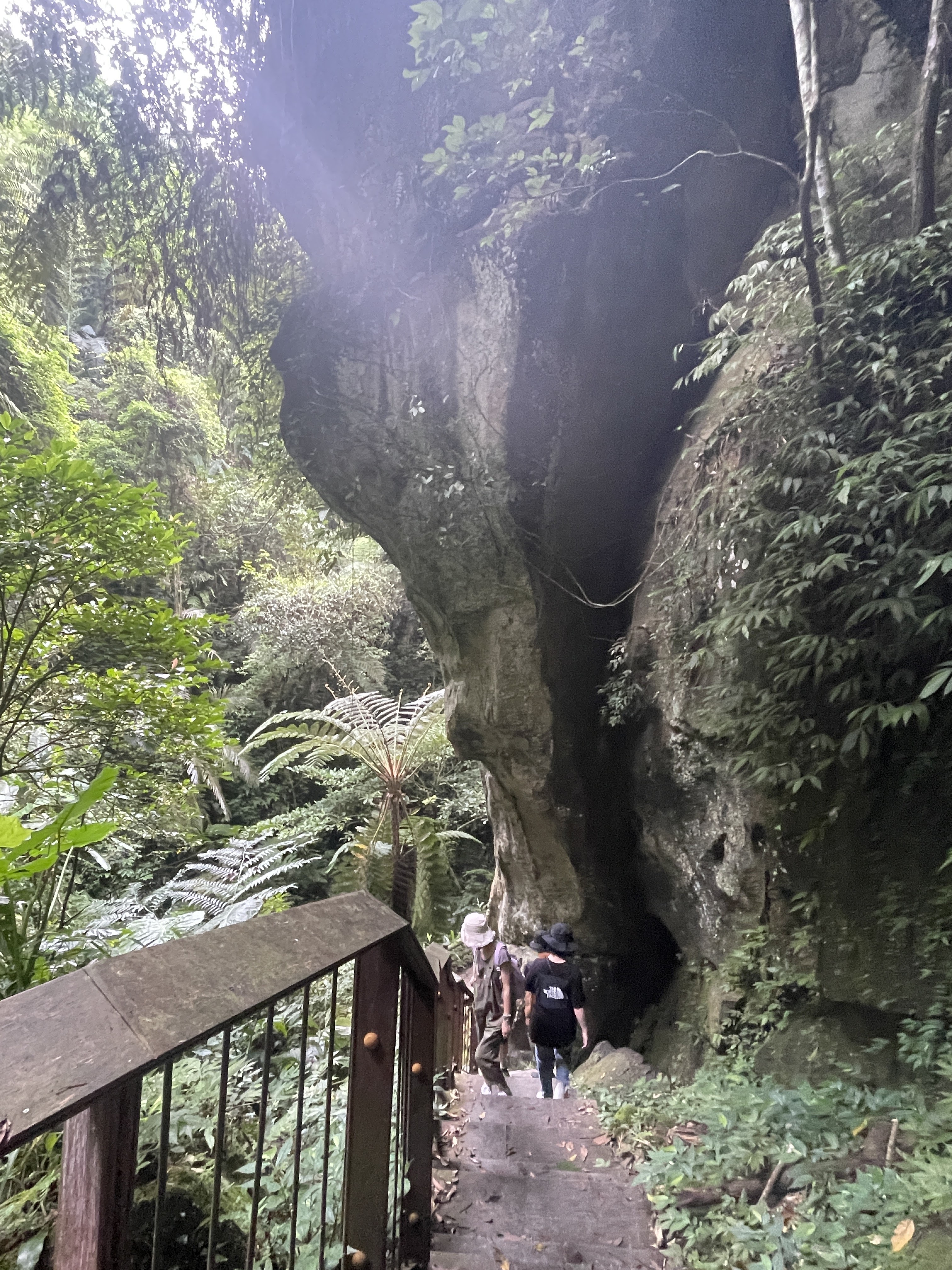
Sanmin Bat Cave (三民蝙蝠洞) is located in the valley in the north of Sanmin Village. It's a huge natural cave and is known as Shuilian Cave because of the spring water above the cave entrance. The cave got its name due to its rough and primitive terrain beside a valley, attracting a large number of bats to inhabit here. In the past, thousands of bats lived here, adding to the mysterious atmosphere.

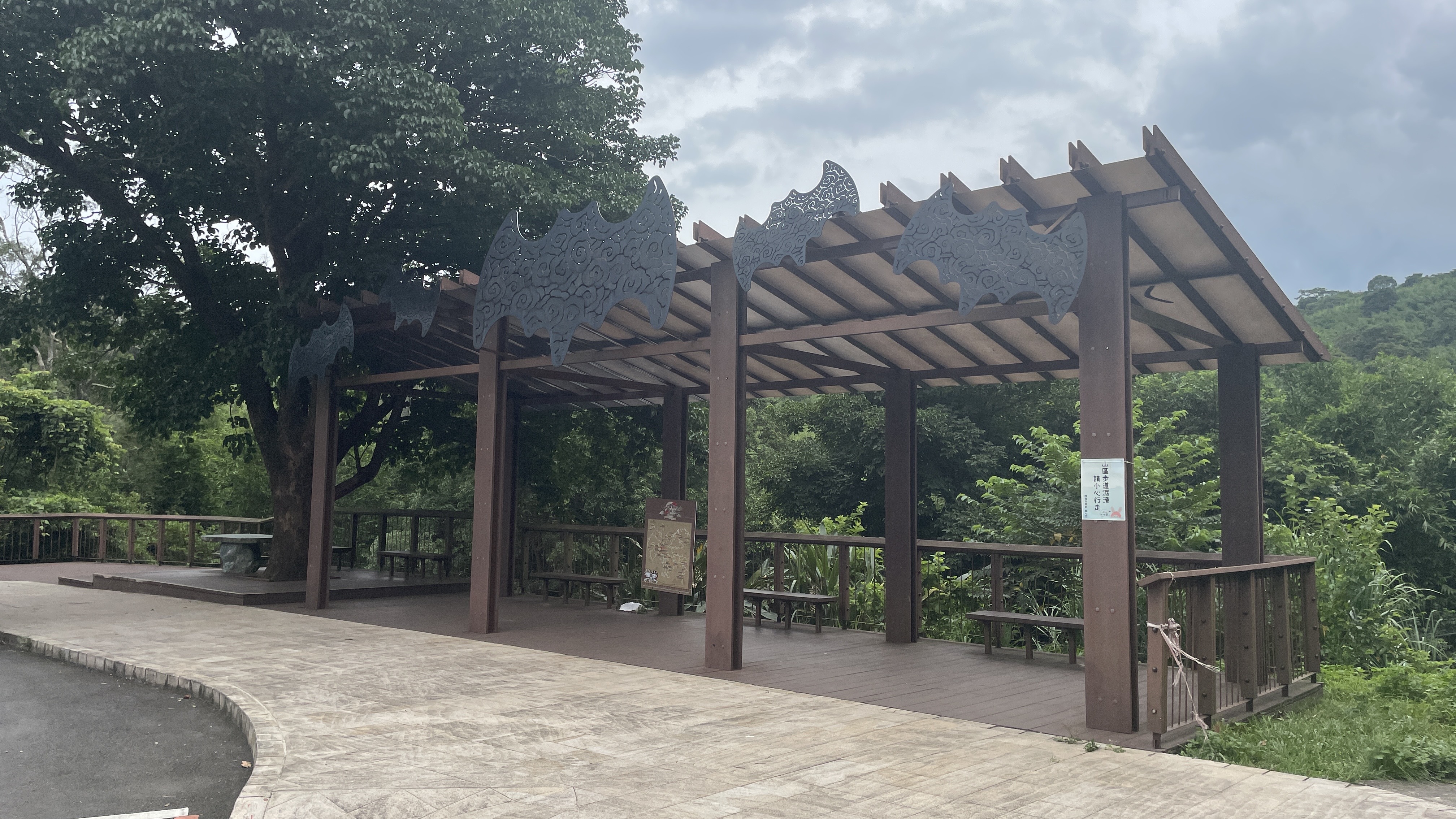
The trail to the bat cave is about 600 meters long, gently sloped, and paved with stone bricks. It takes around 20 minutes to walk to the Bat Cave. Along the trail, there are many trees providing shade, making the walk cool and comfortable. Rest areas with wooden seats are available along the road for those who need a break. There is also a toilet at the beginning of the path. During our walk, we even encountered a friendly pig!
About 450 meters along the trail, you'll reach the observation deck from which you can see mountains in the distance.

The cave entrance is about 20 meters high, 50 meters wide inside, and around 20 meters deep. The shape of the cave resembles a half-moon, and although the bats have migrated to other places, the cave's landscape still attracts many tourists who come to explore its wonders.
In front of the cave, there are two pools, a large one, and a smaller one. A 15-meter-high waterfall flows down, forming a deep pool with a diameter of about 10 meters. The environment is cool and pleasant, making it a suitable place to escape the summer heat.

Unfortunately, we didn't know that swimming isn't allowed here anymore. Five years ago, it was totally fine to swim, and we even saw a few kids playing in the water during our previous visit. However, it seems that it has become a less popular swimming spot due to the government's increasing restrictions on entering waters following accidents and drownings. Interestingly, despite numerous accidents and deaths on the roads, cars and scooters are still allowed.

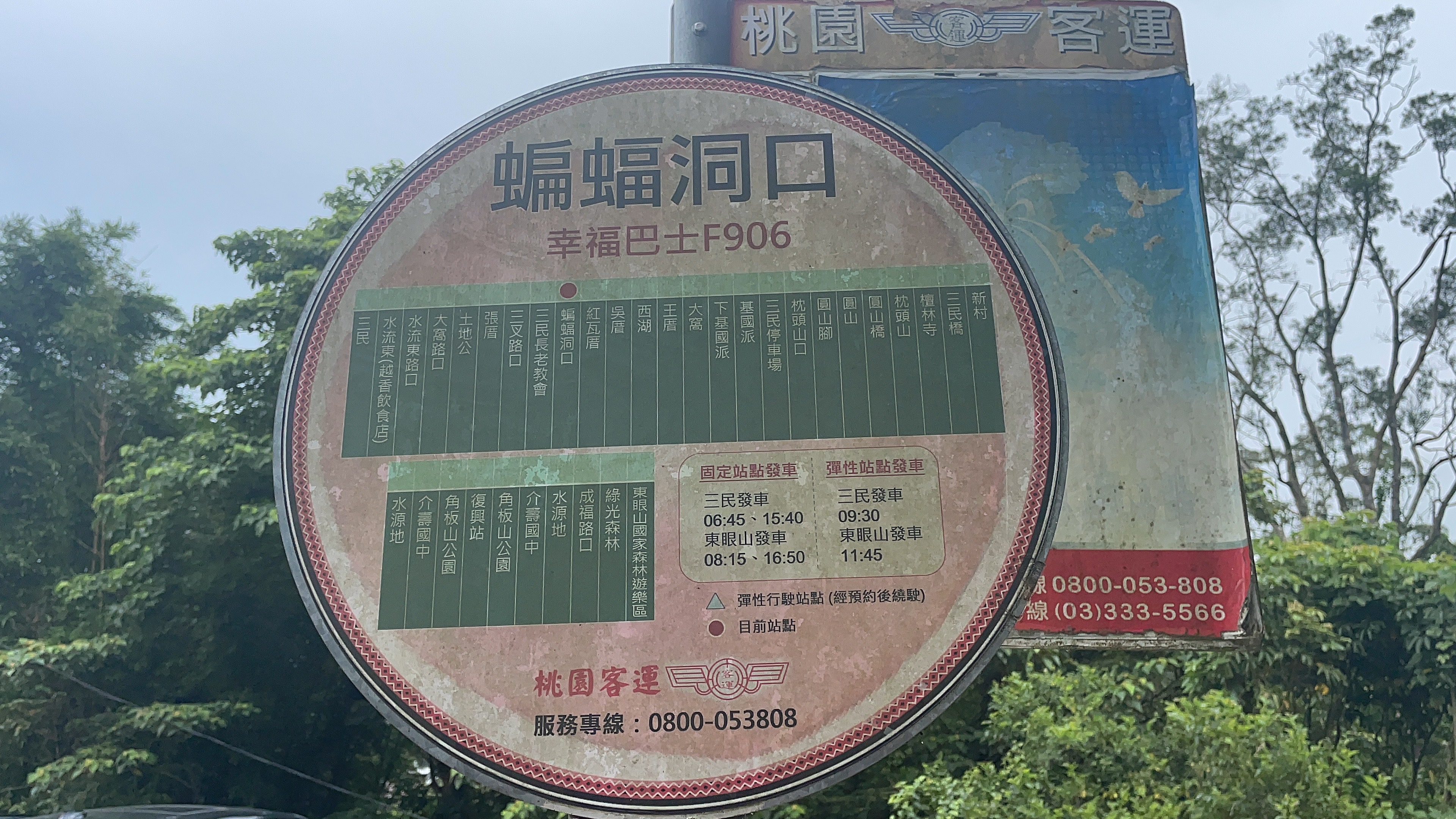
We arrived around noon, but there was barely any sunshine, and the water was cold. There is parking space for about 5 cars, while others are parked in front of someone's home (though we're not sure if it's permitted). Public transportation in Taiwan is available, as we noticed a bus station nearby, making it unnecessary to drive.  


Check out my YouTube video


Jiguopai Church (基國派老教堂)

Afterwards, we also tried to visit Jiguopai Church (基國派老教堂), but unlike in the past, there is now a fence around it, making it impossible to visit.
This Presbyterian Church was built in 1964. The building was reconstructed after 2000, following the collapse of the roof, which caused damage to the building. The church is renowned as the most beautiful stone church in Taiwan.
During Japanese rule, Christianity was restricted in Taiwan. It wasn't until the war ended in 1945 that the first Christian community was established in Sanmin village. In the early years, prayers were held in the homes of church members until the construction of the church could be completed.

This picture is one that I took back in 2018: 


Address:

1. Sanmin Bat Cave: 336桃園市復興區東側五寮溪溪谷內
2. Jiguopai Church: 336桃園市復興區基國產業道路1號

April 21, 2019

Taoyuan Travel: Sankeng Old Street and Tung Blossom Trail


We visited Sankeng in Taoyuan, where we were delighted to see the beautiful tung flowers in full bloom. The surrounding hills were adorned with white flowers, creating a picturesque landscape. The Tung Blossom Trail is just a short walk away from Sankeng Old Street. Although the old street was not very crowded, it served as a starting point for people who wanted to bike along the mountain trail. Thanks to the clean water in the area, it was also possible to spot fireflies during this season.

The natural beauty of Taiwan is truly remarkable, with blooming flowers to be found throughout the year. Currently, in April and May, it is the season of the tung flowers and the Tung Blossom Festival. Tung trees, also known as tung oil trees or China wood-oil trees, were originally cultivated in China's Yangtze River region and were introduced to Taiwan during the Japanese occupation. The largest concentration of tung trees can be found in northern Taiwan, particularly in Miaoli, Hsinchu, and Taoyuan, where they were planted by Hakka people.

For updates about tung blossom check: https://tung.hakka.gov.tw/EN/0000028.html

tung trees blossom, taoyuan, taiwan

tung trees blossom, taoyuan, taiwan
  
Tung trees are deciduous and can reach heights of up to 20 meters. Their flowers, which bloom before the leaves, have white petals with hints of pink or purple. Tung trees bear hard pear-shaped fruits containing oily seeds. It's important to note that all parts of the tung tree are poisonous, including the leaves, which can cause a rash similar to poison ivy.

Tung wood is commonly used in the production of furniture, clogs, toothpicks, matches, and other items. The seeds of the tung tree are used to extract tung oil, which has traditionally been used in lamps and also serves as an ingredient in paint, varnish, and caulk. Tung oil is known for its ability to protect wood furniture and make it waterproof. The use of tung oil dates back to approximately 400 BC and was mentioned in the writings of Confucius. While the demand for tung oil has declined, it still holds significance in Hakka culture.

The Hakka Tung Blossom Festival was first established in 2002 to promote Hakka culture. Every April and May, many people flock to the mountains to enjoy the breathtaking view of the blooming flowers. As the flowers fall from the trees, it creates a magical atmosphere akin to falling snow. Some people even gather the fallen flowers to create shapes like hearts.

When I first saw pictures of the tung trees from afar a year ago, I didn't imagine that I would be captivated enough to visit the mountains to see them in person. However, after exploring various locations with different types of flowers, my interest in witnessing the beauty of the blooming tung trees was piqued.

tung trees blossom, taoyuan, taiwan

tung trees blossom, taoyuan, taiwan

tung trees blossom, taoyuan, taiwan 

tung trees blossom, taoyuan, taiwan

tung trees blossom, taoyuan, taiwan 

tung trees blossom, taoyuan, taiwan

Sankeng Old Street (三坑老街)

Sankeng Old Street (三坑老街) is situated in Taoyuan's Longtan District. It is considered a traditional Hakka settlement, and the earliest development of the Longtan District is associated with an area known as "Longtan First Street." The old street is characterized by its narrow layout. Sankeng's origin can be traced back to the reign of Emperor Kangxi during the Qing Dynasty, and it became a settlement when people migrated to the area in 1744. The topography of the area features three rivers merging into the Dahan River, which created three pits on the land, giving Sankeng its name. With its favorable location for water transportation, Sankeng prospered as a transit station for goods traveling between Longtan and Yangmei. However, due to the construction of Dazhen, railways, and the Shimen Reservoir, the water level of the Dahan River was reduced, resulting in the cessation of water transport and subsequent restrictions on construction in the area. As a result, Sankeng was unable to undergo significant rebuilding for many years, but it managed to retain its original charm.

At the entrance of Sankeng Old Street, you can find the "Black and White Wash" (黑白洗), which was historically used by early residents as a place to wash their clothes. The water for washing comes from the Shihmen Reservoir and can be regulated by wooden blocks. A water pump was recently reconstructed in the area. This traditional Hakka settlement was registered as a historic building in Taoyuan City in 2003.

One notable site along Sankeng Old Street is the Yongfu Palace (龍潭三坑仔永福宮). Originally dedicated to the King of Sanshan, it serves as the center of local faith. Over time, it underwent changes and currently enshrines the Three Officials, the Holy King, Wenchang Emperor, and other deities. The temple was initially built in 1791 and was relocated to its current location in 1924.


sankeng old street, taoyuan, taiwan

sankeng old street, taoyuan, taiwan 

sankeng old street, taoyuan, taiwan

sankeng old street, taoyuan, taiwan

sankeng old street, taoyuan, taiwan

sankeng old street, taoyuan, taiwan

Address:

325桃園市龍潭區三坑老街45號三坑老街

January 20, 2019

Taoyuan Travel: Jiaobanshan Park - the Plum Festival

river, mountains, Jiaobanshan Park, Taoyuan, Taiwan

Travel Date: 2019/01/20

Jiaoban Mt. Park (角板山公園)

It's plum blossom season, so this time we visited Jiaobanshan Park (also known as Fuxing Park), which has the largest plantation of plum trees. Plums are the earliest blossoms to be seen and are also the national flower of Taiwan. Currently, only a portion of the trees are in bloom, but many tourists have already come to visit. From the park, you can also walk to see the suspension bridge. Many people park on the other side of the bridge and hike to the park and back.

On the way to the park, near Shimen Reservoir, we could also see many maple trees, some more red than others. In the park, there are a few large trees and some cherry trees as well. You can also find Banyan Trees planted by Chiang Kai-shek and Madame Chiang. Due to the plum blossoms in bloom, the Xikou Suspension Bridge is free of charge this week (Jan 14 - Jan 21). We took advantage of the opportunity to walk on the longest suspension bridge in Taiwan. Since it was a working Saturday for many people, we were hoping for fewer crowds.

The park attracts many tourists, and cars park quite far away, so everyone walks to the park. Even the parking spaces were full everywhere. We arrived around noon and were lucky to find a parking spot as someone was leaving. We had to park 1 km away, which seemed close enough. The mountain view around Shihmen is very beautiful.
Jiaobanshan Park spans 2 hectares and has more than 300 plum trees. Most of the maple trees in the park have already lost their leaves, but if you drive closer to the reservoir, you can still see some. The park also has some cherry trees, but they haven't bloomed yet, except for a few single flowers.

You can follow the road down the park, which leads to Dahan Creek. We attempted to go there, but it wasn't easy with a baby. We gave up before reaching halfway, and I only took pictures of the suspension bridge from that point. It seemed to be quite far away, and we still had to climb back up... There was no shuttle bus available during this week. Suspension bridges scare me, although this time I wanted to see this bridge from a closer view. We decided to drive there after climbing back up and walking to the car, which also wasn't very close.

It took about a 30-minute drive from the park to reach the bridge. The parking area was 1 km away, and we had to walk for a while. This place was quite empty. Typically, people park around here and cross the bridge to hike up and see the park. To me, that sounds really tiring, especially having to walk both ways. The view from the bridge wasn't particularly special, but the view from the park, with the water surrounded by mountains, was beautiful. Xikou Suspension Bridge spans 330 meters, making it the longest bridge in Taiwan. It has been a tourist attraction since its inauguration in January 2018. The bridge is open from 8 am to 4:30 pm.

See also: Plum blossom in Meiling Scenic Area

plum blossom, Jiaobanshan Park, Taoyuan, Taiwan
  
plum blossom, Jiaobanshan Park, Taoyuan, Taiwan

plum blossom, Jiaobanshan Park, Taoyuan, Taiwan  

amwf couple, polish-taiwanese couple, plum blossom, Jiaobanshan Park, Taoyuan, Taiwan

plum blossom, Jiaobanshan Park, Taoyuan, Taiwan

mountain, river, Jiaobanshan Park, Taoyuan, Taiwan

Jiaobanshan Park, Taoyuan, Taiwan

Jiaobanshan Park, Taoyuan, Taiwan

Address:

336桃園市復興區中正路2號角板山公園