Showing posts with label Greater Poland Voivodeship. Show all posts

February 27, 2025

Discovering Poland’s Historic Castles


My husband loves castles, so this time I found a few, and we went to visit them. On the way, we also passed by three wooden churches from around the 18th century, and we visited one of them inside. However, as time was limited due to the early sunset in the winter months in Poland, we didn't make as many stops and focused on the castle ruins. The weather was partially sunny, but by the time we arrived at the last castle, it had already gotten much cooler, so I didn’t want to walk around it too much.

Church of the Assumption of the Blessed Virgin Mary in Borysławice Kościelne

In a village in the Grzegorzew commune (Koło County), located approximately 13 km east of Koło, lies a church that was built in 1759, funded by Antoni Gorzeński, the cupbearer of Poznań and the owner of the village of Krzykosy, located within the parish. It has undergone numerous restorations.  

Constructed in a log cabin style and covered with wooden paneling, the church is oriented eastward. It is a single-nave structure with a narrower and noticeably lower presbytery (clearly visible from the outside) that ends in a three-sided apse. Two porches adjoin the nave, one on the southern side and one on the western side. The high roofs are covered with wooden shingles. A small turret for a bell is located above the nave. Inside, the ceiling features rounded corners and is adorned with polychrome paintings by Wincenty Strubiński, created in the interwar period, with motifs inspired by the Kujawy region.  

The church houses three Renaissance altars from the second half of the 18th century. The side altars include paintings on wooden panels depicting St. Isidore and St. Roch from the 17th century. A Rococo wall-mounted baptismal font is also present. In the presbytery, there are two fragments of a Renaissance triptych from 1640, including a relief scene of the Flight into Egypt and depictions of Aaron and St. John the Baptist. On the rood beam, a Baroque crucifix can be seen.  
Adjacent to the church is a wooden bell tower from the 18th century, featuring a four-pitched, shingled roof. 


Castle in Borysławice Zamkowe

The Castle in Borysławice Zamkowe is a 15th-century episcopal castle located in Borysławice Zamkowe, Greater Poland Voivodeship.  
The castle was built in the Gothic style on a small island surrounded by the waters of the Rgielewka River. Construction began around 1425 under the initiative of Archbishop Wojciech Jastrzębiec. Subsequent owners, the Russocki and Szczawiński families, did not significantly alter the castle’s appearance. It was destroyed in 1656 by Swedish forces during the Deluge and fell into ruin by the 18th century.  
Today, remnants of the gate tower, parts of the outer gateway walls, and fragments of the residential buildings’ walls remain. The ruins are privately owned and are not open to the public.  

The original castle consisted of two parallel, three-story residential buildings enclosed within defensive walls measuring 21 x 25 meters. A narrow, paved courtyard between the buildings was accessed through a gate on the southeastern side. A polygonal turret stood at one corner. This design exemplified a typical knightly residence from the first half of the 15th century.  
In the latter half of the 15th century, the castle was surrounded by an additional outer wall, creating a defensive outer courtyard (międzymurze) approximately 7 meters wide. The dimensions of the outer wall were 38 x 41 meters, and a new fortified gateway was added.  

By the early 16th century, a three-story, rectangular tower with decorative blind windows (blendy) was built on the walls, along with a fortified gateway strengthened with buttresses. In the northeastern section of the outer courtyard, a new building, likely a storage house (lamus), was constructed, extending slightly beyond the outer wall.  
In the early 17th century, the two residential buildings were joined by a narrow wing, reducing the courtyard’s size.  
It was listed as a historical monument in January 17, 1953.


Castle in Koło

The Castle in Koło, located near the town of Koło in Greater Poland, is a 14th-century Gothic stronghold built by King Casimir III the Great after 1365. It was strategically placed on an artificial hill within a meander of the Warta River, serving as a defensive outpost and administrative center along the important trade and travel routes of medieval Poland. 

Construction of the castle began during Casimir III’s reign as part of his broader efforts to fortify Poland. It was completed after his death, with the first recorded mention of the castle appearing in 1383. The castle was a residence for starosts (royal governors) and hosted Polish kings like Władysław Jagiełło and Kazimierz IV Jagiellończyk. In 1410, Władysław Jagiełło visited the castle on his way to the Battle of Grunwald.
In 15th Century, the castle became a center for political activity, hosting noble assemblies (sejmiki) for the surrounding region. It maintained its importance until starosts moved their residence to Kościelec in the late 16th century.
The castle began to decline in the late 1500s as its administrative significance waned.
By the time of the Swedish Deluge (1655–1660), the castle was described as "ruined." Afterward, its stones were repurposed for local construction projects, including the Bernardine monastery in Koło.

In 19th Century initial interest in the ruins sparked some of the earliest documentation efforts. In 20th century, archaeological excavations revealed fascinating finds, including a 14th-century gold ring adorned with a red gemstone, believed to have belonged to a wealthy noble or royal figure, numerous ceramic artifacts, including pottery and tiles, remains of the donjon foundations and parts of the courtyard’s layout. In 2019–2020, excavations unearthed more medieval artifacts and provided further insight into the castle’s construction techniques.

Significant conservation efforts have been undertaken to stabilize the ruins and prevent further degradation. Recent work includes the reconstruction of northern wall sections and ongoing plans for revitalization to enhance tourism. The castle is now a key historical attraction, hosting events like the Koło Bluesa Festival and drawing visitors interested in its rich history and scenic location by the Warta River.

The castle’s core was a rectangular layout (50 x 30 meters) built with Gothic brick techniques, including Flemish bond and Wendish bond. A donjon tower, measuring approximately 12 x 15 meters and 20 meters tall, was the oldest element. It likely served as a keep for defense and residence. The walls of the tower were exceptionally thick, up to 2.5 meters. The castle featured defensive walls fortified with crenellations and a gate tower, which could be accessed via a drawbridge. The inner courtyard housed auxiliary wooden structures, storage spaces, and two wells (a smaller one inside and a larger one outside the walls).
The castle was surrounded by a moat, with additional water defenses provided by the nearby Warta River. Its elevated position on an artificial hill added another layer of protection.
Only fragments of the defensive walls and parts of the eastern main tower remain intact today. The surviving portions reach up to 10 meters in height.


Church of St. Michael the Archangel in Umień

The Church of St. Michael the Archangel in Umień is a notable example of wooden sacred architecture typical of the eastern Greater Poland region. Here’s a detailed overview of its history and structure:
The village of Umień, located 12 km south of Koło, was first mentioned in King Casimir the Great's document from 1364. The parish was established in the 14th century, initially belonging to the Archdiocese of Gniezno until 1818, then to the Archdiocese of Warsaw, followed by the Diocese of Łódź (1920-1925), and since 1925, it has been part of the Diocese of Włocławek.
The church is listed as a heritage site and protected under Poland's register of monuments. It remains a protected landmark and accessible for outside viewing.

The first wooden church was likely founded in the 14th century by the local lords, the Unieński family, and was first mentioned in 1443.
In 1759, a public chapel was confirmed in Umień, preceding the current church's construction, which was completed by the second half of the 17th century. Throughout its history, the church has undergone various restorations, particularly after World War II when it was looted by the Germans. Restoration efforts have occurred in 1756, 1864, 1929, 1946, 1958, with additional works completed in 1992 and 1999.

The church is orientated, with a wooden frame construction, clad in timber and supported by braces. The building features a single nave, with a narrower, three-sided presbytery to the east and a sacristy attached to the north. On the north side, a square chapel with a tent roof has been added. On the south and west sides, two porches (kruchty) were constructed. A two-pitched roof, covered with metal sheets, rises above the nave, topped by a steeple with a bell.
The interior has a flat, vaulted ceiling and retains Rococo furnishings. Notable is the 18th-century polychrome depicting St. Michael the Archangel.
The wooden bell tower, built in the 18th century, has a four-sided metal roof. The upper section is covered with metal cladding, with slatted openings and a cross-topped lantern.
The churchyard is surrounded by a brick and stone wall with a metal gate, adding to the overall historic feel of the site.

Castle in Besiekiery

The Castle in Besiekiery is a late Gothic fortress located in the village of Besiekiery, in Łęczyca County, Łódź Voivodeship, Poland. The castle's ruins provide a glimpse into its historical significance and architectural development over the centuries.
The castle remains in a state of ruin, but the remains of its residential house and other architectural features can still be seen. The walls and corners of the residential building stand as a testament to its past grandeur.
Today, the castle is a tourist site, and while it has seen restoration work, much of its structure is still in ruins. The surrounding area is being developed with tourism facilities to make it more accessible to visitors.

The castle was likely built at the turn of the 15th to 16th century. The exact origin of its construction is unclear. Early theories suggested Mikołaj Sokołowski, the voivode of Łęczyca, was behind it, though this has been disputed. Instead, it is thought to have been commissioned by one of the Brzeski chamberlains, Mikołaj Sokołowski (1496–1502) or Wojciech Sokołowski (1502–1529).
By the late 16th century, the castle belonged to Andrzej Batory and later his daughter Zofia Batory and her husband Jerzy Rakoczy II.
In the mid-17th century, the castle was renovated by Jan Szymon Szczawiński, who added plaster to the walls, diminishing the fortification’s original Gothic appearance.
The structure suffered from a fire in 1731, which accelerated its decay. By the mid-19th century, it had been repurposed for agricultural uses.
In 2023, renovation work commenced, with the project concluding in December 2024, including conservation and landscaping, creating a new tourism infrastructure around the site.

The castle was built on a mound surrounded by an artificial moat. Constructed with brick on a stone foundation, the plan was an irregular rectangle, measuring approximately 38 × 40 meters.
The southern curtain featured a gatehouse measuring about 12 × 12 meters, which had three floors, each with four rooms. Around 1653, an octagonal tower was added to the gatehouse.
On the northern side, the main residential building was erected, measuring 13 meters in width. It consisted of three smaller rectangular rooms and a square hall on the eastern wall. These rooms were described in the 18th century as the Crimson Room, Marble Room, Hall, and Grand Chamber. Seven windows opened towards the inner courtyard.


February 11, 2025

Poland Travel: Salt Mine Kłodawa - A Hidden Gem in Poland


After visiting the Basilica of Lichen early this morning, we drove an hour to see the salt mine in Kłodawa. There is spacious parking available, but it's advisable to arrive half an hour early. You will be asked to fill in your information and wait for the guide to take you underground. The entire tour lasts about 2.5 hours, allowing visitors to experience the unique atmosphere of the mine, with a constant temperature of 20°C throughout the year. The tour must be booked in advance, and there are two time slots available each day, costing 80 PLN per adult. Visitors can wear real miners' safety helmets, adding an authentic touch to the experience, and take memorable photos with machinery and underground salt formations.

This salt mine is the largest active rock salt mine in Poland and a fascinating destination that blends industrial prowess with natural wonder. It is known for its unique pinkish-white salt, a rare variety caused by natural iron infusion, found nowhere else in Europe except Kłodawa.
The Kłodawa salt dome was discovered through gravitational studies conducted by Professor Edward Janczewski between 1937 and 1939, revealing a vast salt structure stretching across 63 kilometers. In the post-war years, further exploration confirmed the existence of the Kłodawa salt dome—the largest in the Polish Lowlands—measuring 26 kilometers in length and up to 2 kilometers in width.

Check out Basilica of Our Lady of Licheń LINK


Construction of the mine began in the autumn of 1949, with the excavation of the "Michał" and "Barbara" shafts between 1950 and 1954. Salt extraction officially began in 1956, with the use of 40 horses working underground to transport salt. This operation continued until 1966 when the mine introduced electric traction. 
The surface facilities, such as the "Chrobry" ventilation shaft, were also expanded during this time to improve mining efficiency.
Today, the Kłodawa Salt Mine operates at depths of up to 810 meters, with resources expected to last for several decades. The mine produces approximately 650,000 tonnes of rock salt annually, accounting for 88% of Poland's rock salt production. The salt extracted is used in various industries, including food production, agriculture, chemicals, and road maintenance during winter months.

Over millions of years, salt deposits from ancient seas were uplifted, leaving the Kłodawa region with an overburden as thin as 100 meters in some areas. The mine extracts several types of salt, such as older white rock salt, older gray rock salt, magnesium-potassium salt, and young pink rock salt, which is prized for its unique color and flavor.
Kłodawa Salt Mine is not only a vital industrial site but also a major tourist attraction. It features the world’s deepest underground tourist route, extending to a depth of 600 meters. Visitors descend via mining elevators, traveling at 6 meters per second, and explore illuminated salt caverns, observe mining tools and machinery, and learn about the mine's history and operations.

The tour also includes a ghost chamber and a chapel dedicated to Saint Kinga, the patron saint of salt miners. The chapel features a remarkable salt sculpture of Saint Kinga, as well as a commemorative plaque honoring 20 miners who lost their lives underground. The mine’s microclimate is also said to have a beneficial effect on respiratory health, making it an ideal place for therapeutic visits.
While the Kłodawa Salt Mine doesn’t have the medieval charm of other famous Polish mines like Wieliczka or Bochnia, it offers a modern and functional experience. As a fully operational facility, it provides a rare insight into contemporary mining practices. The mine’s extensive tunnel network spans over 350 kilometers, showcasing modern machinery and techniques that differ greatly from the historical mining methods seen in older mines.

The Kłodawa Salt Mine has earned numerous accolades for its exceptional operations and contributions to the industry. In 2007, the mine made headlines when it hosted the deepest underground music concert ever held, at a depth of 600 meters, earning a Guinness World Record for this incredible achievement. The mine's importance is also reflected in its protection under the Natura 2000 program since 2008, due to its unique geological and ecological significance.
Whether you're exploring the mine for its industrial importance, remarkable salt deposits, or health benefits, the Kłodawa Salt Mine offers a truly one-of-a-kind experience. With its combination of history, modern technology, and natural beauty, it's a must-visit destination for anyone seeking to explore Poland's industrial heritage and cultural landmarks.


February 4, 2025

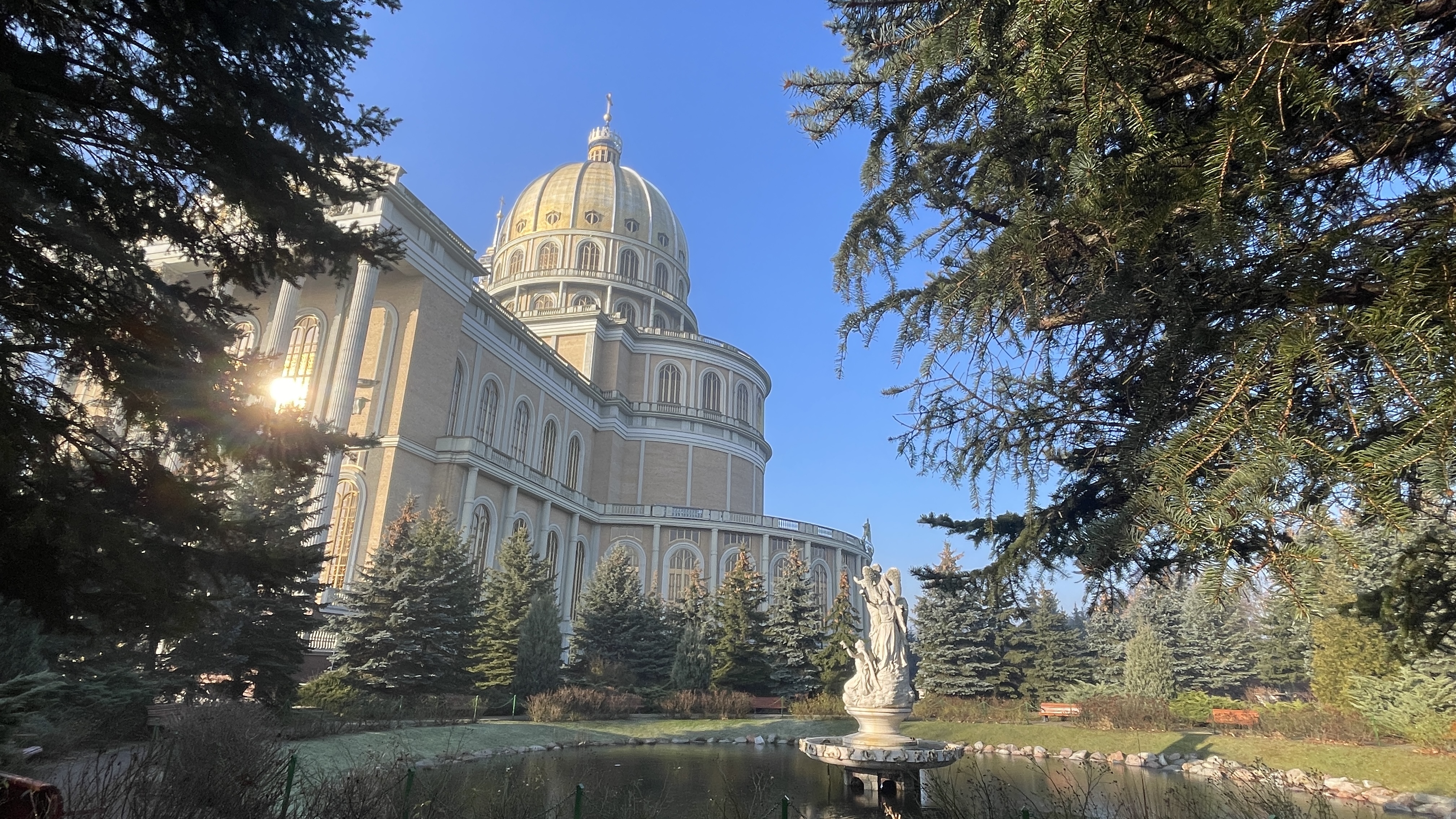
Poland Travel: Basilica of Our Lady of Licheń


The first week in Poland flew by with family visits and cozy moments indoors at my aunt’s house. After several gloomy days, we were finally blessed with sunshine, though the weather was still quite cold. I had already booked an afternoon tour at a salt mine, but with some time to spare in the morning, we decided to explore the Basilica of Our Lady of Licheń.
Back in Taiwan, my husband watched a video about the world’s largest churches, and this basilica was listed among the top ten. There was another, even larger, church within a four-hour drive, but it feels a bit far to go during winter season, so we settled on visiting the Basilica of Licheń. It has an area of 30,000 square metres and  can accommodate up to 18,000 worshippers.

When we arrived after an hour-long drive, we found a spacious parking area in front of the basilica, making it very convenient for visitors. As it was still cold, there were barely any people around. I imagine the scene would be quite different during the summer season!
The basilica is free to visit, though guided tours are available. These tours, lasting between one to three hours, are offered in Polish and English. Prices range from 200 to 450 PLN for Polish tours and 300 to 600 PLN for English tours. Personally, I feel that a tour isn’t necessary since walking around and exploring on your own provides a fulfilling experience. However, if you’re interested in a more detailed exploration, the guided tours might be a good option.

Check out Kłodawa Salt Mine LINK


The Basilica, located in the village of Licheń Stary, is one of the largest and tallest Catholic churches in the world. Its origins date back to 1813, when a Polish soldier, Tomasz Kłossowski, had a vision of the Virgin Mary during the Napoleonic Wars. She appeared adorned in a golden crown and a red gown, holding a white eagle—a symbol of Poland. She promised Tomasz recovery and tasked him with commissioning an image of her for public devotion. This icon, known as Our Lady of Sorrows, Queen of Poland, now resides on the basilica’s main altar.
Designed by the Polish architect Barbara Bielecka, the basilica was constructed between 1994 and 2004, funded entirely by pilgrims’ donations. The nave stretches 120 meters long and 77 meters wide, while the central dome rises 98 meters high. The iconic tower, standing 141.5 meters tall, is a remarkable feature of the structure.

The tower has 762 steps leading to the top. Visitors can either climb the stairs for 2 PLN or take an elevator ride for 5 PLN. Unfortunately, the tower was closed during winter, so we couldn’t experience the view from above.
At first, we thought the church itself might also be closed since some areas were roped off with signs prohibiting entry. However, there are many doors leading inside, and after seeing others enter, we followed. The interior is incredibly spacious and beautifully designed. 
The basilica also houses Poland’s largest pipe organ, featuring 157 stops, six manuals, and a pedalboard. Built between 2002 and 2007, it ranks as the 4th largest organ in Europe and the 13th worldwide.
We stayed for a short while, just long enough to witness the start of a Mass, before leaving quietly.

Outside, the grounds were serene but freezing. The shaded areas were still icy, making the ground slippery—I almost fell near a pond but managed to catch myself in time! Despite the cold, the peaceful atmosphere made the visit worthwhile.
Blessed by Pope John Paul II in 1999, the Basilica of Our Lady of Licheń stands as a testament to faith, resilience, and Polish heritage. It’s a place of worship, a cultural treasure, and a source of inspiration for countless visitors.
After our visit, we headed to our next destination: the salt mine in Kłodawa, another fantastic place to explore.


April 20, 2023

Poland Travel 2023: Discover the Historic Grandeur of Gniezno, Poland's Ancient Capital


Travel Date: 2023/03/24 ~ 04/12
Gniezno: 2023/04/04 

On the second day of our trip, we made our first stop in Gniezno. Despite being a small town, it holds immense historical value. In the 10th and 11th centuries, Gniezno served as the first capital of Poland. Yesterday, we visited Poznań and later today, we will be heading to Bydgoszcz, followed by our visit to Toruń tomorrow.
The weather during our travel is quite cold, with temperatures dropping below freezing in the morning. It's so chilly that it feels as if our muscles are frozen, making it difficult to even speak.

Gniezno is located in central-western Poland, approximately 50 kilometers east of Poznań. As of 2021, it has a population of 66,769, making it the sixth-largest city in the Greater Poland Voivodeship. The city has great historical significance as one of the chief cities of the Piast dynasty. In the 10th and early 11th centuries, it served as the first historical capital of Poland and is mentioned in 10th-century sources, possibly including the Dagome Iudex, as the capital of Piast Poland.
Gniezno is also renowned as the seat of the Roman Catholic Archdiocese of Gniezno, the oldest archdiocese in the country, founded in 1000. The archbishop of Gniezno holds the title of the primate of Poland, making the city the ecclesiastical capital of the country. Additionally, Gniezno serves as the administrative seat of Gniezno County (powiat).

As one of the historic centers of the Greater Poland region, Gniezno is considered the birthplace of the Polish state. The city is built on seven hills, akin to Rome, with notable ones including Lech Hill, where the Gniezno Cathedral is located, and Panieńskie Hill, which is home to the Rynek (Market Square). Gniezno also boasts the presence of five lakes within its city limits, namely Winiary, Jelonek, Świętokrzyskie, Koszyk, and Zacisze.

Check out my YouTube video

Gniezno Cathedral & Gniezno Door

The Royal Gniezno Cathedral, officially known as the Primatial Cathedral Basilica of the Assumption of the Blessed Virgin Mary and Shrine of St. Adalbert (Bazylika Archikatedralna Wniebowzięcia Najświętszej Marii Panny i Sanktuarium św. Wojciecha), is a magnificent example of Brick Gothic architecture situated in the historic city of Gniezno. It holds great significance as the place where several Polish monarchs were coronated and has served as the continuous seat of Polish church officials for nearly 1000 years. Despite enduring a long and tumultuous history, the cathedral has managed to remain largely intact, making it one of Poland's oldest and most treasured religious monuments.

One of the notable features of the cathedral is its twelfth-century two-winged bronze doors, known as the Gniezno Doors (Drzwi Gnieźnieńskie). These doors are adorned with eighteen bas-relief scenes depicting the life and martyrdom of St. Adalbert (Wojciech), whose remains were acquired for their weight in gold and brought back to the cathedral to be enshrined. The cathedral itself is of Gothic architecture, predating the doors as they were carried over from an earlier temple. Created around 1175 during the reign of Mieszko III the Old, the Gniezno Doors are considered one of the most significant works of Romanesque art in Poland.

The left door, when facing the reliefs from outside the cathedral, stands at a height of 328 cm and is 84 cm wide, while the right door measures 323 cm in height and 83 cm in width. Both doors have a thickness ranging from 1.5 to 2.5 cm. They were cast in bronze using the lost wax casting technique, employing a mixture of copper and tin with a small amount of lead. Finer details were added after casting through the use of engraving tools. The left leaf was cast as a single piece, while the right leaf was made from 24 cast sections that were later soldered together. The lion-headed knockers, though not perfectly aligned, were also cast separately and soldered onto the doors.

The Gniezno Cathedral and its Gniezno Doors are recognized as one of Poland's national Historical Monuments (Pomnik historii), a designation received on September 16, 1994. Their preservation and historical significance are closely monitored by the National Heritage Board of Poland.


Medieval seal of Gniezno

Gniezno has a rich history dating back to ancient times. Archaeological evidence indicates human settlement in the area since the late Paleolithic era. Early Slavonic settlements on Lech Hill and Maiden Hill can be traced back to the 8th century. During the 10th century, Gniezno held significant religious importance as a sacred site in the Slavic religion.

Around 940, Gniezno became a prominent fortress and pagan cult center under the early Piast rulers. It was one of the main strongholds alongside other fortresses such as Giecz, Kruszwica, Poznań, Kalisz, Łęczyca, Ostrów Lednicki, Płock, and Włocławek. Archaeological excavations conducted in 2010 on Lech Hill revealed an 11th-century tomb near the remains of a previously discovered pagan burial mound. These discoveries suggest that Lech Hill may have served as a burial place for rulers even before the baptism of Mieszko I, the first historical ruler of Poland. After Mieszko I adopted Christianity, his son Bolesław I the Brave built a church on the hill and enshrined the remains of Saint Adalbert there, emphasizing Gniezno's significance as a religious center and the capital of the kingdom.

In the year 1000, the Congress of Gniezno took place, during which Bolesław I the Brave, the Duke of Poland, received Holy Roman Emperor Otto III. This congress celebrated the foundation of the Polish ecclesiastical province (archbishopric) in Gniezno. The Gniezno Cathedral, which dates back to the 10th century, witnessed the royal coronations of Bolesław I in 1024 and his son Mieszko II Lambert in 1025.
In 1038, Gniezno, along with nearby Poznań, was captured, plundered, and destroyed by the Bohemian duke Bretislav I, leading subsequent Polish rulers to relocate the capital to Kraków. The archepiscopal cathedral was reconstructed under the rule of Bolesław II the Generous, who was crowned king in Gniezno in 1076.

Over the centuries, Gniezno evolved as a regional seat in the eastern part of Greater Poland. In 1238, it was granted municipal autonomy by Duke Władysław Odonic. Gniezno continued to serve as a coronation site, with coronations taking place in 1295 and 1300.
The historical significance of Gniezno and its role in the early Polish state make it a city of great importance in Polish history.

Museum of the Beginnings of Poland

The Museum of the Beginnings of the Polish State in Gniezno offers visitors a unique opportunity to explore the history of Poland in the early Middle Ages, as well as the history of Gniezno and its surroundings. The museum showcases a wide range of valuable exhibits, including a significant collection of Baroque and Renaissance stove tiles, 19th-century paintings, and fragments of equipment from the Gniezno Cathedral.

The museum features both permanent and temporary exhibitions, providing visitors with a comprehensive understanding of the early Polish state. One of the most captivating exhibitions is "The Beginning of the Polish State," which was officially opened in 1983. This exhibition boasts over 500 artifacts, including a reconstruction of the wooden fortress of Gniezno from the 10th century, architectural details from the Gniezno Cathedral, and objects related to the religion and daily life of the first Piasts. Additionally, visitors can explore elements of old military equipment.

In addition to the main exhibition, the museum also hosts other captivating displays such as "Gniezno in the Olden Days," "The Armory in Old Poland," and "The Piasts Painted History." These exhibitions further enhance the visitor's understanding of the historical and cultural context of the first Piasts.
To enrich the museum experience, an audiovisual performance is available, allowing visitors to delve deeper into the history and culture of the early Piasts. The museum offers a fascinating journey through time, showcasing the beginnings of the Polish state and the significance of Gniezno in shaping the nation's history.


Address:

1. Gniezno Cathedral: Wzgórze Lecha, 62-200 Gniezno, Poland
2. Old Market Square: Rynek 17, 62-200 Gniezno, Poland
3. Museum: Kostrzewskiego 1, 62-200 Gniezno, Poland