Showing posts with label Pingxi (平溪). Show all posts

February 19, 2019

Illuminating Traditions: Lantern Festival Celebrations Across Taiwan

lantern festival, taiwan

It's the second time I have the chance to see the Lantern Festival. A year ago, we went to the Chiayi Lantern Festival, and during the Mid-Autumn Festival, I had the opportunity to see Sky Lanterns. Both celebrations take place on the 15th day of the first lunar month. In my previous posts, I wrote about the traditions of the Lantern Festival and the legend of sky lanterns. Check them out if you want to know more!

The first Lantern Festival was held in 1990. The Tourism Bureau decided to organize a major lantern festival together with the Sky Lantern Festival and the Yanshui Firework Festival, which are very old customs. The festival originally took place at Chiang Kai-shek Memorial Hall in Taipei. Now it is known and celebrated all around the island. But that's not the only form of celebrating this day. Other well-known events on this day include the Sky Lantern Festival in Pingxi, the Yanshui Firework Festival in Tainan, and the Bombing Master Handan Festival in Taitung.

lantern festival, hsinchu, taiwan 

lantern festival, hsinchu, taiwan

 
lantern festival, xiluo, yunlin, taiwan

lantern festival, xiluo, yunlin, taiwan

How Lantern Festival is celebrated around Taiwan?

One of the special celebrations is the Yanshui Firework Festival in Tainan, which includes a firecrackers ceremony. Every year, a man and a woman wearing helmets stand in the middle of several structures loaded with fireworks that are then set off. This celebration is believed to be a way of thanking Guan Gong, who rescued this place from a plague in the 19th century. This festival is very dangerous, and I have never been there yet.

Another similar celebration is held in Taitung, called the Bombing Master Handan Festival. This festival has been celebrated since 1954. Every year, one volunteer represents the local God of wealth, Master Han Dan. This volunteer, wearing only red shorts, a scarf, and goggles, stands in the middle of the crowd while people throw firecrackers at him.

Another festival during this day is a Hakka tradition called the Bombing the Dancing Dragon Festival. The festival is held to welcome spring and bring good luck. Several people wear a dragon costume and move up and down. The crowd throws fireworks at the dancing dragon to ask for blessings and pray for fortune. The more explosive the dance and the more the dragon gets hit by fireworks, the more luck and prosperity for those who participate. The dragon is built using bamboo frames and covered with fabric in the colors of red, green, blue, silver, and gold, which represent the five elements in nature according to Taoism.

The Sky Lantern Festival in Pingxi is named the second biggest New Year's Eve festival in the world. The festival lasts about two weeks and is always held on the 15th day of the first lunar month as part of the Lantern Festival. Pingxi is the only place where the release of sky lanterns is allowed by the government. Sky lanterns, also known as Kongming lanterns, were invented by Zhuge Liang and were originally used to convey military messages.


Yanshui Beehive Festival, Tainan (Picture source: https://goo.gl/images/Q8tDc3)

Bombing Master Handan, Taitung (Picture source: https://goo.gl/images/HEzSRq)

Bombing Dragon Festival, Miaoli (Picture source: https://goo.gl/images/pz5NKr)

Sky Lantern Festival, Taipei (Pictures source: https://goo.gl/images/7GbHLR)

September 22, 2018

New Taipei Travel: From Ancient Origins to Skyward Wishes: The History of Pingxi and Sky Lanterns


Travel Date: 2018/09/18

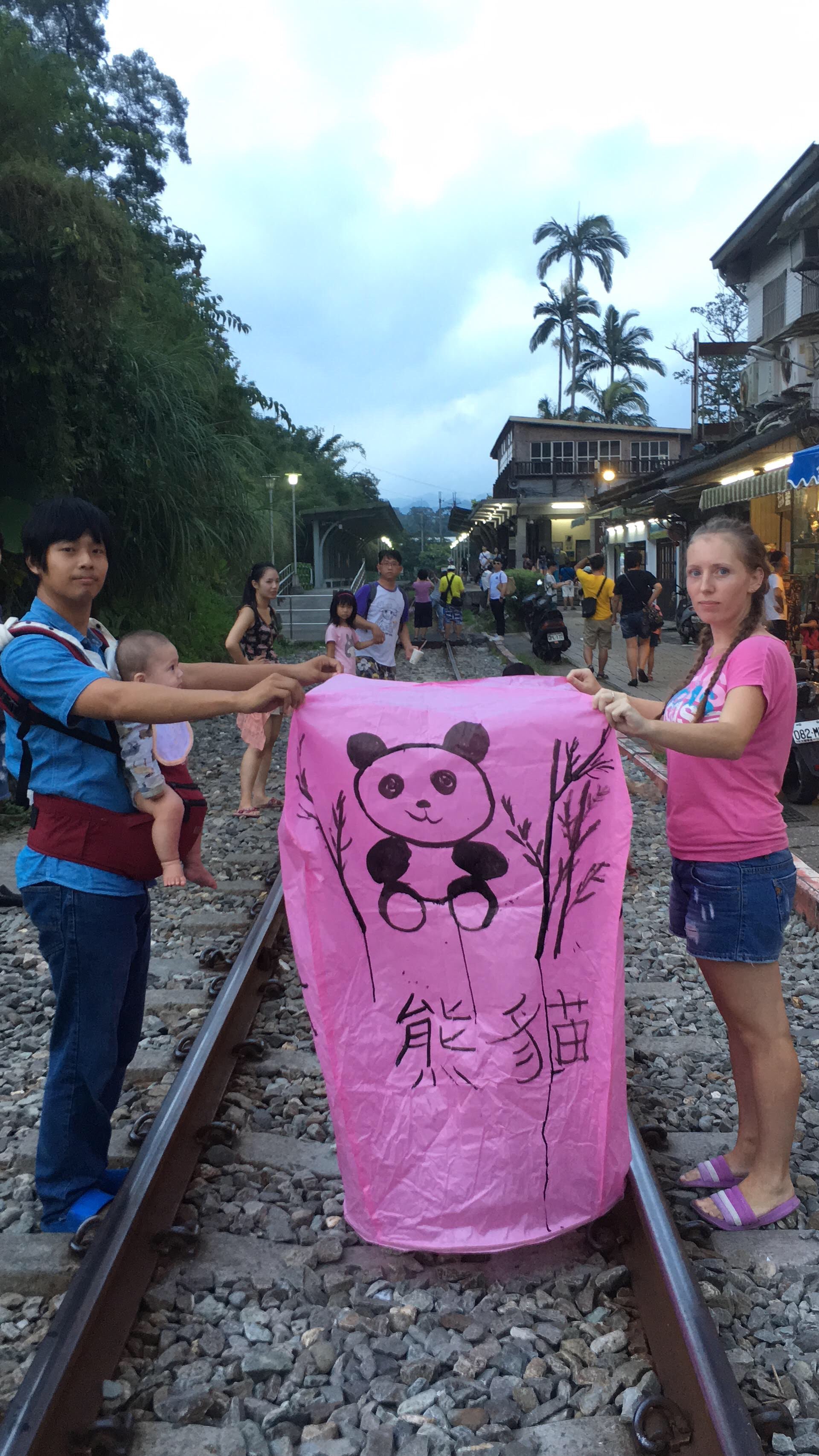
Today, we came to release sky lanterns in Pingxi. Unfortunately, it wasn't the best timing as the Middle-Autumn Festival would take place two days later, so I couldn't witness the sight of thousands of lanterns floating in the sky. This is my third time in this area—last year, we visited the incredible Shifen Waterfall. I hope to return here next year during the Lantern Festival to fulfill my dream.
This time we traveled with firends from Nantou, as they came to Hsinchu to visit us.

Pingxi is a small mountain town that is truly worth visiting. Besides the lanterns, the main attraction here is Pingxi Train Station. The streets around are filled with lantern-like decorations and street food.
Pingxi is known for its waterfalls, with 36 discovered in the area. One of the most popular waterfalls is Shifen Waterfall (十分瀑布). Over millions of years, geological forces have created numerous valleys and canyons. The average height of mountains in Pingxi is only 500 meters.
The area has played an important role in Taiwan's mining history. It is a sedimentary rock formation that contains valuable resources such as coal, oil, and gas. This geological structure was formed 3-4 million years ago.

In the 1870s, Pingxi had many indigo plantations and was a prosperous place, accounting for 80% of all indigo plantations. However, synthetic dyes quickly gained popularity, leading to the replacement of the plantations with tea gardens. Oolong tea is the most important tea variety grown here, and it was primarily exported to Europe and America during the Japanese period.
See also: Shifen Waterfall

pingxi, new taipei, taiwan

pingxi, new taipei, taiwan

pingxi, new taipei, taiwan

pingxi, new taipei, taiwan

pingxi, new taipei, taiwan

The development of the Pingxi coal mine began in 1908 when the Japanese obtained the rights to the coalfield and built the Pingxi Line railway. Pingxi has the longest operating history among Taiwan's coal mines. However, in the 1970s, due to the emergence of alternative energy sources, labor disputes, and significant losses from mining disasters, Taiwan's mining industry disappeared. Pingxi Train Station became a popular place, particularly for releasing sky lanterns.

Sky lanterns, also known as Kongming lanterns, were invented by Zhuge Liang during the Three Kingdoms period. In the past, these lanterns were used to convey military messages.
The Sky Lantern Festival in Pingxi is named the second biggest New Year's Eve festival in the world. The festival lasts about two weeks and is always held on the 15th day of the first lunar month as part of the Lantern Festival. Pingxi is the only place where the release of sky lanterns is allowed by the government.

Traditionally, lanterns have four or five sides on which wishes can be written. They are made of rice paper, bamboo, and wire, which allows for recycling. Making lanterns is relatively simple. Bamboo is split into strips and formed into a semicircular frame. A triangular wire piece is placed on the bottom to hold joss paper, which serves as the fuel. The frame is then covered with four or five layers of rice paper. Before being placed on the wire, the joss paper is coated with a mixture of peanut oil and kerosene. When the hot air rises into the lantern, it eventually floats into the sky.

There are a few speculations about how sky lanterns became popular in Pingxi. According to one belief, in 1821, Chinese people arrived in Pingxi and began building villages. During the Qing Dynasty, these villages were difficult to control and protect by the provincial government. When the final harvest was finished, villagers would sometimes pack up and hide in the mountains. Only a few men would stay behind to protect their village. Once the dangerous time had passed, these men would release lanterns as a signal for others to return.
Another belief suggests that the sky lantern festival originated from the practice of releasing prayer lanterns every spring. Women would often release these lanterns while praying for smooth childbirth and a bountiful harvest.

pingxi, new taipei, taiwan

pingxi, new taipei, taiwan

pingxi, new taipei, taiwan

pingxi sky lanterns meaning of colors taiwan

Address: 

226新北市平溪區平溪街226新北市平溪區平溪街

July 3, 2017

Taipei Travel: Captivating beauty of Shifen Waterfall - Taiwan's Little Niagara

Shifen Waterfall (十分瀑布)

Staying in Taipei just for a few days, we decided to make the most of our time and explore the surrounding areas. Today, we visited Pingxi District to see one of the famous waterfalls, Shifen Waterfall. 

Pingxi is known for its numerous waterfalls, with 36 discovered to date. One of the most popular waterfalls in the area is Shifen Waterfall (十分瀑布). Over millions of years, geological processes have shaped the landscape, creating valleys and canyons. The average height of mountains in Pingxi is around 500 meters.
The region has a significant historical connection to mining in Taiwan. The area's sedimentary rock formation contains valuable resources such as coal, oil, and gas. This geological structure formed approximately 3-4 million years ago.
Pingxi is also well-known for its Sky Lantern Festival.

Shifen Waterfall (十分瀑布) is located in Pingxi District, not Xinyi. The name "Shifen" originates from ten families who played a significant role in the area's development, similar to the naming of Jiufen Village. The trail leading to the waterfall is relatively long and passes through a beautiful bamboo forest.
Shifen Waterfall is approximately 20 meters tall and 40 meters wide, making it the widest waterfall in Taiwan. Its shape has earned it the nickname "Little Niagara of Taiwan." The water pool below the waterfall is also quite deep.
The waterfall is situated in a scenic area along the Keelung River. This area is known for its waterfall valley landscape, thanks to the erosion and cutting terrains nearby, which result in the formation of numerous waterfalls.
While there is no access to the water itself, visitors can enjoy the beauty of the waterfall from different viewing decks at various levels. On sunny days, it's possible to spot rainbows in the splashing water, which has led some people to refer to it as the "Rainbow Pond." Admission to the waterfall is free. From October to May, the visiting hours are from 9 am to 5 pm, with the final entrance to the park at 4:30 pm. From June to September, the hours are extended to 9 am to 6 pm, with the last entrance at 5:30 pm.


shifen waterfall, pingxi, shifen, taiwan, little niagara

shifen waterfall, pingxi, shifen, taiwan, little niagara

trail to shifen waterfall, pingxi, shifen, taiwan, little niagara

shifen waterfall, pingxi, shifen, taiwan, little niagara

shifen waterfall, pingxi, shifen, taiwan, little niagara

Near the Suspension Bridge that leads to Shifen town, you can also find Yanjingdong Falls. Once you've finished exploring the waterfall, head back to Shifen, where you'll find a variety of food stalls awaiting tired visitors. The town is approximately a 30-minute walk away. The old train station in Shifen was built in 1918 for the transportation of coal.

area nearby shifen waterfall, pingxi, shifen, taiwan

area nearby shifen waterfall, pingxi, shifen, taiwan

Address:

226新北市平溪區乾坑10號十分瀑布