Showing posts with label archeology. Show all posts

July 17, 2022

Taitung Travel: Exploring Beinan Site - Taiwan's First Archaeological Site Park


2022/07/19-20

We attended the Hot Air Balloon Festival in Taitung after convincing my husband to go. We stayed in Taitung for only two days, primarily for the festival, but we also had the opportunity to visit other places. We attended the festival twice, once at night and once during sunrise. Unfortunately, the wind was too strong at night, resulting in fewer balloons being launched.
Additionally, we visited the Beinan Site and Longtian Village, which have many remnants from the Japanese era. We also made a stop in Hualien, specifically at a Japanese-era shrine. Lately, I've developed an obsession with Japanese buildings and shrines, even though I never had a desire to visit Japan. Perhaps I've become a bit bored with Taiwan and its architecture.

On our drive back along the coast road, we visited Nanrenshi, Sanxiantai, and even had the chance to see wild monkeys and the Amis Folk Center.
During our trip, my husband had a job interview with another company. He stayed in the car while I explored Beinan. Unfortunately, his interview was rescheduled and slightly disrupted our travel plans, as it was supposed to take place before we arrived in Taitung. Nonetheless, he managed to complete it. However, the signal in our accommodation wasn't strong enough for him to stay there, so he had to go to the nearby park.
We also had to shorten our trip because he had a second round of interviews. Wish him good luck anyway!

~ ~ ~ ~

So happy to be back in Taidong, although part of our travel plans was unexpectedly disrupted as my husband had a job interview. It was originally scheduled for yesterday, but there was a mistake with the date, so it's happening today instead. The drive from our home to Taidong city takes about 3.5 hours. We stopped only for lunch and wanted to head to our accommodation, but Grandma told us it was too early and we had to come back at 3 PM. With still two hours to spare, my husband had to find a place to do his interview. In the end, we drove to Beinan Site, as the park is quite large. My son Adrian and I walked around while my husband conducted his interview in the car. It's our second time visiting this park, but the first time seeing an actual archaeological site. When we were here three years ago, the place was closed for renovation.

Beinan Site (卑南遺址)

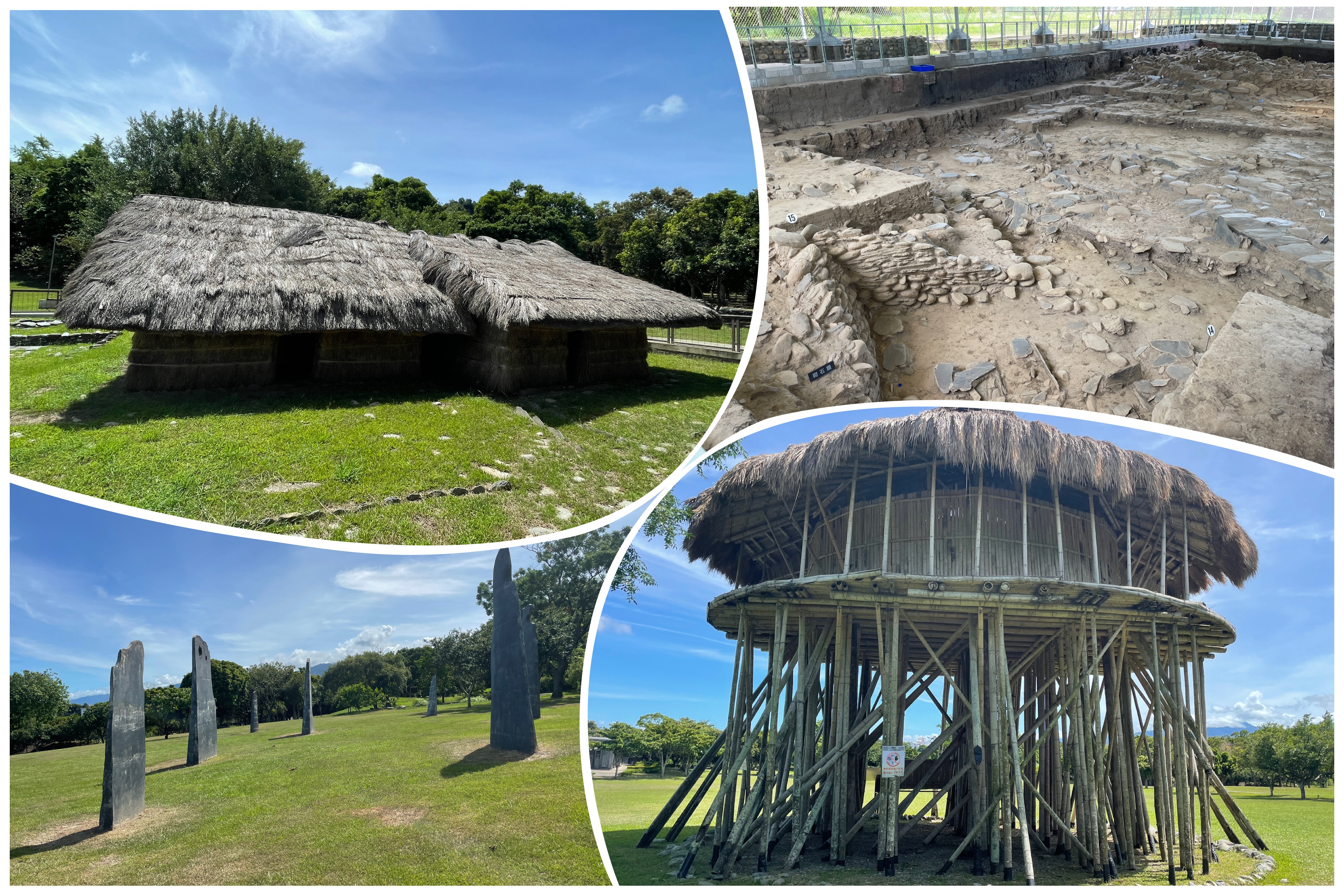
The moon-shaped stone pillar near the entrance of Beinan Cultural Park is considered one of the park's landmarks. The Beinan site, located at the southeastern tip of Beinan Mountain, is a representative site of the Beilin culture from the Neolithic Age in eastern Taiwan. According to archaeologists, the site dates back 5,300 to 2,300 years ago, with its most prosperous period being from 3,500 to 2,300 years ago. Covering an area of over 300,000 square meters, the Beinan site is the largest prehistoric settlement ever discovered in Taiwan. Numerous slate slabs and exquisite funerary objects have been unearthed at the Beinan site, making it the largest slate tomb ruins in the Pacific Rim and Southeast Asia. Beinan Cultural Park is the first archaeological site park in Taiwan. The Beinan site itself is quite extensive, covering an area of over 300,000 square meters.
Recognizing the significance of the Beinan site, Professor Song Wenxun proposed the construction of a field museum on-site in 1982. In 1988, the Beinan site was designated as a national first-class monument. In 1991, the central government decided to develop the site into the "Beinan Cultural Park." The National Taiwan Prehistoric Culture Museum was opened in August 2002.

In 1896, the early Japanese-born anthropologist Tori-Ren took two photos of the stone pillars at the Beinan site. Luye Zhongxiong was the first scholar to study the Beinan site as an archaeological site. In an article published in the 1930s by Yukio Utano, it was mentioned that there were numerous standing slate columns at the site. In 1945, Jin Guanhu and Guo Guozhi began the first excavation around the largest standing stone and uncovered buried pottery and house remains.
During the construction of Beinan Railway Station in 1980, a large number of remains and relics were exposed. Rescue archaeological work was carried out, yielding fruitful results. The excavation area, the number of unearthed stone plaques, and the quantity of relics set an unprecedented record in Taiwan's archaeological history, especially with the discovery of a large number of exquisite jade artifacts.

In addition to the Beinan site, other important sites include Zhabiao, Fushan, Donghe, and other locations where a significant number of agricultural tools such as sickles and stone knives have been unearthed. This suggests the importance of farming in the region. Coastal ruins have also yielded abundant fishing equipment, such as net pendants and hooks, highlighting the reliance on marine resources.
Hunting and farming were the primary livelihoods of the Beinanese culture. They hunted wild boars in the mountains and sika deer in the hills and plains. Cultivated grains included dry rice and millet, and fields were cleared using the "mountain burning" technique. Many agricultural tools, such as stone shovels, axes, and knives, have been discovered. Stone spears and sarcophagi were the main hunting tools. Although the settlement was located on the edge of Beinan Daxi, the villagers were not adept at fishing, and fish served only as supplementary food.
The long-term settlement led to the development of various technologies. Apart from agricultural and hunting tools made of stone, pottery was a common daily-use item, primarily used for water storage and cooking. Pottery was typically handcrafted, baked in the open air, and subjected to low firing temperatures. Common shapes include cans, pots, small-mouth bottles, as well as tools like ceramic spinning wheels, pottery pots, and spoons.

Exquisite jade artifacts best exemplify the aesthetics and craftsmanship of the tribe. They include headwear, earrings, neck ornaments (such as small jade bells), chest ornaments, wrist ornaments, arm ornaments (such as flared rings), as well as non-utilitarian sexual weapons, tools, and various unique styles. Among the different types, earrings display the most diverse range of shapes. The human body shape earring, in particular, has been selected as the emblem of the National Taiwan Museum of Prehistoric Culture. These jade articles were primarily ordinary decorations used by the tribe. After the individuals' death, they were buried as part of underground burials. Based on the intricacy of these jade artifacts, it is likely that some individuals specialized in making and trading jade jewelry.




Address:

Beinan Site: 950台東縣台東市文化公園路200號

September 14, 2019

Taitung Travel: National Museum of Prehistory

Travel Date: 2019/08/31-09/02

I enjoyed walking around and exploring the various exhibitions. The National Taiwan Museum of Prehistoric Culture is quite spacious, and you have the option to purchase tickets specifically for the museum or joint tickets to also visit the Beinan Site. It provides a great opportunity to learn not only about the lives of prehistoric people in Taiwan but also about the aboriginal cultures.

National Taiwan Museum of Prehistoric Culture (國立臺灣史前文化博物館) 

Located in Taitung City, the National Museum of Prehistory is the most significant national museum for anthropological and natural history in Taiwan. It is also the only national museum in eastern Taiwan that focuses on Taiwanese prehistoric culture and aboriginal heritage. The museum encompasses the Beinan site, which covers about 10 hectares and includes the Beinan Relics Park, as well as the Nanke Archaeological Museum in the Tainan Science Park. The building itself was designed and constructed by American architect Michael Graves.

The discovery of the Beinan Cultural Site in July 1980, during the construction of the South Beinan Station (now Taitung Station) by the Taiwan Railway Administration, led to the excavation of a large number of cultural relics. Under the leadership of Professor Song Wenxun and Professor Lian Zhaomei from the Department of Anthropology at National Taiwan University, the excavation became the largest Neolithic excavation site in Taiwan. Through years of rescue, research, and planning, the National Taiwan Museum of Prehistoric Culture was established and showcases three main themes: Taiwan's natural history, Taiwan's prehistoric history, and the cultures of the South Island tribes. While the museum is not directly built on the archaeological site, a Beinan Cultural Park was established to preserve the site.

In April 1989, the Ministry of Education submitted the "National Taiwan Prehistoric Culture Museum Planning Program," which was approved by the Executive Yuan in July of the same year. The Preparatory Office of the National Taiwan Prehistoric Culture Museum was then established on February 1, 1990. In November 1990, the Ministry of the Interior approved the conversion of protected areas near Beinan Station into park land for museum construction. However, due to the expansion of the Beinan site in 1991, large-scale buildings were deemed unsuitable for construction. As a result, the Preparatory Office requested assistance from the Ministry of Education, and a museum construction site in Taiti County was planned.

In 1995, the Institute of History and Philology of the Academia Sinica, commissioned by the National Science Council, conducted a site investigation in the Tainan Science Park. A total of 58 archaeological sites were discovered, along with the newly developed Tainan specific industrial zone and Shugu Industrial Park. The new project for the National Taiwan Museum of Prehistoric Culture began in 1998, and the prehistoric pavilion underwent a trial operation and held an opening ceremony in 2001. The reconstruction of the prehistoric pavilion was completed and officially opened in 2002.

In 2004, the Ministry of Education approved the establishment of the Nanke branch under the Prehistoric Museum. It was also decided to construct the Nandao Cultural Park. In 2007, the Executive Yuan approved the project for the South Branch of the Prehistoric Museum, with a construction budget of NT$1.5 billion. The museum, temporarily named "National Taiwan Museum of Prehistoric Culture, Nanke Archaeological Museum," covers an area of 2.44 hectares. In October 2008, the East Broadcasting Center of the Aboriginal TV Station opened in the prehistoric pavilion, and in 2015, the prehistoric pavilion introduced its first ticket purchase service.

national museum of prehistory, taitung, taiwan

national museum of prehistory, taitung, taiwan

national museum of prehistory, taitung, taiwan

national museum of prehistory, taitung, taiwan

national museum of prehistory, taitung, taiwan

national museum of prehistory, taitung, taiwan

national museum of prehistory, taitung, taiwan

national museum of prehistory, taitung, taiwan

national museum of prehistory, taitung, taiwan

national museum of prehistory, taitung, taiwan

national museum of prehistory, taitung, taiwan

Address:

950台東縣台東市博物館路1號國立臺灣史前文化 博物館

September 10, 2019

Taitung Travel: Archeological Site of Beinan

Travel Date: 2019/08/31-09/02

In my opinion, this place is really interesting and a must-see in Taidong. Unfortunately, part of this place was under maintenance, but a large part of it, especially the small museum, was open for visitors. We can learn more about the lifestyle of ancient people and how they dealt with many problems. Even without our modern technology, they were able to make their own clothing, jewelry, pottery, and many everyday items. It amazed me to learn that they used stones that could only be found in the central mountains area, which was quite far from their location. They didn't have cars or machinery to assist them in their work, yet they still managed to transport stones that were several meters long and quite thick to build their coffins, houses, and more. Unfortunately, many of their utensils are still not well understood by today's researchers.

Newer post about Beinan Site: HERE

Beinan Site (卑南遺址)

Beinan Site, was partly closed for renovation, so we couldn't see the exact place where the relics were found. However, the park surrounding the site and the small museum were very interesting, with different things to see. We could see prehistoric houses, boats, and many artifacts unearthed in this area. The museum also had replicas of coffins. Everything was explained in English, and at certain times, a tour guide would provide additional information in English as well. The ticket to this place costs 30 NTD, and if combined with the National Museum of Prehistory ticket, it costs only 80 NTD.

The moon-shaped stone pillar near the entrance to the Beinan Cultural Park is considered one of the park's landmarks. The Beinan site, located at the southeastern tip of the Beinan Mountain, is a representative site of the Beilin culture from the Neolithic Age in eastern Taiwan. According to archaeologists, the site dates back 5,300 to 2,300 years ago, with the most prosperous period being 3,500 to 2,300 years ago. Covering an area of over 300,000 square meters, the Beinan site is the largest prehistoric settlement ever discovered in Taiwan. Many slate slabs and exquisite funerary objects have been unearthed at the site, making it the largest slate tomb ruins in the Pacific Rim and Southeast Asia. The Beinan Cultural Park is the first archaeological site park in Taiwan.

The development of the Beinan site as an archaeological site began in the early 20th century. After the end of World War II, many Taiwanese scholars came to Beinan to conduct investigations, although no excavation was carried out at that time. In 1980, during the construction of the Beinan Railway Station, a large number of remains and relics that had been buried for thousands of years were exposed, causing significant damage. The Taitung County Government entrusted professors Song Wenxun and Lian Zhaomei from the Department of Archaeology and Anthropology at Taiwan University to conduct rescue archaeology. The rescue work lasted for 9 years and yielded fruitful results. The excavation area, the number of unearthed stone plaques, and the quantity of relics set an unprecedented record in Taiwan's archaeological history, especially the large number of exquisite jade artifacts that were discovered.

Apart from the Beinan site, other important sites include Zhabiao, Fushan, Donghe, and other locations where numerous agricultural tools such as sickles and stone knives have been unearthed. These tools indicate the development of farming as a crucial activity. In the coastal areas, abundant fishing equipment such as net pendants and sharp tools have been found, highlighting the reliance on marine resources.

beinan site, taitung, taiwan

beinan site, taitung, taiwan

beinan site, taitung, taiwan

beinan site, taitung, taiwan

beinan site, taitung, taiwan

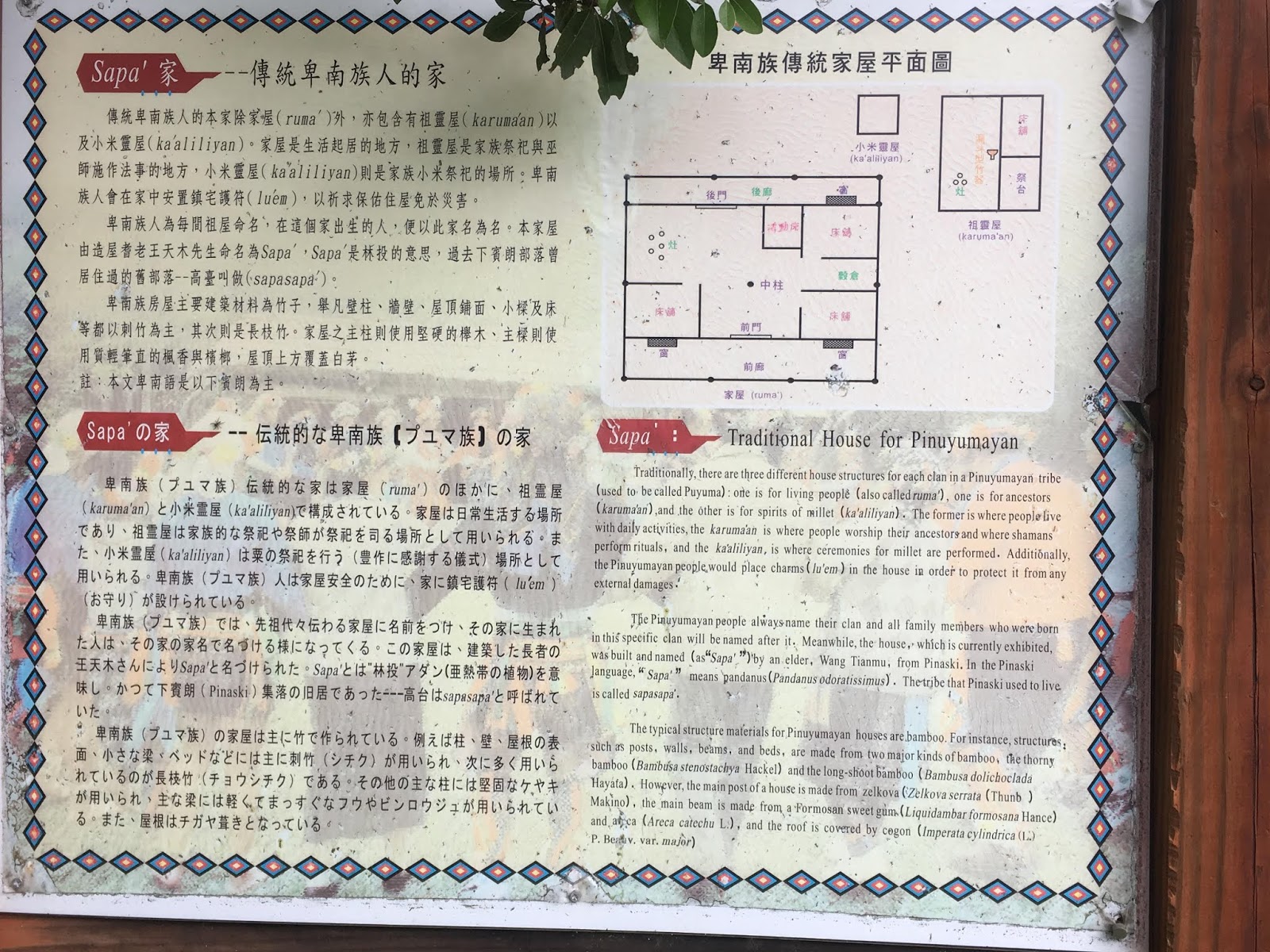
The Beinan ruins feature slate house buildings similar to those of the Paiwan tribe's leader. The site covers a large area, exceeding 300,000 square meters. The buildings are arranged in rows, indicating a well-organized social structure. The houses have a slightly north-south axis, facing Dulan Mountain. Each house faces west to east, providing views of the stream and the ocean. The main structure of the houses is rectangular, measuring 11.5 meters in length and 5.5 meters in width. Slate boards and large boulders are used as wall foundations, with wooden columns and bamboo frame roofs covered in thatch. In front of the houses, there are square vestibules, and behind the houses, oval stone masonry structures are used for food storage and large clay pots. The settlement also features sporadic elevated silos, equipped with pillars that have anti-rat boards.

Hunting and farming were the main activities of the Beinan culture. They hunted wild boars in the mountains and sika deer in the hills and plains. The cultivated grains included dry rice and millet, with fields being opened through the practice of "mountain burning." Many agricultural tools have been unearthed, such as stone shovels, axes, and knives. Stone spears and sarcophagi were the main hunting tools. Although the settlement is located on the edge of the Beinan Daxi, the villagers were not skilled in fishing, and fish only served as supplementary food.
Various types of technology were developed as a result of long-term settlement. In addition to agricultural and hunting tools made of stone, pottery was one of the most common utensils used in daily life, primarily for water storage and cooking. Pottery was usually hand-made, occasionally utilizing a turntable refurbishment technique, and fired in low-temperature open-air kilns. The main pottery shapes included jars, pots, small-mouth bottles, as well as tools like ceramic spinning wheels, pottery pots, and spoons.

Exquisite jade artifacts can best showcase the aesthetics and craftsmanship of the tribe. These include headwear, earrings, neck ornaments (such as small jade bells), chest ornaments, wrist ornaments, arm ornaments (such as flared rings), and various unique styles of non-utilitarian weapons and tools. Among the various earring shapes, the human body shape is particularly representative and has been selected as the museum emblem by the National Taiwan Museum of Prehistoric Culture. Most of these jade articles were ordinary decorations used by the tribes. After a person's death, they were buried as grave goods. Based on the fine craftsmanship of these jade articles, it is likely that some individuals specialized in making and trading jade jewelry.

In addition, thousands of slate slabs have been found buried under the buildings at the Beinan ruins. They are distributed in a strip shape and correspond to the position of the above-ground buildings, indicating a significant meaning. The plaques also contain abundant and exquisite burial jade and pottery. It can be inferred that the people of that time had a concept of the afterlife, believing in a world beyond death and conducting funeral rituals accordingly. The homes and tombs at the site closely overlap, which is a major characteristic of the Beinan site. The remains of headless individuals believed to be headhunters have also been found, likely indicating intergroup competition for natural resources and the beginning of tribal warfare.

Recognizing the importance of the Beinan site, Professor Song Wenxun proposed the construction of a field museum on-site in 1982. In 1988, the Beinan site was designated as a first-class national monument. In 1991, the central government planned the site as the "Beinan Cultural Park." The National Taiwan Prehistoric Culture Museum was opened there in August 2002. The entire Beinan Cultural Park was planned to encompass the site as an open-air museum.
The largest stone pillar at the Beinan Site measures 4.85 meters in height, 2.12 meters in width, and is 15 centimeters thick.

beinan site, taitung, taiwan

beinan site, taitung, taiwan

beinan site, taitung, taiwan

beinan site, taitung, taiwan

beinan site, taitung, taiwan
Stone coffins

beinan site, taitung, taiwan

beinan site, taitung, taiwan
The largest stone pillar at Beinan Site measures 4.85m in height, 2.12m in width and is 15cm thick.

beinan site, taitung, taiwan

beinan site, taitung, taiwan

beinan site, taitung, taiwan

beinan site, taitung, taiwan

beinan site, taitung, taiwan

Longfeng Temple (龍鳳佛堂)

Longfeng Temple, located in the scenic area of Liyu Mountain, is known as the landmark of Taitung City. The temple's evolution is connected to the transformation of Bo'ai Road in Taitung City, which is now known as Dongling Palace. The main deity worshipped in the temple is Guan Shengdi, a descendant of the emperor, and the founding committee aims to promote Taitung. Lin Jinquan, a mountain freight business owner, serves as the main committee member, while Wu Jiangxiang is the deputy chairman, and Zheng Yuxin is responsible for project supervision and design.

The construction of Longfeng Baoyu Tower was completed in 1973, followed by the completion of the Longfeng Buddhist Temple in 1976. However, in the 1980s, due to a lack of maintenance, even the pagoda buildings were deemed unsafe. As a precautionary measure, visitors were not allowed to go upstairs to enjoy the panoramic view of Taitung from the air. Subsequently, the management committee invested nearly 10 million yuan to improve and maintain the temple, enhancing its beauty.
The second floor of the Buddhist temple houses the Daxiong Hall, dedicated to the Goddess of Mercy. The main ceremonies held include the Guanyin Bodhisattva Enlightenment Day, and the Longfeng Pagoda follows a three-section practice. The Baoyu Tower and Buddhist Temple have now merged into the same unit, and the decoration of the Buddhist temple has gradually improved. The stakeholders hope that the Longfeng Buddhist Temple will overcome its difficulties and thrive once again.

As early as the foundation of the Buddhist temple in 1968, stone artifacts were unearthed. Professor Song Wenxun from the Department of Archaeology and Anthropology at National Taiwan University led students in conducting research and exploration. The cultural relics discovered here are similar to those unearthed at the Beinan Cultural Site, indicating prehistoric activity in the Carp Mountain area.

beinan site, taitung, taiwan


beinan site, taitung, taiwan

beinan site, taitung, taiwan

beinan site, taitung, taiwan

beinan site, taitung, taiwan

Address:

Beinan Site: 950台東縣台東市文化公園路200號卑南遺址考古現場