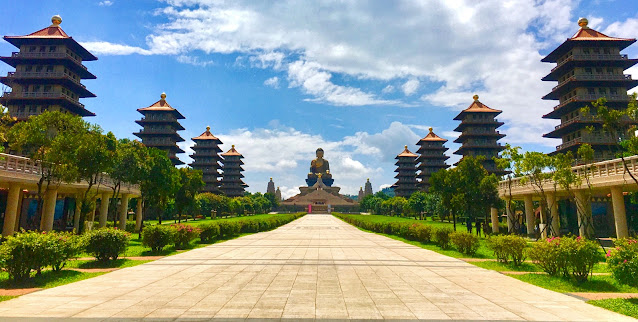
Built on a hill in Dashu District, Kaohsiung, the Fo Guang Shan Buddha Museum is a truly enormous place. At the entrance of the first building, you can obtain a map of the museum, which is really helpful for deciding where to go. When we visited, some of the eight towers were closed, so we didn't have the chance to explore every tower since it would have taken too much time. However, if you are interested in Buddhism, you can learn a lot here. We spent over an hour in the museum, but due to the extremely hot weather, we didn't see much. I wouldn't recommend visiting during the summer as it can be quite exhausting.
Fo Guang Shan Buddha Museum (佛光山佛陀紀念館)
The Fo Guang Shan Buddha Museum is located in Dashu District, Kaohsiung. It was inaugurated in 2011 after a nine-year construction period, with the foundation stone being laid in 2003. In 1998, Master Xingyun traveled to Bodh Gaya, India, to propagate the Three Universal Truths. At that time, the Tibetan Dalai Lama, Kunga Dorje Rinpoche, recognized that Fo Guang Shan had long been promoting cultural exchange between Buddhism and the Han people, and had established the Chinese Sino-Tibetan Cultural Association. It had also organized the World Buddhist Conference and established the International Buddhist Progress Society, making remarkable contributions to the promotion of Buddhism worldwide. The Dalai Lama expressed his wish to entrust the preservation of the Buddha's tooth relic, which he had cherished for nearly 30 years, to a pavilion in Taiwan to carry forward the Dharma. Thus, the museum was established to house this precious religious relic. Master Xingyun has always adhered to the principle of "people-oriented" lifelong education, making the museum the most comprehensive and distinctive in its field.
The Buddha Memorial Hall serves as the core of the museum and embodies the values of giving, precepts, patience, diligence, concentration, and wisdom. It aims to foster literature, research, education, exploration, public services, leisure, and sightseeing. In one year alone, nearly 10 million people visit the museum.
The Buddha Memorial Hall consists of four permanent exhibitions and four exhibition halls. It also houses a professional performance theater called "Da Jue Tang," which can accommodate 1,500 people. The public can enjoy various art performances there. In order to build the 48-story pagoda, a special exhibition area called the "Reconstruction of Buddhist Pagoda" was designed to replicate the Famen Temple in Shaanxi, showcasing cultural relics from the pagoda. The "Countdown to the Gate of the Pagoda" was designed to allow visitors to experience the passage of time and space.
Covering a total area of 100 hectares, the Buddha Museum's design went through more than 100 iterations, with the final layout featuring a grand main building in the front, a large Buddha statue in the rear, a spiritual mountain in the south, and a garden in the north. The main building is situated on the central axis and is accompanied by the "Ri Jing Hall," "Eight Towers," "Millions of Photographs," "Bodhi Square," the Fo Guang Shan Buddha Memorial Museum, and the "Fo Guang Buddha."
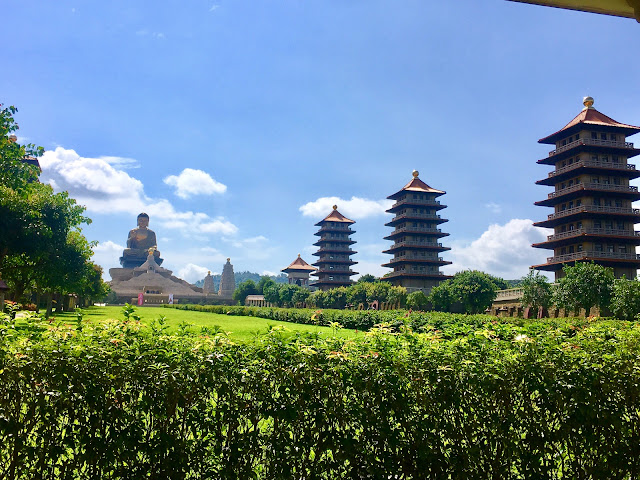
Lijing Hall
Lijing Hall is located at the entrance of the museum. Its name is derived from the blessings of the Buddhas. It is a three-story building with a basement. Inside the hall, there are facilities such as a water feature, a guest hall, an international service desk, off-campus teaching facilities, group guide services, foreign language guide services, currency exchange, a nursery room, restrooms, exhibition areas, a gourmet area, a Buddhist art gallery, and a gift area.
In front of the hall's entrance, there are two statues. The elephant on the right represents the Buddha's birth, symbolizing the white elephant that accompanied his mother Queen Maya. The lion on the left represents the Buddha's wisdom, signifying the enlightened understanding of the Buddha's teachings.
The meaning of eight towers
In front of the museum, there are eight towers with different functions, symbolizing the fundamental teachings of Buddhism. The eight towers share the same square, seven-story pavilion design, standing at a height of 37 meters. They have reinforced concrete structures, with yellow sandstone on the base, small marble for the outer walls, flying bird roof tiles, and stone railings.
The first tower represents humanistic Buddhism. Master Xingyun stated, "All teachings that contribute to the promotion of a happy life are humanistic Buddhism." This tower serves as a multifunctional space for meetings, events, courses, volunteer workshops, education, training, and can be borrowed by schools and groups at all levels.
The second tower is dedicated to Sanhao Children's Hall, which is based on the Three Acts of Goodness advocated by Master Xingyun: "do good deeds, speak good words, and think good thoughts." The design of this tower incorporates interactive technology and games for children.
The third tower represents "good deeds, good words, and good thoughts through the body, speech, and mind." This tower functions as a collaborative office, featuring a conference room and a reception room. It serves as a modern and versatile space.
The fourth tower serves as a cultural square, providing a space for the public to immerse themselves in the world of books and enjoy tranquility. Master Xingyun encourages readers with four phrases. This tower also includes a children's section, offering an ideal learning environment for families and children.
The fifth tower represents "self-reliance, family harmony, respect for others, social harmony, and world peace." The Wuhe Tower is a "family house." It caters to various ceremonies, such as Buddha weddings, blessings for newborns, elder birthday celebrations, and graduation ceremonies. The hall creates a joyful atmosphere.
The sixth tower embodies the six paramitas in Buddhism: giving, precepts, patience, diligence, concentration, and wisdom. It houses a permanent exhibition featuring the "Public Welfare Trust Nebula Master Education Fund" and calligraphy by Master Xingyun, as well as a 3D film.
The seventh tower serves as a guesthouse, providing visitors with a place to rest, have tea, and engage in conversations.
The eighth tower represents the Noble Eightfold Path, consisting of right view, right intention, right speech, right action, right livelihood, right effort, right mindfulness, and right concentration. This path leads to liberation and nirvana. The Badao Tower functions as a guest hall, where films and briefings about the Buddha Memorial Hall are screened.

Double loft
Located to the north of the Buddha Memorial Hall, the Double Loft is a space designed for relaxation of the body and soul. The golden building is called the "Double Loft" and overlooks an ecological pool filled with lotus flowers, creating a humanistic ambiance. The surrounding area, including the eucalyptus forest and ecological pool, serves as an off-campus teaching site, providing an immersive educational experience in a natural ecological setting.
The second floor of the Double Loft houses the "Tea Zen" space, where Chinese tea ceremony culture is promoted. On the third floor, there is a "Pu Jing Tang" where visitors can engage in copying Buddhist scriptures, such as the "Buddha's Name" and the "Heart Sutra," as a means of cultivating the mind and understanding the scriptures. To enhance the cultural atmosphere, the third floor also hosts the "Double Loft Masters Lecture," providing a platform for humanities and cultural activities. It aims to purify people's hearts through education, culture, and art. In this green and serene environment, the public can enjoy profound art, listening, and experiencing beauty and inspiration.
Bodhi Square
After passing through Chengfo Avenue, visitors arrive at the "People's Photo Desk." Ascending the 37 steps, symbolizing the "37 Factors of Enlightenment," which are the methods of Buddhist practice, one will face the east, with the towering bronze statue of the Buddha behind them.
Main building
The main building consists of three halls on the first floor: the Guanyin Temple, the Golden Buddha Hall, and the Jade Buddha Hall.
The Guanyin Temple is dedicated to the Thousand-Handed Guanyin Bodhisattva. Designed by Master Xingyun, the temple features a white glass wall adorned with 33 Guanyin statues created by the artist Shi Jinhui. Visitors can offer their prayers for blessings. The curved outer wall of the temple displays verses from the "Universal Door Chapter" of the Lotus Sutra, creating a serene and fragrant atmosphere.
The Golden Buddha Hall houses the Thai Golden Buddha. In 2004, the Thai royal family produced 19 golden Buddha statues to celebrate the King's 90th birthday. Princess Sirindhorn presented one of these statues to the Fo Guang Shan Buddha Museum, symbolizing the cultural exchange between Buddhism in Thailand and Taiwan.
The Jade Buddha Hall is dedicated to the True Buddha, with a reclining Buddha carved from white jade from Burma. This statue represents the Buddha's nirvana image. In front of the Buddha, Master Xingyun inscribed a couplet expressing regret for the karma accumulated in the body and emphasizing the impermanence of life. The large-scale colored jade carvings on both sides of the Buddha statue depict the Eastern Pure Land and the Western Pure Land. The cedar wood carvings of stupas showcase the beauty of Buddhist art.
Buddhist Palace Restoration Hall
The Buddha Memorial Hall consists of 48 underground palaces that serve as repositories of historical, contemporary, and commemorative memories, as well as cultural relics. It revolves around the theme of "belief, life, culture" and aims to preserve and continue the common culture of humanity for centuries to come.
The Buddhist Palace Restoration Museum features four exhibition areas: "Famen Temple," "Guanyin Stone Inscriptions," "Ritual Buddhist Objects," and "Spirit Monuments." These areas house a total of 134 groups of Buddhist cultural relics.
Buddhist Festival Hall
The Buddhist Festival Hall showcases various festivals celebrated throughout the year in Buddhism. It allows visitors to experience the world of Buddhism through these festivals. The main festivals highlighted include the "Fobao Festival" on the eighth day of the Lunar New Year, the "Shu Bao Festival" on July 15th, and the "Falun Festival" on the eighth day of December. These festivals not only showcase the compassion and wisdom of the Buddha and Bodhisattvas but also reflect the belief characteristics of Buddhism and the traditional ideas and customs of the people.
FoGuangShan Founder's Museum
To provide the public with insights into the past and future of Fo Guang Shan, the first floor of the museum houses the "Fo Guang Shan Founder's Museum." This section documents the history of the development of Buddhism by humanity, covering topics such as the birth of Fo Guang Shan, its establishment in Taiwan, and the founding of the Fo Guang Pu Zhao Wu Conzhou, among others.
Buddha Life Hall
The Buddha Life Hall presents a 4D animation called "The Life of Buddha," which depicts the life of the Buddha. The script for the animation is provided by Shi Xingyun. The exhibition combines 4D theaters, murals, texts, sound and light effects, and interactive displays to showcase the birth of the Buddha and his teachings.
Dajuetang
"Da Jue Tang" is a large and versatile performance hall with a seating capacity of 2,000 people. It features a unique 360-degree circular screen as the centerpiece. The main lamp in the center represents a blooming lotus flower, and the surrounding auspicious clouds change color, creating a vibrant effect. The innovative circular lifting stage can rotate in reverse, allowing performers to engage with the audience clearly through the stage.
Four holy tower and Great Buddha
The pedestal of the main building features four towers with embossed walls. Each tower houses a Bodhisattva statue: the Great Goddess of Mercy, the Bodhisattva of Great Wisdom, the Bodhisattva of Great Hope, and the Bodhisattva of Daxing. At the highest point of the central axis, there is the world's largest copper-casting Buddha, facing east to west. The Buddha weighs 1,780 metric tons and holds the lotus print in its right hand, symbolizing enlightenment, while the left hand displays the wishing seal, representing human compassion. To accommodate visitors who wish to worship the Buddha up close, Shi Xingyun has built a "Great Buddha Platform" that can accommodate 2,000 people. Every Saturday, the Master leads the practice of circumambulating the tower with the Four Holy Towers and the Great Buddha Platform.
Forty-eight underground palaces
The Buddha Memorial Hall houses forty-eight underground palaces located beneath the main building. These palaces contain thousands of artifacts and serve as a repository of historical trajectories and collective memories from around the world. The underground palaces include 22 exhibits showcasing the significant episodes of the Buddha's life, known as the "Buddha's Lineage Skills." Additionally, the Buddha Memorial Hall features 40 lifelike sculptures painted by renowned mainland Chinese artists Gao Ertai and Pu Xiaoyu. The Eight-Tower Promenade displays 70 paintings from the "Human Painting Collection" and 14 embossed figures from the "Foguang Cai Gen Tan," resulting in a total of 86 artworks. The black granite walls feature Shi Xingyun's "Foguang Cai Gen Tan," consisting of 75 verses written in different calligraphic styles by renowned calligraphers. These engravings add to the solemn ambiance of the space.
Stone carving art in the museum showcases the beauty of simplicity and solidity. International artist Wu Rongci Hui Xing carved the eight ancestral masters in Quanzhou Baishi and the eighteen arhats in Quanzhou Qingdou, exemplifying their flexibility and charm. The Eighteen Arhat statues, which differ from conventional depictions, are located on both sides of the Bodhi Square in front of the main building.
Exhibition hall
The Buddhist Pavilion comprises four exhibition halls divided into north and south sections. The first and second halls feature three-dimensional exhibits that allow visitors to appreciate the essence of the artifacts. The third and fourth halls provide flexible spaces for various artistic expressions. The Buddha Memorial Hall promotes cultural exchanges on both sides of the Taiwan Strait, showcasing Buddhist cultural relic exhibitions in collaboration with the China Cultural Relics Exchange Center. It also hosts exhibitions on intangible cultural heritage and special art exhibitions.
To promote Chinese culture, life education, moral values, and respect and tolerance among students, the Buddha Memorial Hall advocates the "Three Acts of Goodness": doing good deeds, speaking good words, and cultivating good intentions. It welcomes students and groups from various schools, both domestic and international. As an official member of the International Council of Museums, the Buddha Memorial Hall is internationally recognized and attracts visitors from around the world, offering profound cultural experiences.



Address:
84049高雄市大樹區統嶺路1號佛光山佛陀紀念館


