Showing posts with label Shell Temple. Show all posts

August 10, 2023

Changhua Travel: Exploring Sanqing Sanyuan Palace ~ Shell Temple in Taiwan

Sanqing Sanyuan Palace Shell Temple 三清三元宫贝壳庙, changhua, taiwan

Travel Date: 2023/07/16

We were staying in Yunlin for the weekend, but early Sunday morning, my parents-in-law had to go somewhere, so we decided to head back home as well. However, I had the idea to make a stop in Changhua to revisit two temples we had explored a few years ago: the Shell Temple and the Glass Temple. Fortunately, they were located close to each other, just a few minutes' drive away.
It's not our first time in this place. We visited the temple 4 years ago.

~ ~ ~

We reached the Shell Temple first. Initially, the small road leading to the temple was easy to overlook. Once we arrived, we noticed a cemetery nearby, and the parking area was right there. From the outside, the temple might not seem very attractive, but its interior was quite impressive. It felt like nothing had changed since the last time we were here, except that on that previous visit, we were accompanied by friends who no longer live in Taiwan. Over the past two years, some of our friends had moved away, and later, I myself moved 200km away, leaving me with only one friend. So, once again, I find myself as the lonely girl, haha.

The weather this time was really good, allowing me to take better pictures of the surroundings. Inside the temple, everything remained the same - there was a peaceful pond with fish and a shop selling shells and decorations made from them. Except for us, there were no other visitors (just like last time), making it seem like a rather unpopular place.

Sanqing Sanyuan Palace Shell Temple (三清三元宫贝壳庙) 

Sanqing Sanyuan Palace Shell Temple was built by Huang Qichun, who was born into a poor family. He attended school in the countryside for one year but dropped out at the age of 12 to work as a laborer. At 16, he became an apprentice in an ironworks and learned the skill of making kitchen knives. After his unsuccessful entrepreneurial ventures, he started selling vegetables in Taipei. 
In the 1970s, Huang bought land near the Xiucuo Public Cemetery in Fuxing Township, Taiwan, to raise tropical fish. Despite warnings from friends about the unfavorable feng shui of the land, he persisted and reclaimed the land with his wife, Huang Lixiao. 

Huang Qichun often dreamed of spiritual phenomena after moving to this place. He dreamt of a stone-covered temple adorned with shells and similar decorations. Inspired by the dreams, he decided to build a temple on the remaining land after the fishponds were constructed.
Huang collected various seashells like conch, snail, and abalone, as well as stones from Sihou Li in Hengchun Town. He skillfully arranged the shells and stones using iron wires, pouring cement over them to create the unique temple design. Huang personally worked on the temple's walls, gates, and fences, embedding them with seashells. The walls, except for the pillars, roofs, and entrance gates, were all handmade and decorated with shells. 

Local villagers were initially surprised by Huang's temple construction, but they eventually got used to it. They called him "Guai Chun" (strange Chun) and referred to the temple as the "Beikemo Temple." Despite facing challenges due to the agricultural and fish farming nature of the land, Huang continued his temple construction, and by 1996, the temple was mostly completed.
As Huang Qichun's son grew older, he also helped with farming, allowing his father more time to focus on building the temple, which was eventually completed in late January 1997.

The temple features a square-shaped structure with a decorative roof depicting dragons and phoenixes. Inside, there are various sections, including the main hall, dragon palace tunnel, tropical fish farming area, and an art section. Inside the temple, various seashell artworks, including miniature models of Lukang Mazu Temple and Kirin, are displayed. One notable piece is a 2-meter tall, 3-meter long "Millennium Seashell Dragon," created to celebrate the Millennium Dragon Year.
Due to the land being a farmland, it was impossible to obtain temple registration.
By 2001, the temple has gained fame, attracting many visitors, and Huang often volunteered to guide large tour buses that arrived at the limited parking space near the temple.


Sanqing Sanyuan Palace Shell Temple 三清三元宫贝壳庙, changhua, taiwan

Sanqing Sanyuan Palace Shell Temple 三清三元宫贝壳庙, changhua, taiwan

Sanqing Sanyuan Palace Shell Temple 三清三元宫贝壳庙, changhua, taiwan

Sanqing Sanyuan Palace Shell Temple 三清三元宫贝壳庙, changhua, taiwan

Sanqing Sanyuan Palace Shell Temple 三清三元宫贝壳庙, changhua, taiwan

Sanqing Sanyuan Palace Shell Temple 三清三元宫贝壳庙, changhua, taiwan

Sanqing Sanyuan Palace Shell Temple 三清三元宫贝壳庙, changhua, taiwan

Sanqing Sanyuan Palace Shell Temple 三清三元宫贝壳庙, changhua, taiwan

Sanqing Sanyuan Palace Shell Temple 三清三元宫贝壳庙, changhua, taiwan

Sanqing Sanyuan Palace Shell Temple 三清三元宫贝壳庙, changhua, taiwan

Sanqing Sanyuan Palace Shell Temple 三清三元宫贝壳庙, changhua, taiwan

Sanqing Sanyuan Palace Shell Temple 三清三元宫贝壳庙, changhua, taiwan

Sanqing Sanyuan Palace Shell Temple 三清三元宫贝壳庙, changhua, taiwan

Sanqing Sanyuan Palace Shell Temple 三清三元宫贝壳庙, changhua, taiwan

Sanqing Sanyuan Palace Shell Temple 三清三元宫贝壳庙, changhua, taiwan

Sanqing Sanyuan Palace Shell Temple 三清三元宫贝壳庙, changhua, taiwan

Sanqing Sanyuan Palace Shell Temple 三清三元宫贝壳庙, changhua, taiwan

Sanqing Sanyuan Palace Shell Temple 三清三元宫贝壳庙, changhua, taiwan
 

Address:

506彰化縣福興鄉振興巷10-1號三清三元宮貝殼廟

May 6, 2021

Penghu Travel: Sea Turtles at Zhuwan Temple and Erkan Historic Village


Travel Date: 27/03/2021-01/04/2021

It's our first time visiting Penghu, and I'll describe the process, prices, our accommodation, and the places we visited in separate posts as I have a lot planned. 
We started by visiting the historical Ash Kilns and the famous attraction known as "Moses Parted the Sea," where we witnessed the low tide creating a pathway to a nearby small island. We also explored Nanliao Village, renowned for its traditional fishing settlement, with many interesting buildings to see.

In addition to the main island, we ventured to the smaller islands connected by sea-crossing bridge. On Yuwengdao Island in Xiyu Township, the furthest island, we visited the Yuwengdao Lighthouse, the Sanxian Pagodas with their breathtaking views of the sea, and observed the fake cannon. We also enjoyed the natural beauty of Daguoye Columnar Basalt, Niuxin Mountain and Paradise Road. In Xiyu, there are several forts worth exploring, such as the Western Fort, Eastern Fort, and the Five-hole bunker
Zhuwan Temple left me with mixed feelings as I enjoyed seeing the turtles but felt sorry for them living in captivity underground.
Chen Erkan Historical House, along with the entire village of unique old buildings, is a famous place to visit in Penghu. 
Going south on Magong Island, we explored the remains of a Dutch castle (actually a memorial), as well as the South and North Pagodas, which have unique and intriguing designs, though their exact story remains unknown. 
Magong City is also filled with historical architecture. We explored Zhongyang Old Street, old wells, Mazu Temple, and the sole remaining city gate.

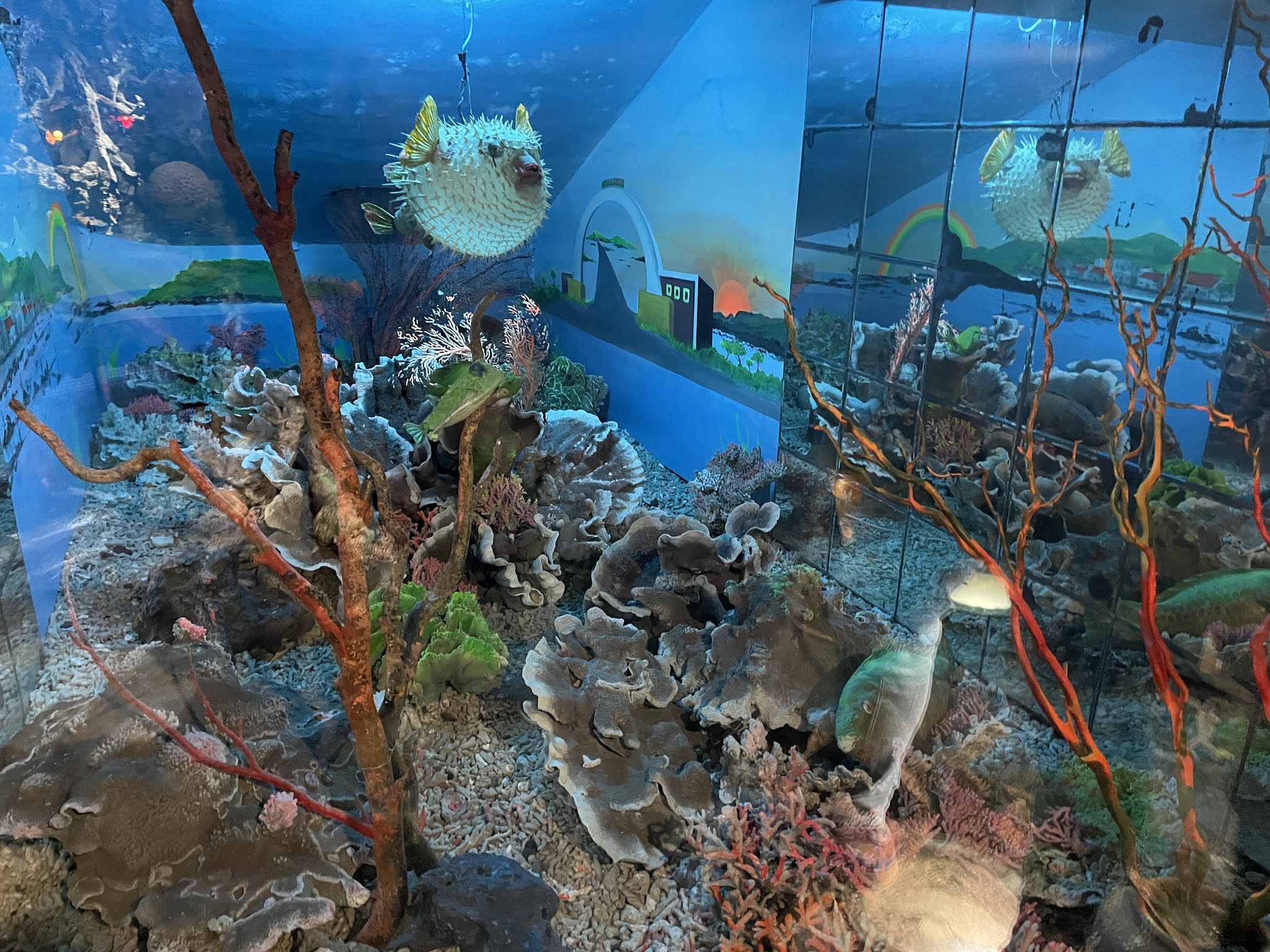
We discovered a place in Penghu where you can interact with starfish and sea urchins, which was particularly interesting for kids as they could learn more about the underwater world. 
Another fort we visited, Jinguitou Fort, was once used to defend the island of Penghu. 
For those interested in temples and religions, the Confucius Temple is worth a visit. 
In just four days, we experienced an incredible amount. Penghu is truly beautiful, and I hope to revisit someday in the future.

UPDATE: As of the end of 2022, the sea turtles have finally been released into the wild!

Today's trip plan is to visit Zhuwan Dayi Temple, Erkan Chen Family Historical Houses, and Xiaomen Islet. Our accommodation is close to Magong City, so we have to drive about 25km again, as we weren't able to finish visiting everything on the further-laying Xiyu Island. We only have a few days, and I want to see as many places as possible (as I always do). There's no time to relax, sorry husband. It's quite far away, and traveling to Penghu takes more time and costs more than just driving around our home, so I don't want to stay here and see nothing.

Zhuwan Dayi Temple (竹灣大義宮)

Zhuwan Dayi Temple is the only temple in Taiwan where sea turtles are legally raised, although I hope that practice becomes forbidden. It is truly saddening to see a few sea turtles confined in a small pond underground the temple, deprived of sunlight and freedom for many years.
The history of Dayi Palace can be traced back 400 years ago during the Ming Dynasty. Initially, the temple was built at the northeast port of Xiyu Township, taking advantage of the calm sea in the inner bay and the vibrant bamboo forest in the vicinity.

Around 1862, the temple was established in collaboration with neighboring villages, known as "Na Gong" at that time, which was a public temple. Later, as Hengjiao, Hejie, and Xiaomen developed rapidly, residents from these areas found it inconvenient to travel to Penny's Bay, leading them to construct temples in their own villages.
During the Japanese Occupation period, the temple was relocated to its present site in 1909, with Chitose of Wenfu as the main deity. In 1922, the temple underwent expansion and worshipped Guan Gong, the emperor of Wenheng, as the main god, due to the admiration for Guan Gong's legendary deeds.

In 1973, the temple was rebuilt at Dayi Palace in Zhuwan, with a fundraising amount of NT$16 million, completing the construction in 1983. In 1986, the temple invested 1.8 million to build a lotus cave adorned with coral, lotus, strange stones, and whale bones. Within the temple's basement, green turtles, loggerhead turtles, hawksbill turtles, and other wild animals were raised, making it a highly anticipated tourist attraction.
It was said that wild turtles were initially raised in an outdoor Banyue Pond in 1976, before the "Wild Animal Conservation Law" was enacted in 1989. However, when the Dayi Palace was renovated, the turtles were relocated to the basement pool. At that time, there were a total of 9 turtles, including 5 green turtles, 1 loggerhead turtle, and 3 hawksbill turtles. There have been at least 18 sea turtle breeding records.

In 2018, animal conservationists raised concerns about the poor ventilation and narrow living environment in the temple's basement. The turtles were confined for prolonged periods, resulting in fights and shell softening due to lack of sunlight. Additionally, the temple allowed visitors to throw coins for wishes, leading to potential injuries to the turtle shells and metal poisoning. These practices, lasting for 30 years, were seen as cruelty to animals.
In the same year, students from Ocean University urged Dayi Palace to improve the living conditions for the sea turtles within a specified timeframe. They requested the temple to propose specific plans and schedules to address improper breeding practices and employ professionals to assess all breeding behaviors.


Erkan Chen Family Historical Houses (二崁陳家古厝)

The Chen's House in Erkan was built by Chen Ling (1872-1948) and Chen Bang (1875-1959). The building consists of three houses with three entrances, showcasing a fusion of Fujian and Yangtze architectural styles. It was designated as a county monument in 1988.
Chen Ling and Chen Bang, brothers from Penghu, migrated to Taiwan in 1887. Initially, they worked in a winery and later pursued studies in pharmacology at Jinxieyuan Han Pharmacy. After completing their education, they successfully operated Yuanyi Pharmacy in Tainan. The Chen brothers then returned to their hometown to construct the Chen family house, which was completed in 1912.

Located at the center of the village, Erkan Chen's House faces southeast to northwest. It combines the architectural elements of southern Fujian and the local characteristics of Penghu, reflecting the influence of Western historical-style architecture during the Japanese Occupation. The building consists of three main spaces: the foyer, the main hall, and the back hall, each featuring a courtyard that offers spaciousness and natural light.
The structure primarily uses Penghu stone and basalt, giving it a solid appearance. In addition to couplets and doors, the gate is adorned with reliefs and auspicious tiles. The first entrance showcases Western architectural style, while the second and third entrances incorporate traditional southern Fujian techniques.


Xiaomen Islet

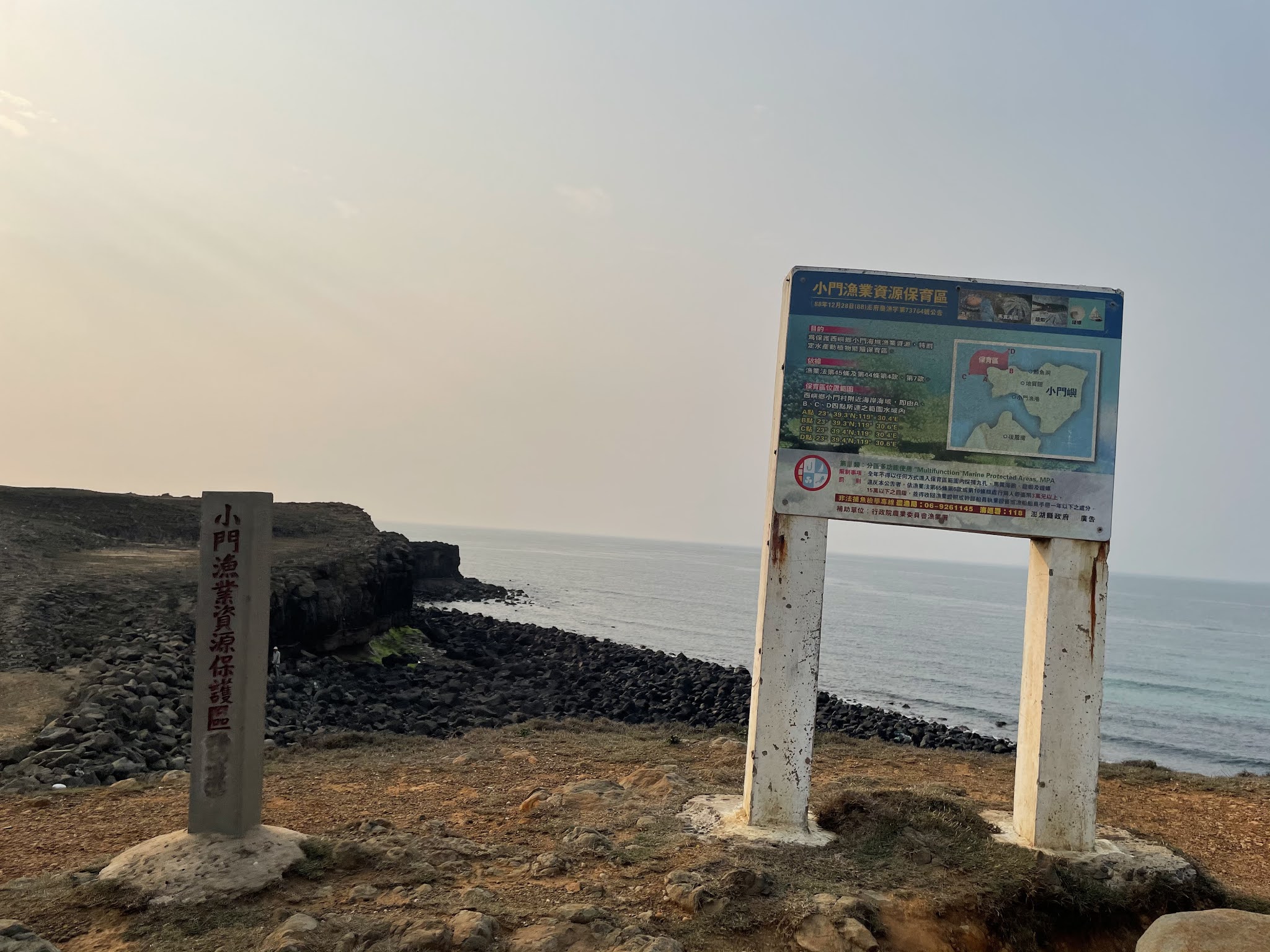
Xiaomenyu is situated in the waterway between Baisha and Xiyu, connected to the main island of Xiyu by the Xiaomen Bridge, commonly known as the cross-sea bridge. It is a typical square-shaped island formed by basalt.

Whale Cave (鯨魚洞) 

Whale Cave is located on the northwest coast of the island. The sea erosion has formed a giant sea cave with columnar jointed basalt cliffs. From a distance, it resembles a stranded whale on the beach. Inside the cave, visitors can hear the roaring sound of the sea waves. The cave has a height of approximately 7.8 meters and is considered the most distinctive sea-eroded terrain on Xiaomen Island. There are two sea-eroded pillars on the east side of Whale Cave, formed by the collapse of another sea-eroded arch.


Xiaomenyu lighthouse (小門嶼燈塔)

Xiaomenyu Lighthouse serves as an important navigational aid for ships traveling through the waters between Baisha and Xiyu.
The lighthouse stands on the northeastern part of Xiaomen Islet, overlooking the surrounding sea and coastline. It was constructed to improve maritime safety and guide ships passing through the area.


Address:

1. Zhuwan Dayi Temple: 881澎湖縣西嶼鄉竹灣大義宮
2. Erkan Chen Family Historical Houses: 881澎湖縣西嶼鄉6號二崁陳家古厝
3. Xiaomen Islet: 881澎湖縣西嶼鄉11之12號小門地質探索館