There are many places to visit in Penghu. Here are some of places that we visited our last time travel. Usually people travel in the summer, so if you go in the winter there will be less crowd, but some places could be closed.
Agriculture and Fisheries (澎湖縣政府農漁局水產種苗繁殖場)
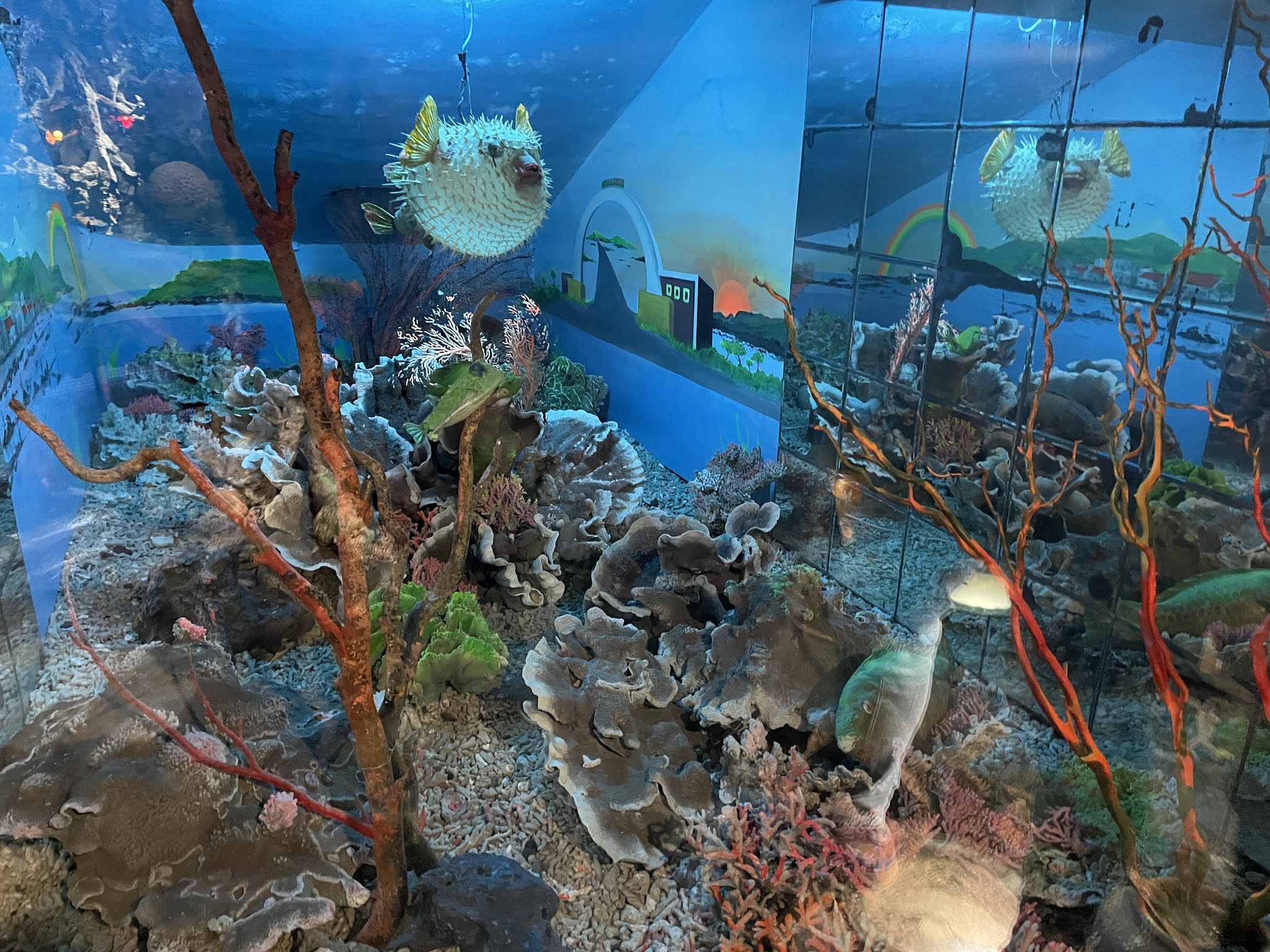
It's a nice place to visit. There are some starfish, sea cucumbers, sea urchins you can touch. There are several aquariums with corals and sea animals. Another part of this place has big breeding tanks, to bred fishes, sea urchins, as well as seaweed.

Jinguitou Fort (金龜頭砲臺)
Jinguitou Fort is one of 12 forts that guarded the Penghu Hall City of the Qing Dynasty. The specific time of the creation of the old fort is unknown. The first construction was around 1718, but the current Fort was built in 1887. It was announced as a national monument on 2001.


Zhongyang Old Street (中央老街 )
Zhongyang Street is the earliest developed street in Penghu, also known as the "first street". In 1973, the street was officially listed as a "special area for preservation of historical sites". In 1983, the residents of Penghu Old Street formed the "Penghu First Street Revitalization Association". The government subsidized the restoration and reconstruction of the old street. The old street was reorganized into the current Fujian-style architectural style.
Wenjun Well (萬軍井)
There is a well outside of Shi Gong Ancestral Hall, formerly known as Ma Gong Dajing. During Qing Dynasty, Shi Lang led a fleet expedition to Penghu to fight the Ming and Zheng navy. When passing through Penghu, the soldiers would be exhausted. Shi Lang therefore prayed to the gods that he could use the emperor's sword to dig a well and have abundant well. It's for everyone to use, to solve Wanjun’s drinking water urgency, hence the name "Wanjunjing". It's currently listed as a national third-class monument along with Shi Gong Temple.

Four-eye Well (四眼井)
The Four-eye Well is the oldest ancient well in Penghu County. It was established in the early Ming Dynasty (1592). The four-hole well is actually just a large well with a large amount of water. The well is 5.6 meters deep and 2 meters wide. In the past, it used to be a source of living and drinking water for residents in Zhongyang Old Street.

Mazu Temple / Tianhou Palace (澎湖天后宮)
The establishment of Tianhou Palace was during Ming Dynasty. The earliest documented date is 1604, when the Dutch East India Company came to Penghu. On December 28, 1983, the Ministry of Internal Affairs announced the first batch of 15 first-class monuments. Penghu Tianhou Temple was listed among them. In May 1997, after the "Law on the Preservation of Cultural Assets" was amended, the classification was no longer classified into the first to third levels of historical sites, and the three levels of national, municipal and county-cities were adopted. Tianhou Temple was changed to a national monument.

Magong Dutch Castle (馬公風櫃尾荷蘭城堡)
The Fort was built by Dutch East India Company on December 1622. It was built with soil, grass, wood, lime and rocks. Castle was destroyed in September 1624. Shetou Mountain, where the Dutch East India Company was founded, is commonly known as the "Dead Fanzi City". Except for the Dutch foreign soldiers who died in battle with the Ming army in 1624, the French navy launched Penghu in 1885. During the occupation of Penghu by service ships, about 200 to 300 soldiers who died of cholera were buried here. On April 30, 1908, the Japanese Navy’s Matsushima ship accidentally exploded in the sea area, with 222 on board. People died or disappeared. The local residents feared the ghost harassment of foreign troops and horses.

North and South Pagodas (鎖港北塔)
The exact time and reason for those Pagodas to be built is unknown.

Zhuwan Dayi Temple (竹灣大義宮)
It's the only temple in Taiwan where sea turtles were legally raised until end of 2022 when they was released. The history of Dayi Palace was originally traced back 400 years ago (Ming Dynasty).
Erkan Chen Family Historical Houses (二崁陳家古厝)
Chen's House in Erkan was built by Kunzhong of Chen Ling (1872-1948) and Chen Bang (1875-1959). The building is in the form of three houses with three entrances, belonging to the Fujian and Yangtze eclectic style buildings. It was announced as a county monument in 1988.

Xiyu Western Fort (西嶼西臺)
Because it's one of the few well-preserved ancient forts in Taiwan and has historical value, it was designated as a first-class monument in 1983. Xiyu West Fort, built by General Wu Hongluo in 1887 had four British Armstrong cannons. The entire fort area covers more than 8 hectares.

Five Hole Bunker (五孔碉堡)
Located in the east of Chima Village, Xiyu Township. You need to follow the trail up the mountain to get to the bunker. Because there are five hole-shaped openings on the stone wall of the fortress for a bird’s eye view of the harbor and monitoring the enemy’s situation, it's called the five-hole bunker.
The fort was built in 1888, by Wu Hongluo, navy commander in Penghu.
Xiyu Eastern Fort (西嶼東臺)
After visiting Western Fort, we also drove to Eastern Fort, although Monday and Tuesday is closed... We still had time to came back here on Wednesday anyway. The entrance here is free.
Xiyu East Fort, also known as Dongtai Ancient Fort, is a military facility located in Nei'an Village. It was built in the late Qing Dynasty and is a national monument.

Niusin Mountain (牛心山)
Niuxin Mountain is located in Nei'an Village, Xiyu Township. It stands alone by the bay. Its unique shape attracts many tourists.
The top of the mountain is bare basalt, and the bottom of the basalt to the foot of the mountain is covered with blanket flowers and weeds.

Daguoye Columnar Basalt (池東大菓葉玄武岩)
During the Japanese Occupation, in order to connect Magong and Xiyu by sea, a wharf was built at Daguoye Beach. When excavating rocks and soil, this magnificent columnar basalt buried in the soil and sleeping for thousands of years was accidentally excavated. It's the only columnar basalt that is easy to get close to.

Yuwengdao Lighthouse (漁翁島燈塔)
Yuwengdao Lighthouse is located at the southwest end of Yuweng Island in Penghu County. It was originally built in 1778 as seven-level stone tower. It's the icon of Taiwan's coastal navigation mark, and the only original lighthouse established in country with records. One stone stele of "Xiyu Tower Lamp Stele" is still preserved.
The current Yuweng Island lighthouse was built in 1875. The tower was made of round iron and equipped with 3 cast iron cannons. In 1915 all building were painted white. The Yuweng Island Lighthouse is a national monument, and the surrounding area is listed as a monument park. It was opened to the public in 1992.

Sanxian Pagodas (三仙塔)
According to residents of Wai'an Village, those pagodas was built to make man and woman life expectancy similar. Because Wai'an village lives on fisheries, men often died by accidents, so boys have shorter life spans than girls. Villagers believe that this is because the mountains on the east side of the village extend shorter to the south, so boys have a shorter life expectancy.
They were instructed to: "Build the Sanxian Pagoda on the hill on the west side of the village about the same distance as the end of the hill on the east side. The three towers run north-south. The purpose is to slightly shorten the life span of girls to be same as boys. The Sanxian Pagodas have the central tower as the main tower, and the left and right towers as the man and woman.

Nanliao Village (南寮社區魚灶)
Nanliao Village is not close to the sea and its development is not easy. As a result, a large number of people in the village moved out in the early days. Because of this, many old tribal buildings have been left unused, which makes Nanliao more maintain the traditional rural atmosphere of Penghu. So far, there are many traditional houses with red tiles and stone walls in Nanliao Village. There are single-family houses, triple courtyard houses, and large family-style buildings, ox carts and luxury houses are very common here.


Baikeng Ash Kiln (白坑灰窯遺跡)
The Baikeng ash kiln was built in 1960, the ash it produced was an important construction material in Penghu at that time. Its existence witnessed the production process and method of Penghu oyster shell ash and stone ash. The current condition is still intact. At present, one of the few remaining industrial buildings in Penghu has important historical and cultural value, so it's recommended to register as a "historical building."

Guoye Ash Kiln (菓葉灰窯)
The Guoye Ash Kiln is located on the seashore southeast of Guoye Village, Huxi Township. It's a lime burning kiln built by villager Chen Fuxi in 1960. Its shape is quite spectacular, and it looks like a "castle" from a distance, so it has always attracted the attention of tourists. From the point of view of building materials, this ash kiln may have undergone many additions and renovations to form the present style. When it was built in 1960, because cement was not popular, the walls were built with basalt and mortar. Later on, the walls were built with hollow cement bricks and reinforced concrete floors or roofs.

Moses divided the sea (奎壁山摩西分海)
First time we went in a low tide timing, the road to an island was pretty wide. It wasn't that beautiful as I saw on pictures. Luckily we went another day, just in time to see the sea getting low and the trail appearing. It's really nice view.