Showing posts with label tradition. Show all posts

June 14, 2025

A Hidden Gem in Zhunan, Miaoli: The Chen Family Residence and the Spirit of Joss Paper


Travel Date: 2025/06/07

Just 3km from our home, we recently visited a place filled with history, craftsmanship, and quiet beauty - the Chen Family Historic Residence (中港陳家古厝) in Zhunan Township, Miaoli County. We visited on a Saturday and, surprisingly, there were no other visitors. This isn’t a popular attraction, which makes it all the more special. If you enjoy history, architecture, and cultural heritage, it’s absolutely worth your time. The house is open to visitors, and guided tours are available for those interested in learning more.

You can visit the Joss Paper Factory (陳協和金紙行) and see firsthand how the paper is made - from attaching the silver foil, to painting it gold using a special edible dye imported from abroad (and very expensive), to the drying process, which takes one to three days depending on the stage of production.
The paper is placed outside to dry, so you can see bundles along the road and in front of the house. But once you enter the factory, there are tins and tons of paper ready to be decorated, cut, or assembled. There are four workers in total - or at least that’s what we saw, all of them elderly.
The third-generation owner is still working despite his age. He seemed quite happy to introduce the process, though he spoke in Taiwanese, and I couldn’t understand a single word... Thankfully, I brought my translator (aka my husband) with me!

Chen Family Historic Residence: A House That Breathes the Past

Located just 50 meters south of the famous Ciyu Temple, the Chen Family Residence is a beautiful Minnan-style Sanheyuan (three-sided courtyard home) built in 1937. Though surrounded by modern buildings today, the red brick courtyard gives off a quiet, nostalgic charm that instantly transports you back in time.
The home’s architecture blends traditional Minnan features - like red-tiled roofs and wooden beams with unique Japanese-era elements such as terrazzo walls, floral tile decorations, and circular “ox-eye” windows. The result is a rare and elegant structure that reflects Taiwan’s layered cultural past.

The house belongs to Mr. Chen Baocheng, who grew up in the neighborhood. After returning years ago and seeing the house in ruins, he made it his mission to restore it. Starting in 2013, he worked with local craftsmen and experts to revive the house. The restoration took two years, using traditional materials and techniques to bring the 1937 design back to life.
Today, the home isn’t a museum but a living cultural space, used for local workshops, exhibitions, weekend events, and school field trips. Visitors can see the Chen family history woven into fabric curtains, and read about their former joss paper business - a perfect bridge to the next part of our story.


Zhunan Handmade Joss Paper: A Vanishing Craft Still Alive in Zhonggang

Not far from the Chen family home is Chen Xiehe Joss Paper Store, one of Taiwan’s few remaining handmade joss paper shops. Run by Chen Kun-Hui, it carries a legacy dating back over 100 years - a time when joss paper played a vital role in Taiwanese spiritual life.
We learned about this rich tradition from an article written by Chen Mutian, highlighting how deeply intertwined joss paper is with the local identity of Zhunan, especially the Zhonggang (中港) area.

During the Japanese occupation, the Kominka Movement sought to suppress traditional Taiwanese customs, including joss paper burning. Making joss paper was banned, and anyone caught could face harsh punishment.
Chen Kun-Hui, holding a 12-pound mallet once used to secretly make joss paper, recounts how his family used recycled student notebooks and scrap paper to continue production in secret. Even tools had to be handmade or salvaged. A piece of rubber from a car tire was used to silence the sound of hammering - a quiet resistance through culture.
After natural disasters and wartime bombings, fear drove people to cling more tightly to spiritual practices, and joss paper became more essential than ever - even more valuable than cash at one point.

The Fanshe neighborhood, where the Chen Family Residence is located, was originally a Taokas indigenous village called Makaliwu. Later, Han settlers brought with them the art of joss paper. By the 1980s, over 380 joss paper factories thrived here, exporting spiritual currency across Asia.
Local stories abound, including one about a gambler who won over NT\$6 million and spent NT\$300,000 on joss paper and Taoist ceremonies to thank the gods. Business boomed so much that Chen’s father had to drive south at 4 a.m. to restock paper and resold it for double the price.

Traditional joss paper is made from bamboo pulp, which is both eco-friendly and spiritually favored. Each sheet is carefully stamped with red seals indicating its purpose:
- Gold paper (金紙) for deities.
- Silver paper (銀紙) for spirits.
- Joss money (紙錢) for general use.

Handmade sheets use tapioca starch glue, dried in the sun, and cut with bamboo knives. It’s a labor-intensive process - one bundle of 100 sheets can take dozens of steps, but the result is beautiful, meaningful, and biodegradable.
Though machine-made paper is cheaper (NT$10–15), Chen’s handcrafted stacks sell for about NT$40, barely enough to keep the tradition alive. “It’s better to burn good paper than a lot of bad paper,” Chen says. “Offerings should be sincere.”

Today, Chen’s philosophy echoes that of modern temples like Xingtian Temple in Taipei, which no longer uses incense burners or outdoor offering tables. The focus is on less burning, but higher quality offerings, a balance between cultural heritage and environmental responsibility.


November 21, 2021

Chiayi Travel: Daqing Incense Factory

Daqing Incense Factory (大慶製香) 

Daqing Incense Factory is a century-old incense industry located in Xingang, Chiayi. The original factory was opened in 1898, and the current Daqing Incense Factory was established in 1989 by 謝宏銘. Since 2009, it has been operated by his son 謝博全.

The factory is dedicated to producing high-quality incense, and their expertise in the craft is evident in the products they create. While the factory operates daily to ensure a steady supply of incense, they open their doors to visitors on weekends, allowing people to witness the production process firsthand.

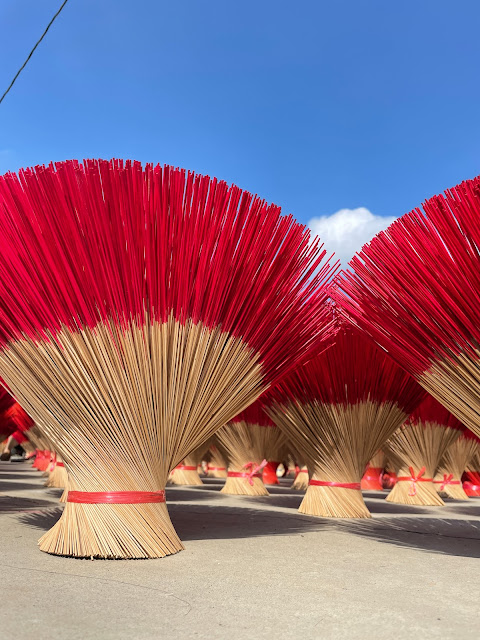
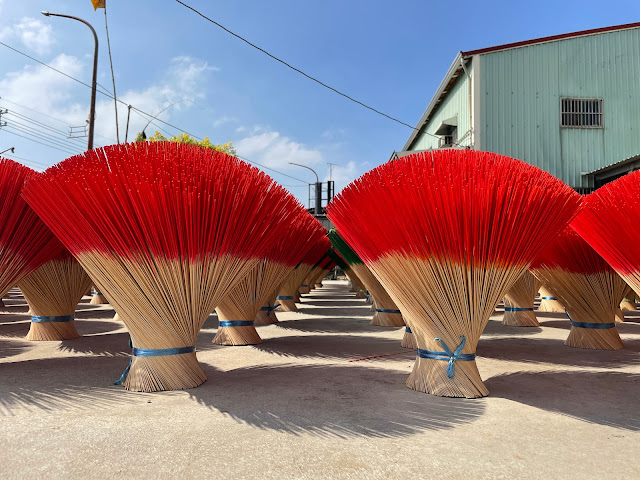
The visiting hours are from 9 AM to 4 PM. Parking along the road is convenient, and if the weather permits, you can see incense displayed in front of the factory. Although the place is not large, it offers picturesque surroundings. The bright red and green colors of the factory look particularly beautiful in the sunshine.


Address:

616嘉義縣新港鄉董厝37號大慶製香

December 15, 2017

From Bean to Plate: The History of Soy and Soy Products

Taiwan has a long history of cultivating and importing soybeans and soy products. Soybeans were first cultivated in Northeast Asia at least 2700 years ago. Since at least 1647, Taiwan has been importing soybeans. Currently, 97% of all consumed beans in Taiwan are imported from America.

Formosan beans, native to Taiwan, also grow wild in Indonesia and Hawaii. During the Japanese occupation, soybeans were primarily grown for oil, which was used in lamps and cooking. Soybeans are the world's number one source of vegetable oil and the sixth largest food crop globally. In Taiwan, the 50,000 hectares of soybeans grown are primarily used to fix nitrogen in the soil.

Soybeans have higher protein, calcium, vitamin C, vitamin B1, and vitamin B9 content compared to other major crops. Soy products are often considered healthier options. However, consuming excessive amounts of soy can lead to the formation of kidney stones due to the presence of oxalic acid. Unfermented soy products like tofu and soy milk contain phytic acid, which can inhibit the absorption of iron, zinc, calcium, and copper. The isoflavones in soy can also hinder iodine absorption, potentially leading to hypothyroidism. On the positive side, soy consumption has been associated with anti-cancer effects due to the presence of phytoestrogens.

Soybean seeds contain around 18-19% oil. The oil is extracted by cracking the beans, adjusting their moisture content, and extracting the oil using commercial hexane. The oil is then refined. The material left after extraction is known as soymeal, which contains about 50% protein and is used as animal feed. Soy can also be used to make flour, which contains 50% protein, 5% fiber, and is gluten-free. Baked goods made with soy flour have a rich color and dense texture. Soy can be used as a substitute for eggs, milk, margarine, yogurt, cheese, and meat. It can also be used to make nut butter. Roasted and ground soybeans can serve as a caffeine-free substitute for coffee.


There are various types of soy products, including soy milk (豆漿, dòujiāng), tofu (豆腐, dòufu), dried tofu (豆干, dougan), and bean-curd pudding (豆花, douhua). Tofu, also known as bean curd, has been consumed in China for over 2000 years. The Shenkeng District in New Taipei City is considered the capital of stinky tofu (臭豆腐, choudoufu).

Unpressed fresh tofu, also known as soft tofu, silken tofu, or douhua, is gelled soy milk without being cut or pressed to remove liquids. Impressed extra soft tofu is made by mixing soy milk with seawater or saline water, resulting in soft and loose curds. Silken tofu (滑豆腐, huádòufu) is gelled with gypsum and has high moisture content, making it suitable as a substitute for dairy products and eggs.

Bean-curd pudding (豆花, douhua) is similar to silken tofu and is usually eaten a few hours after being made. Some variations are made from black soybeans, resulting in a more gelatinous texture and grayish color. Firm tofu (老豆腐, lǎodòufu) is dried and pressed tofu with high moisture content, while extra firm tofu (豆干, dòugān) has the least amount of moisture among fresh tofu varieties.


There are also many processed tofu products. Pickled tofu (豆腐乳, dòufurǔ), also known as fermented tofu, is air-dried and slowly fermented with the help of airborne bacteria. Stinky tofu (臭豆腐, chòudòufu) is a soft tofu that undergoes fermentation in a vegetable and fish brine, resulting in its distinct pungent smell.


Frozen tofu (冰豆腐, bīngdòufu) is made from soft tofu, and the formation of ice crystals creates layered cavities. It has reduced water content, resulting in a harder and gummier texture with a yellowish color. Tofu skin is produced by boiling soy milk, forming a skin of protein and lipids on the surface. It can be collected and dried into yellowish sheets known as soy milk skin (腐皮, fǔpí) or dried into tofu skin (腐竹, fǔzhú), which can be shaped into various forms.

Soy pulp (豆腐渣, dòufuzhā) is the fiber, protein, and starch leftover after extracting soy milk from soaked beans. It can be used as an ingredient in vegetarian burgers or ice creams but is mostly used as animal feed. Soy milk (豆Soybeans are also an important ingredient in soy sauce (醬油). Soy sauce brewing began approximately 2500 years ago during the Han Dynasty in China and was introduced to Taiwan in 1649. WanChuang Soy Sauce (丸莊醬油) Factory, established in 1909, is one of the soy sauce factories where you can observe the traditional brewing method.