Showing posts with label Food Recipes (食譜 / 食物). Show all posts

January 18, 2024

[Recipe] Making Chinese Dim Sum Dish - Turnip Cake


Chinese Radish Turnip Cake, known as ''Lo Bo Gao'' or "Lo Bak Go" in Cantonese, is a popular Chinese dish often enjoyed during the Lunar New Year and other festive occasions. This savory cake features shredded radish (daikon) or turnip combined with a flavorful batter made from rice flour. The cake is steamed until firm and can be enjoyed in various ways, such as pan-frying for a crispy exterior. In Taiwan it's also served as part of breakfast.

Ingredients:
600g turnip
70g minced meat
30g Chinese mushrooms

Flour Mix:
1.5 teaspoons salt
30g sugar
240ml water
150g turnip cake powder (120g rice flour, 25g wheat starch)
1/2 teaspoon ground white pepper
2 teaspoons sesame oil

1. Soak the dried mushrooms until fully hydrated.
2. Peel and shred the turnip, setting it aside for later.
3. Once hydrated, drain the mushrooms (retain the soaking water) and chop them into smaller pieces.
4. In a bowl, combine all the ingredients in the flour mix to form a batter.
5. Add the batter to the turnip mixture and thoroughly combine.
6. Fry pork mince and mushrooms until fragrant. Set aside.
7. Fry the grated turnip until translucent.
8. Add the pork and mushrooms back in, stirring everything together.
9. Pour in the flour mix and cook for a few minutes to condense.
10. Brush some oil on the surface of the container you will use for steaming.
11. Spoon the turnip mix into the container, leveling the top.
12. Cover with aluminum foil.
13. Steam the turnip mixture over medium heat for about an hour.
14. Allow it to cool down and refrigerate for a few hours to let it firm up.
15. Cut the turnip cake into slices.
16. Pan-fry both sides until golden brown.


December 22, 2023

[Recipe] Ginger Tea with Brown Sugar: A Soothing and Warming Brew


Sip and savor the soothing warmth of the ginger tea with brown sugar. It's a comforting and invigorating beverage, perfect for cold days or as a pick-me-up.
Adjust the amount of brown sugar based on your taste preferences.
Feel free to experiment with additional ingredients such as lemon slices or a dash of honey for added flavor variations.
I was inspired by one of the popular Taiwanese chefs while watching a TV show and created my own version.

Ingredients:
250g Ginger
100-150g Brown Sugar
1L Hot Water

Instructions:
1. Sslice the ginger into thick pieces.
2. Use a kitchen tool or the back of a knife to smash the ginger slices. This helps release the flavors during brewing.
3. In a pan, lightly fry the ginger until fragrant. You can char it a bit.
4. Pour 1 liter of hot water into the pan with ginger. Bring the mixture to a boil.
5. Allow it to simmer for about 10 minutes. This simmering process ensures the ginger infuses its essence into the water.
6. After simmering, add brown sugar to the ginger tea. Start with 100g and adjust according to your sweetness preference. Stir well to dissolve the sugar.
7. Strain the ginger tea to remove the ginger pieces (it will get very spicy if you keep it in)


December 5, 2022

[Recipe] Making Mapo Tofu - Try it, if you love spicy food


I love spicy food, so I also make my own Mapo Tofu. I add more chilies if I make it for myself, but this version is milder in spice so that my husband can also enjoy it. Making it is very simple! Check out my video for full instructions.


Ingredients:
0.5 tbsp Sichuan pepper
300g tofu
4-5 cloves garlic, minced
Sesame oil for frying
120g ground pork meat
2 tbsp chili bean paste
Chilies, to taste
200ml water
1 tbsp brown sugar
1 tbsp rice wine
1 tbsp light soy sauce


Instructions:
1. Heat up a frying pan, add half a tablespoon of Sichuan peppercorns, and fry until fragrant.
2. Cut the tofu into cubes (avoid using silken tofu, opt for a firmer variety). Simmer in salted water for 2-3 minutes, then leave it in the water until ready to use.
3. Heat up some light sesame oil. Add 120g of minced pork meat and fry for a couple of minutes over medium heat.
4. Add chili bean paste and stir it in. Add minced garlic and continue frying. Add ground (roughly chopped) Sichuan peppercorns and some chilies to taste.
5. Pour in water or broth and let it boil. Add the tofu and season to taste with brown sugar, rice wine, and soy sauce.
6. Boil for a few minutes until the sauce reduces.
7. Make a slurry from 1 tbsp cornstarch and 1 tbsp water, add it to the pot, and bring it to a boil.
8. Serve with rice.


November 14, 2022

20+ popular desserts and candies from Poland

Poland offers a wide variety of sweets and desserts, and here is a list of popular items that you can find. Many of them are truly worth trying ~ 

1. Szarlotka ~ Apple Pie
This well-known Polish dessert is made with sweet crust pastry and spiced apple filling, usually topped with crumble. It is often served hot with a scoop of vanilla ice cream.

Picture source: everydayhealthyrecipes.com

2. Budyń ~ Polish Custard
Similar to English custard, budyń is a thick, creamy dessert made from potato starch, sugar, and warm milk. It comes in flavors like vanilla and chocolate and can be served hot or chilled with a drizzle of fruit syrup.

Picture source: haps.pl

3. Kisiel ~ Custard-like Fruit Dessert
Kisiel is a silky fruit dessert made from sweetened fruit puree thickened with potato or corn starch. It can be served hot or cold and has a sticky, jelly-like texture.

Picture source: polishfoodies.com

4. Sernik ~ Cheesecake
A popular dessert in Poland, sernik is made primarily from twaróg, a type of fresh curd cheese. It has its roots in Christian and Jewish traditions and is believed to have been brought to Poland by King Jan III Sobieski.

Picture source: wszystkiegoslodkiego.pl

5. Kremówka ~ Cream pie
Also known as Napoleonka, kremówka consists of layers of vanilla-flavored pastry cream sandwiched between thin, crisp French puff pastry. It is dusted with powdered sugar and gained fame when Pope John Paul II mentioned it from his hometown bakery.

Picture source: newdailycompass.com

6. Karpatka ~ Carpathian Mountain Cream Cake
Karpatka is a crispy and creamy Polish dessert made of two layers of choux pastry filled with vanilla milk pudding or custard cream. Its puffed appearance resembles rugged mountain tops, and the powdered sugar gives it a snow-like finish.

Picture source: kwestiasmaku.com

7.  Makowiec ~ Poppy Seed Cake
Makowiec is a yeast-based cake filled with finely ground poppy seeds, honey, butter, raisins, and walnuts. The dough and poppy seed filling wind around each other in a spiral, and the cake is usually glazed with icing. It is a traditional Christmas Eve dessert.

Picture source: swiatciasta.pl

8. Pączki ~ Polish Doughnuts
Pączki are deep-fried pastries made with leavened dough. They have a crispy golden exterior and a soft, airy interior. Traditionally, they are filled with rose or plum marmalade and topped with powdered sugar. They are commonly enjoyed on Fat Thursday.

Picture source: jocooks.com

9. Faworki ~ Angel Wings
Faworki are crispy, deep-fried pastries that resemble angel wings in both taste and appearance. The dough, made with egg yolk, flour, and cream, is rolled into thin, rectangular shapes and twisted into decorative bows before frying. They are served with powdered sugar and are prepared for Fat Thursday.

Picture source: everyday-delicious.com

10. Mazurek ~ Easter Shortcake  
Mazurek is a flat cake traditionally prepared for Easter. It consists of a short pastry base with a layer of butter sponge cake and a thin layer of marmalade. The cake is covered with a fudge caramel cream and decorated with nuts, dried fruits, and jelly. Mazurek is known for its sweetness and is inspired by Turkish desserts.

Picture source: malacukierenka.pl

11. Wuzetka ~ Chocolate Cake with Cream
Wuzetka is a Polish chocolate sponge cake filled with whipped cream and a thin layer of marmalade. It is topped with chocolate icing and a dollop of cream.

Picture source: przyslijprzepis.pl

12. Babka ~ Easter Bundt Cake
Babka is a traditional Easter cake baked in a bundt pan. It comes in various variations such as Sandy Babka, Marble Babka, and Lemon Babka. A piece of babka is placed in a basket and taken to church for blessing on Easter morning.

Picture source: thespruceeats.com

13. Piernik ~ Gingerbread
Piernik is a honey-spice cake enjoyed as a popular Christmas treat. It consists of flour, honey, and spices like cinnamon, cloves, nutmeg, ginger, and pepper. It's traditionally layered with plum jam and prepared well in advance to allow the flavors to develop. 
Toruń gingerbread, produced since the Middle Ages in Toruń, is a renowned variety.

Picture source: wszystkiegoslodkiego.pl/

Picture source: zwiedzajtorun.p

14. Chałka ~ Sweet Yeast Bread
Chałka is a sweet yeast bread shaped into a braided form. It originated from Jewish cuisine, where challah was adapted for Sabbath and holiday rituals. Polish challah bread is slightly sweeter and often topped with sweet streusel-like crumble.

Picture source: kosapopatelni.pl

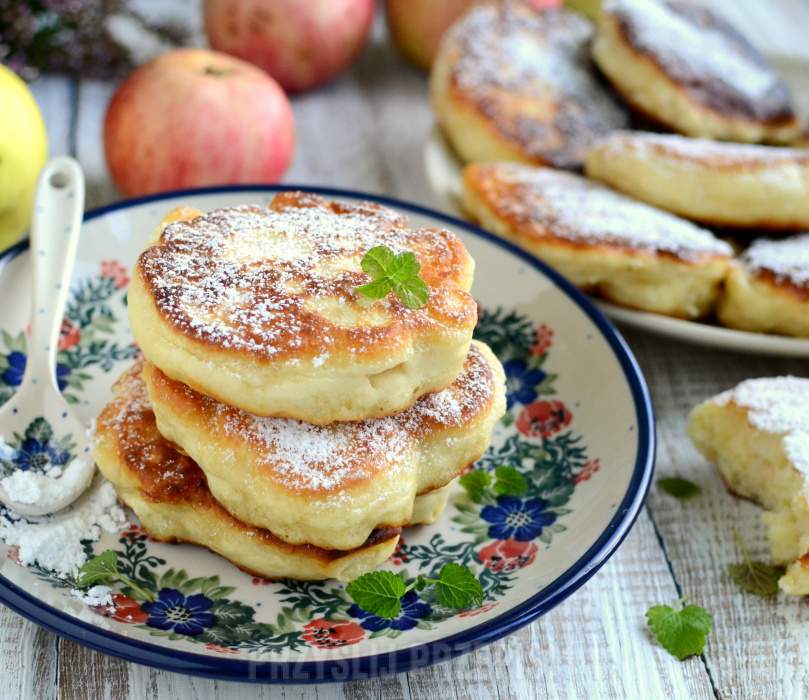
15. Racuchy ~ Yeast Pancakes
Racuchy are small, fluffy pancakes similar to doughnuts. They are often stuffed with apple, pan-fried until crispy, and served with powdered sugar.

Picture source: przyslijprzepis.pl

16. Kołacz ~ Polish Wheel Cake
Kołacz is a traditional Polish yeast cake similar in texture to babka but without a central hole. It is filled with sweet curd cheese and was traditionally served at weddings and special holidays, especially in southern Poland.

Picture source: przyslijprzepis.pl

17. Kogel-mogel 
Kogel-mogel is a fast, homemade dessert of Jewish origin. It is made from egg yolks, sugar, and can be flavored with cocoa or aroma extracts. It is loved by children, and there is an adult version flavored with vodka (ajerkoniak).

Picture source: 196flavors.com

18. Kutia ~ Christmas Wheat Pudding
Christmas Wheat Pudding: Kutia is a sweet grain pudding of Ukrainian and Russian origin enjoyed in eastern Poland. It consists of cooked wheat or barley, poppy seeds, honey, and extras like raisins, nuts, and sometimes cream. It is traditionally served as a dessert on Christmas Eve.

Picture source: natashaskitchen.com

19. Sękacz ~ Polish Tree Cake
Sękacz is a layered sponge cake baked on a rotary spit above a flame. The cake, originating from Lithuania, features striped layers of bright and scorched dough, resembling growth rings in a tree trunk.

Picture source: polki.pl

20. Krówki ~ Polish Fudge   
Krówki are semi-soft milk toffee candies often referred to as "little cows." They were invented at the beginning of the 20th century and wrapped in paper with a picture of a cow, giving them their name.

Picture source: aniagotuje.pl

21. Ptasie Mleczko 
Ptasie mleczko is a creamy marshmallow coated in chocolate. Invented by the Wedel company in the 1930s, these chocolates are exported worldwide and have a bird in their logo.

Picture source: smaker.pl

22. Kukułki
Kukułki are Polish chocolates often served after dinner parties. They have a crispy chocolate caramel with a soft cocoa filling and a dark brown color with white stripes resembling a cuckoo bird.

Picture source: slodkiwawel.pl


February 3, 2022

Lunar New Year Food and Its Symbolism


Parents-in-law being vegetarians, many of these foods don't appear on our table during Chinese New Year. However, if you join a traditional non-vegetarian family for dinner, these are the must-have dishes for Chinese New Year.

The most common Chinese New Year foods

Fish - an Increase in Prosperity

Fish is one of the most typical Chinese New Year foods. In Chinese, "fish" (魚 ; Yú) sounds like surplus. People believe that having a surplus at the end of the year will lead to making more in the next year. Steamed fish is one of the most famous Chinese New Year recipes. There are several types of fish that can be eaten during this time:
Crucian carp: The first character of 'crucian carp' (鯽魚 ; jìyú) sounds like the Chinese word 吉 (jí ; good luck), so eating crucian carp is considered to bring good luck for the next year.
Chinese mud carp: The first part of the Chinese for mud carp (鯽魚 ; lǐyú) is pronounced like the word for gifts (禮 ; lǐ), symbolizing a wish for good fortune.
Catfish: The Chinese for "catfish" (鯰魚 ; niányú) sounds like 年餘 (nián yú), meaning 'year surplus', representing a wish for surplus in the year.

Dumplings - Wealth

With a history of more than 1,800 years, dumplings (餃子 ; Jiǎozi) are a classic lucky food for Lunar New Year and a traditional dish eaten on New Year's Eve. Chinese dumplings can be made to look like Chinese silver ingots, which are boat-shaped, oval, and turned up at the two ends. Legend has it that the more dumplings you eat during the New Year celebrations, the more money you can make in the New Year. Popular fillings include minced pork, diced shrimp, fish, ground chicken, beef, and vegetables. Dumplings can be cooked by boiling, steaming, frying, or baking. On New Year's Eve, it's a tradition to eat dumplings with cabbage and radish, implying that one's skin will become fair and one's mood will become gentle.

Spring Rolls - Wealth

Spring rolls (春捲 ; Chūnjuǎn) are named because they are traditionally eaten during the Spring Festival. They are a dim sum dish consisting of cylindrical-shaped rolls filled with vegetables, meat, or something sweet. The fillings are wrapped in thin dough wrappers and then fried until they turn golden-yellow.

Sweet Rice Balls (Tangyuan) - Family Togetherness

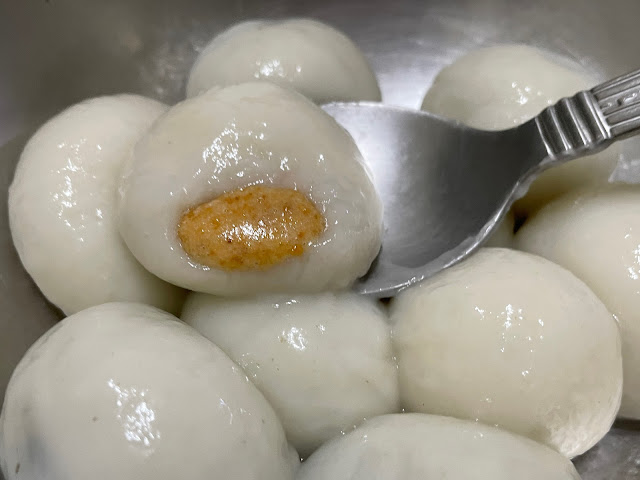
Sweet rice balls (湯圓 ; Tāngyuán) are the main food for the Lantern Festival. The pronunciation and round shape of tangyuan are associated with reunion and togetherness.

Longevity Noodles - Happiness and Longevity

Longevity noodles (長壽麵 ; Chángshòu Miàn) symbolize a wish for longevity. They are longer than normal noodles and remain uncut, either fried and served on a plate or boiled and served in a bowl with broth.

Good Fortune Fruit - Fullness and Wealth

Certain fruits are eaten during the Chinese New Year period, such as tangerines, oranges, and pomeloes. These fruits are selected because they are particularly round and "golden" in color, symbolizing fullness and wealth. Eating and displaying tangerines and oranges is believed to bring good luck and fortune due to their pronunciation and symbolism.

Prosperity cake (Fa Gao) - Fortune 

Prosperity cake (Fa Gao, 发粿) is a steamed, cupcake-like pastry commonly enjoyed during Chinese New Year. It's also known as Fa ban (发粄) among the Hakka community. The name "Fa Gao" translates to "prosperity cake" or "fortune cake" in English. When cooked, the cake has a characteristic split top.

The name "Fa Gao" carries symbolic meanings related to prosperity and expansion. The Chinese character "fa" represents both prosperity and expansion, while "gao" means cake. This conveys the idea of the cake expanding and bringing forth prosperity and fortune.
In Hakka tradition, the split top of the Fa Gao is called "xiao," which means smiling. It is seen as a sign of incoming fortune. The bigger the split top, the better it is believed to be for one's fortune.

The cake is typically made from rice flour, leavening agents (traditionally yeast, but chemical leavening can also be used), and sugar. It is steamed on high heat until the top splits into three or four segments.
Fa Gao cakes are often dyed in bright colors such as white and pink, but they can also be turned brown by adding palm sugar for a different flavor and appearance.

New Year Cake (Nian Gao) - Higher Income or Position

Nian gao (年糕), also known as Chinese New Year's cake, is a traditional food made from glutinous rice flour. It is considered good luck to eat Nian Gao during the Chinese New Year as the name is a homonym for "higher year" or "grow every year" (年高), symbolizing a more prosperous year ahead. The traditional Nian Gao is round in shape and often decorated with auspicious characters like the character for prosperity (福) on top.
According to folklore, Nian Gao was believed to be an offering to the Kitchen God to ensure he couldn't speak ill of the human family in front of the Jade Emperor. The sticky nature of the cake was thought to stick the Kitchen God's mouth together.

Regional variations of Nian Gao

Guangdong: Sweet Nian Gao in Guangdong is dipped in egg and pan-fried. It is typically sweetened with brown sugar, resulting in a dark yellow color. The batter is poured into a cake pan and steamed until it solidifies. Once heated, the Nian Gao becomes stretchy and extremely sticky, and it is served in thick slices.
Fujian/Hokkien: In the southern region of Fujian, Nian Gao is commonly used for New Year rituals and gifts. It is made with glutinous rice and taro, usually sliced and cooked before consumption. It can also be wrapped in egg or cornstarch and fried.
Jiangnan/Shanghainese: Shanghai-style Nian Gao can be savory or sweet. It is made by mixing rice with glutinous rice powder and can be steamed, fried, sliced, or used in soups. The Shanghai variety is usually packaged as a thick, soft rod to be sliced and stir-fried or added to soup. The sweet version uses white sugar, while the almost tasteless version is enjoyed for its chewy texture.
Northern: Northern Nian Gao can be steamed or fried and is mainly sweet in taste. Different regions in the north have their own variations. For example, Beijing versions may include jujube and either glutinous rice or yellow rice, while Shanxi uses yellow rice and red bean paste or jujube paste for filling.

Nian Gao-like cakes can also be found in other countries such as Burma, Cambodia, Japan, Vietnam, Korea, and Indonesia, each with their own unique preparations and flavors.


September 25, 2021

Delicious Delicacies: Exploring the World of Mooncakes


I had many different mooncakes this Mid-Autumn Festival, although I finished them before I got the idea of writing a blog post about them. Usually, mooncakes have egg yolk inside, which isn't really my type of food. Luckily, my son likes the salty yolk, so I can eat the rest with red bean or mung bean paste.
This year was my first time trying Hong Kong style mooncakes, and I'm in love with them! Not only do they taste good on the outside, but they also have many non-traditional fillings. We had some with banana, strawberry, and pear flavors!

What is a moon cake?

A mooncake (月餅) is a bakery product traditionally eaten during the Mid-Autumn Festival (中秋節) in parts of Asian countries. The festival is about lunar appreciation and moon watching, and mooncakes are regarded as a delicacy. Mooncakes are offered between friends or family while celebrating the festival.

Typical mooncakes are round pastries with a rich and thick filling, usually made from red bean paste or lotus seed paste, surrounded by a thin 2–3 mm crust. They may also contain yolks from salted duck eggs, symbolizing the full moon. Traditional mooncakes have imprints on top consisting of the Chinese characters for "longevity" or "harmony," as well as the name of the bakery and the filling inside. Additional decorations may include imprints of the Moon, Lady Chang'e on the Moon, flowers, vines, or a rabbit (symbol of the Moon).

Traditional mooncake fillings

Lotus seed paste (蓮蓉)

Considered by some to be the original and most luxurious mooncake filling. White lotus paste is even more premium. Sometimes, white kidney bean paste is used as a filler due to the high price of lotus paste.

Sweet bean paste (豆沙)

There are various pastes commonly used as fillings in Chinese desserts. While red bean paste made from azuki beans is the most common worldwide, regional preferences exist for bean paste made from mung beans or black beans.

Jujube paste (棗泥)

This sweet paste is made from ripe jujube (date) fruits. It has a dark red color, a slightly fruity/smoky flavor, and a slightly sour taste.

Five kernels (五仁) or mixed nuts

A filling made of coarsely chopped nuts and seeds, held together with maltose syrup. Different regions use various nuts and seeds such as walnuts, pumpkin seeds, watermelon seeds, peanuts, sesame seeds, or almonds. Candied winter melon or rock sugar pieces are often added for additional flavoring.

Mooncake crusts

Mooncake crusts vary widely depending on the region where they are produced. Most regions have many types of fillings but only one type of crust. While vegetarian mooncakes may use vegetable oil, many mooncakes use lard. 

The most popular types of crusts are:

Chewy

This crust, commonly used in Cantonese-style (Hong Kong style) mooncakes, has a reddish-brown tone and glossy sheen. It is made using a combination of thick sugar syrup, lye water, flour, and oil, resulting in a rich taste and a chewy yet tender texture. Maltose syrup can be added to increase chewiness.

Flaky

Flaky crusts are indicative of Suzhou- and Taiwan-style mooncakes. The dough is made by rolling alternating layers of oily dough and flour that has been stir-fried in oil, resulting in a texture similar to puff pastry.

Tender

Mooncakes from certain provinces of China, such as Shanghai-style mooncakes, have a tender crust instead of a flaky or chewy one. The texture of this crust is similar to the shortcrust pastry used in Western pie crusts or tart shells. It is made with a mixture of sugar, oil, flour, and water. This type of crust is also commonly used in other types of Chinese pastries, such as egg tarts.

Crumbly

Yunnan-style mooncakes have a dense, crumbly crust made using a hot water crust pastry that combines different kinds of flour with oil, salt, and hot water. This type of crust is uncommon in other regions.

Less traditional types of mooncake crusts can be made with:

Glutinous rice

This crust has a texture similar to mochi and is known colloquially as "snowskin mooncakes".

Jelly

A crust made from gelling mixtures such as agar, gelatin, or konjac, flavored with a wide variety of fruit flavors.


Left: Hong Kong style mooncake with banana filling
Right: Taiwanese style mooncake with red bean paste and salted egg yolk

Thousand layer mooncake with taro and egg yolk
Photo by: whisknfold.com

No bake mooncakes with outer layer made of jelly
Photo by: eatwhattonight.com

Snow skin mooncake

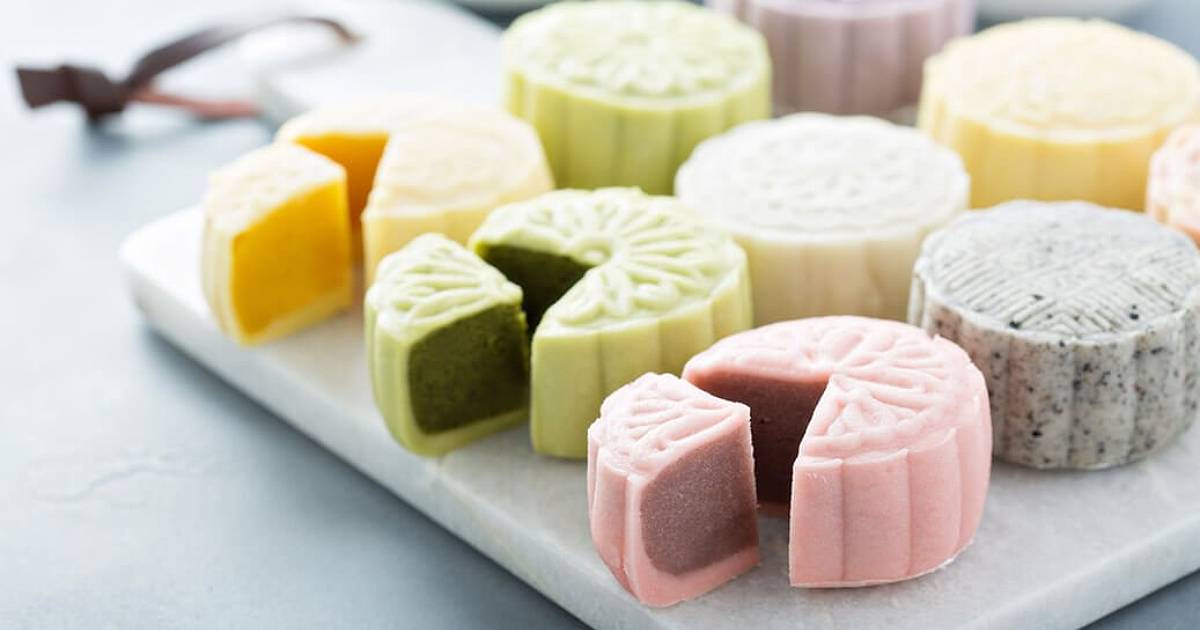
Snow skin mooncakes are non-baked mooncakes originating from Hong Kong. They can also be found in Macau, Mainland China, Taiwan, Vietnam, Singapore, Malaysia, and Indonesia. Unlike traditional mooncakes that are baked in ovens, snow skin mooncakes are not baked. Additionally, while traditional mooncakes are typically served at room temperature, snow skin mooncakes are typically eaten cold.

The snow skin mooncake emerged in the 1960s when a bakery in Hong Kong developed it as an alternative to traditional mooncakes, which had high sugar and oil content due to the use of salted duck egg yolks and lotus seed paste. To address customer concerns about the oily nature of traditional mooncakes, the bakery used fruit for filling and reduced the amount of oil, creating a mooncake with lower fat content. In the 1970s, snow skin mooncakes gained popularity and were also referred to as "crystal mooncakes" (水晶月饼). The name "Bing Pi Yue Bing" (冰皮月饼) appeared in advertisements in the early 1980s.

The crust of snow skin mooncakes is made from glutinous rice, which is frozen. This crust is similar to the ones used in mochi ice cream or yukimi daifuku, as they all have glutinous rice crusts and need to be kept frozen. Snow skin mooncakes are typically white and served cold, hence the name "snow skin". However, mooncakes can have other colors due to added flavors in their crusts. While traditional mooncakes are commonly filled with salted duck egg yolks and lotus seed paste or red bean paste, snow skin mooncakes can be filled with a variety of fillings such as mung bean paste, fruit, green tea, jam, strawberry, chocolate, coffee, and cheese. Other flavored fillings include durian, sesame, mango pomelo sago, and purple yam.

Snow skin mooncakes
Photo by: eastcoastpodiatry.sg

History of Mid-Autumn Festival

The Mid-Autumn Festival, also known as the Moon Festival, is a traditional festival celebrated in mainland China, Taiwan, Hong Kong, Macau, Vietnam, as well as by overseas Chinese and Vietnamese communities. Similar holidays are observed in Japan (Tsukimi), Korea (Chuseok), and throughout Southeast Asia. It is one of the most significant holidays in Chinese culture, with a history dating back over 3,000 years. The festival is held on the 15th day of the 8th month of the Chinese lunisolar calendar, which usually corresponds to mid-September to early October on the Gregorian calendar. On this day, it is believed that the moon is at its brightest and fullest, coinciding with the harvest season in the middle of autumn. In Taiwan, outdoor barbecues have become a popular tradition for friends and family to gather and enjoy each other's company.

June 16, 2021

Sweet dumplings?? Polish people are strange! (+ Recipes)


I've much more time currently, so I've started cooking different Asian and Polish dishes. Lately, I've been making dumplings (I don't remember ever making them from scratch before). Taiwan has plenty of options for dumplings, but they are usually savory, such as baozi (steamed buns), tangyuan (glutinous rice dumplings), or mochi (Japanese rice cakes). These are often sweet and filled with sesame, peanut paste, custard, taro, or red beans. While I enjoy them, there are still some flavors I miss from my childhood. In Poland, we have savory dumplings, usually filled with meat or cabbage and mushrooms. In the past, I wasn't a fan of savory dumplings and barely ate meat, so my all-time favorite was filled with blueberries, strawberries, and cream cheese. The only exception was Ruthenian Dumplings, which are filled with a potato and cheese mixture spiced with pepper.

Another difference in eating dumplings is that in Taiwan, they are often dipped in soy sauce, sometimes with added ginger. In Poland, we would cover them with sauce as well. For savory dumplings, we often fry onions with fatty meat or bacon. For sweet dumplings, we would use sour cream and sugar.
When it comes to dumplings, the dough is usually made of flour and water. In Poland, we have different types of food classified as dumplings in English, such as potato dumplings (kopytka), Silesian dumplings (kluski śląskie), lazy dumplings (pierogi leniwe), potato plum dumplings (knedle ze śliwkami), or "Little Ears" dumplings (uszka).

Potato dumplings (kopytka) are made by mixing cooked potatoes with flour and egg. The dough is then rolled into thin rolls, flattened, and cut into little hoof shapes (kopytka). After boiling, they can be served sweet or savory.

Silesian dumplings (kluski śląskie) are also made from boiled potatoes, but potato flour is used instead of wheat flour. The dough is rolled into small balls, flattened, and pressed in the middle to create a little hole.

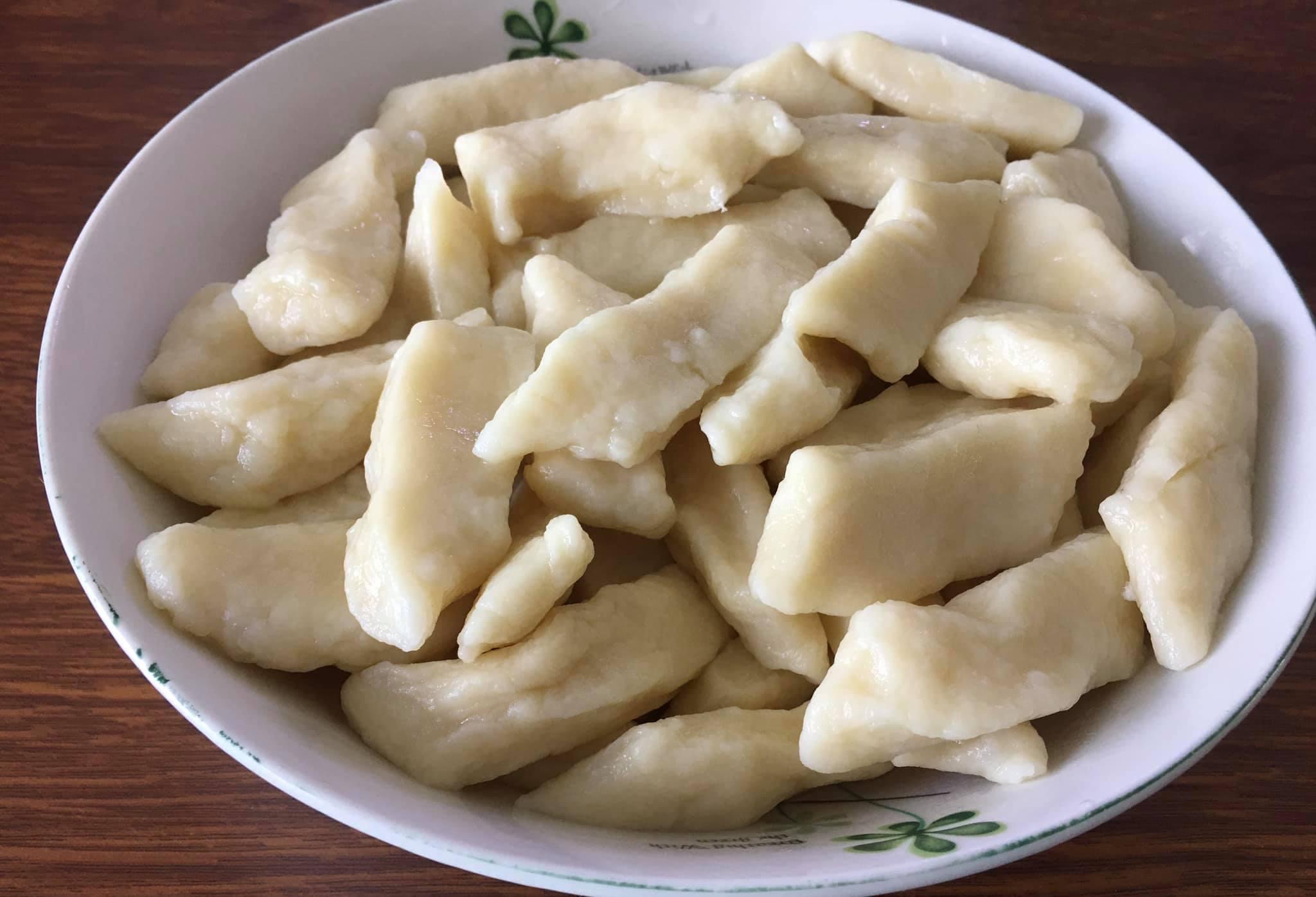
Lazy dumplings (pierogi leniwe) can be made with or without potatoes, using cottage cheese (twaróg), eggs, and flour. They are rolled and cut in a similar way to kopytka.

Potato plum dumplings (knedle ze śliwkami) are also made with a potato-based dough. They are round in shape with a plum inside.

"Little Ears" dumplings (uszka) are made similarly to regular dumplings, but they are folded differently. They are usually stuffed with sauerkraut and mushrooms and served in beetroot soup (barszcz) for Christmas Eve.

Dumplings

Potato dumplings / Little hoofs (kopytka)

Silesian dumplings (kluski śląskie)

Cheese dumplings recipe:

Dough:
- 250 g flour
- 150 g hot water

Filling:
- 250 g cream cheese
- 30 g sugar powder

Directions: 
1. Pour hot water into the flour and mix it with a spoon until well combined.
2. Knead the dough until it becomes very elastic and smooth.
3. Roll out the dough thinly on a floured surface.
4. Use a cup or any round object to cut out round shapes from the dough.
5. In a separate bowl, mix the cheese with powdered sugar until well blended.
6. Place a spoonful of the cheese filling in the center of each round dough piece.
7. Fold the dough in half, sealing the edges to enclose the filling.
8. Bring a pot of water to a boil and add a pinch of salt.
9. Carefully place the dumplings into the boiling water and cook them for about 7-10 minutes, or until they float to the surface.
10. Once the dumplings are cooked, remove them from the water using a slotted spoon and serve them hot.

Traditionally, dumplings in Poland use cottage cheese (twaróg), which is not readily available in Taiwan. I used American/Australian-style cream cheese (the type used for baking cheesecakes) and it worked really well.


Silesian dumplings recipe:

Dough:
- 300 g potatoes (after peeling)
- 60 g potato starch
- egg (optional)

Directions:
1. Start by peeling the potatoes, then boil them until they are cooked through.
2. Once the potatoes are cooked, drain them and mash them until smooth.
3. Add the potato starch to the mashed potatoes. If you don't have a scale, you can estimate the amount.
4. In a bowl, flatten the mashed potatoes and divide them into four equal parts.
5. Take one part out and fill the space with potato starch. Then, combine the remaining potatoes and knead the mixture until it forms a dough.
6. Roll out the dough into a thin sheet and cut it into evenly-sized pieces.
7. Shape each piece into a round dumpling and flatten it slightly. Make a small indentation in the middle of each dumpling using your thumb.
8. Bring a pot of water to a boil and add a pinch of salt.
9. Carefully place the dumplings into the boiling water and cook them for approximately 3-5 minutes, or until they float to the surface.
10. Once the dumplings are cooked, remove them from the water using a slotted spoon and serve them hot.

Lazy dumplings with cheese recipe:

Dough:
- 250 g potatoes (after peeling)
- 125 g cheese
- 150 g flour
- 1 egg

Directions:
1. Peel the potatoes and cut them into small pieces. Boil the potatoes until they are soft.
2. Drain the potatoes and mash them well with cheese until smooth.
3. Add an egg and flour to the mashed potatoes and cheese. Knead the mixture until it forms a dough.
4. Take small portions of the dough and roll them into thin logs.
5. Flatten the logs and cut them into diamond-shaped dumplings.
6. Bring a pot of water to a boil and add a pinch of salt.
7. Carefully drop the dumplings into the boiling water and cook them for 3-4 minutes, or until they float to the surface.
8. Remove the cooked dumplings from the water using a slotted spoon and transfer them to a serving dish.
9. Serve the dumplings hot as a delicious and comforting dish.