June 21, 2025

Yunlin Travel: Discovering Tranquility and Tradition at Chih-Fa Mazu Temple


Travel Date: 2025/05/31

Nestled quietly amid the green fields of Huwei Township in Yunlin County, Chih-Fa Mazu Temple (持法媽祖宮) is a peaceful haven unlike any other. While it may not boast the grandeur or fame of Beigang’s Chaotian Temple, it more than makes up for it with authenticity, elegance, and mindful simplicity. There are no glittering golden roofs or lavish decorations here - just a heartfelt tribute to Mazu, the beloved sea goddess, set apart from the crowds and surrounded by serene farmland.

Open year-round, Chih-Fa Mazu Temple offers a calming spiritual environment, but it holds a special surprise during the Lunar New Year. From the 1st to the 4th day of the lunar calendar, two extraordinary areas open their gates to the public:
The Dressing Pavilion Garden (梳妝樓園區), a beautifully imagined space that reflects Mazu’s youth, with items like a traditional dressing table thoughtfully arranged to express her early, human life.
The Stone Sculpture Mazu Garden (石雕媽祖園區), which illustrates Mazu’s ascension to divinity. Visitors enter through a path lined with stone carvings of historical figures and blooming osmanthus trees, eventually encountering a hidden giant stone Mazu and a striking 10-meter-tall statue of Wu-De, the God of Wealth.


Set across more than two hectares, the temple is designed in the elegant style of a Jiangnan classical garden - complete with flowing water, arched bridges, pavilions, and scenic walkways. The architecture blends natural serenity with human artistry, featuring Koji ceramics (交趾陶) and vibrant murals that celebrate the depth of Taiwan’s Mazu culture. The entire space invites reflection and reverence without the distraction of loud rituals or ornate excess.

What makes Chih-Fa Mazu Temple truly special is its dedication to tradition, craftsmanship, and sustainability. Built by a group of devoted Mazu followers—guided, they believe, by divine instruction - the temple adheres to classical Taiwanese architectural principles. Highlights include:
- Ceramic details by Master Kuo Chih-Lang, inspired by traditional water wheels
- Vivid guardian paintings by Master Liu Chia-Cheng
- Intricate wood and stone carvings, crafted with elegance and cultural depth

The temple also stands out for its environmentally conscious practices. Unlike many temples, Chih-Fa does not permit joss paper burning and encourages minimal incense use. Their message is clear:
”One stick of incense per censer is enough. Sincerity is what truly matters.”
As a result, Chih-Fa Mazu Temple is considered one of the most eco-friendly religious sites in Taiwan, blending ancient tradition with modern environmental awareness.

During the holiday period, visitors can participate in a variety of symbolic and joyful rituals that offer both spiritual meaning and festive fun:
- Blessing Rice Balls (吃紅圓): Enjoy sweet red glutinous rice balls, symbolizing happiness and completeness.
- Peace Bridge Walk (過平安橋): Cross a ceremonial bridge as 108 celestial generals and 28 constellations are invoked to bless the year ahead.
- Treasure Pot Draw (吉祥聚寶盆): Reach into a pot for a lucky charm or symbolic item representing wealth and good fortune.
- Fortune Candy (喜童發喜糖): Children distribute candy to share joy and blessings.
- Tangerine Divination: Toss divination blocks to receive a lucky tangerine from Mazu, symbolizing great fortune.
- God of Wealth Red Envelopes: Ask for a red envelope from the God of Wealth - if the blocks fall right, you may just receive a symbolic token of prosperity.

Whether you're drawn by faith, art, or a desire for peace, Chih-Fa Mazu Temple offers a uniquely human, artistic, and spiritual journey. Especially during the Lunar New Year, it becomes a living tapestry of Taiwan’s rich cultural and religious traditions - a place to pause, reflect, and embrace blessings for the year to come.


June 14, 2025

A Hidden Gem in Zhunan, Miaoli: The Chen Family Residence and the Spirit of Joss Paper


Travel Date: 2025/06/07

Just 3km from our home, we recently visited a place filled with history, craftsmanship, and quiet beauty - the Chen Family Historic Residence (中港陳家古厝) in Zhunan Township, Miaoli County. We visited on a Saturday and, surprisingly, there were no other visitors. This isn’t a popular attraction, which makes it all the more special. If you enjoy history, architecture, and cultural heritage, it’s absolutely worth your time. The house is open to visitors, and guided tours are available for those interested in learning more.

You can visit the Joss Paper Factory (陳協和金紙行) and see firsthand how the paper is made - from attaching the silver foil, to painting it gold using a special edible dye imported from abroad (and very expensive), to the drying process, which takes one to three days depending on the stage of production.
The paper is placed outside to dry, so you can see bundles along the road and in front of the house. But once you enter the factory, there are tins and tons of paper ready to be decorated, cut, or assembled. There are four workers in total - or at least that’s what we saw, all of them elderly.
The third-generation owner is still working despite his age. He seemed quite happy to introduce the process, though he spoke in Taiwanese, and I couldn’t understand a single word... Thankfully, I brought my translator (aka my husband) with me!

Chen Family Historic Residence: A House That Breathes the Past

Located just 50 meters south of the famous Ciyu Temple, the Chen Family Residence is a beautiful Minnan-style Sanheyuan (three-sided courtyard home) built in 1937. Though surrounded by modern buildings today, the red brick courtyard gives off a quiet, nostalgic charm that instantly transports you back in time.
The home’s architecture blends traditional Minnan features - like red-tiled roofs and wooden beams with unique Japanese-era elements such as terrazzo walls, floral tile decorations, and circular “ox-eye” windows. The result is a rare and elegant structure that reflects Taiwan’s layered cultural past.

The house belongs to Mr. Chen Baocheng, who grew up in the neighborhood. After returning years ago and seeing the house in ruins, he made it his mission to restore it. Starting in 2013, he worked with local craftsmen and experts to revive the house. The restoration took two years, using traditional materials and techniques to bring the 1937 design back to life.
Today, the home isn’t a museum but a living cultural space, used for local workshops, exhibitions, weekend events, and school field trips. Visitors can see the Chen family history woven into fabric curtains, and read about their former joss paper business - a perfect bridge to the next part of our story.


Zhunan Handmade Joss Paper: A Vanishing Craft Still Alive in Zhonggang

Not far from the Chen family home is Chen Xiehe Joss Paper Store, one of Taiwan’s few remaining handmade joss paper shops. Run by Chen Kun-Hui, it carries a legacy dating back over 100 years - a time when joss paper played a vital role in Taiwanese spiritual life.
We learned about this rich tradition from an article written by Chen Mutian, highlighting how deeply intertwined joss paper is with the local identity of Zhunan, especially the Zhonggang (中港) area.

During the Japanese occupation, the Kominka Movement sought to suppress traditional Taiwanese customs, including joss paper burning. Making joss paper was banned, and anyone caught could face harsh punishment.
Chen Kun-Hui, holding a 12-pound mallet once used to secretly make joss paper, recounts how his family used recycled student notebooks and scrap paper to continue production in secret. Even tools had to be handmade or salvaged. A piece of rubber from a car tire was used to silence the sound of hammering - a quiet resistance through culture.
After natural disasters and wartime bombings, fear drove people to cling more tightly to spiritual practices, and joss paper became more essential than ever - even more valuable than cash at one point.

The Fanshe neighborhood, where the Chen Family Residence is located, was originally a Taokas indigenous village called Makaliwu. Later, Han settlers brought with them the art of joss paper. By the 1980s, over 380 joss paper factories thrived here, exporting spiritual currency across Asia.
Local stories abound, including one about a gambler who won over NT\$6 million and spent NT\$300,000 on joss paper and Taoist ceremonies to thank the gods. Business boomed so much that Chen’s father had to drive south at 4 a.m. to restock paper and resold it for double the price.

Traditional joss paper is made from bamboo pulp, which is both eco-friendly and spiritually favored. Each sheet is carefully stamped with red seals indicating its purpose:
- Gold paper (金紙) for deities.
- Silver paper (銀紙) for spirits.
- Joss money (紙錢) for general use.

Handmade sheets use tapioca starch glue, dried in the sun, and cut with bamboo knives. It’s a labor-intensive process - one bundle of 100 sheets can take dozens of steps, but the result is beautiful, meaningful, and biodegradable.
Though machine-made paper is cheaper (NT$10–15), Chen’s handcrafted stacks sell for about NT$40, barely enough to keep the tradition alive. “It’s better to burn good paper than a lot of bad paper,” Chen says. “Offerings should be sincere.”

Today, Chen’s philosophy echoes that of modern temples like Xingtian Temple in Taipei, which no longer uses incense burners or outdoor offering tables. The focus is on less burning, but higher quality offerings, a balance between cultural heritage and environmental responsibility.


June 6, 2025

White Lilies and Ocean Wind: A Ride Along Miaoli’s Coast


Travel Date: 2025/06/01

There’s something magical about setting out on a scooter with no strict schedule - just the sun on your back, the scent of summer, and a vague destination in mind. One hot morning in early June, we left Toufen with a bottle of water, a camera, and a simple goal: to visit Houlong’s Cape of Good Hope (後龍好望角風景區) and hopefully catch the white lilies I’d heard were blooming on the hills.

We had been here long ago to enjoy the view, and it feels different nowadays. I remember hills covered in grass, but now a large part of the area has been turned into a designated car and scooter parking lot. A public toilet has also appeared here. No surprise this place is full of people these days.

The ride itself is part of the adventure. As you head toward the coast, the urban buzz of Toufen slowly fades into open fields, gentle hills, and the occasional roadside fruit or food stand.
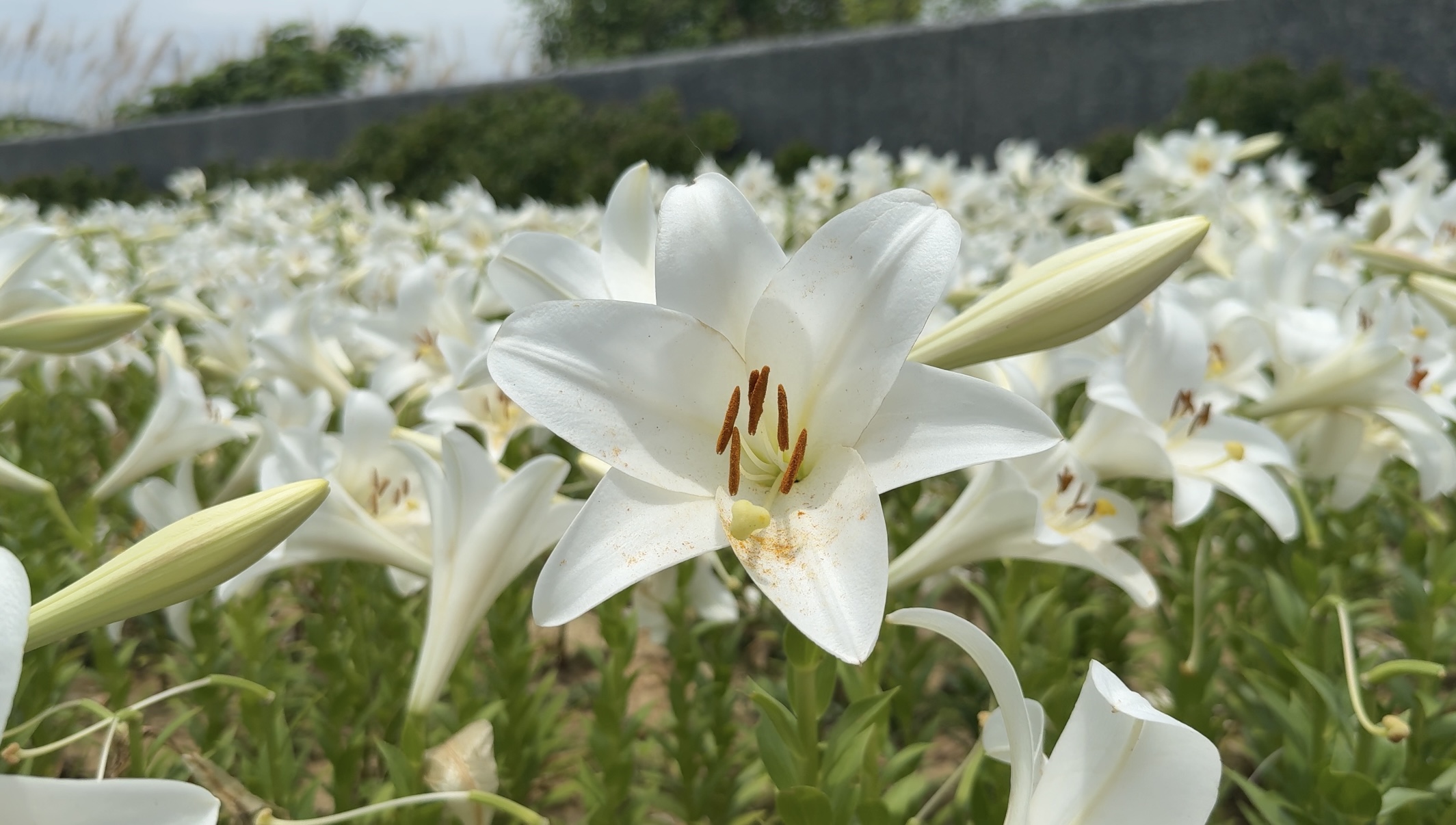
And then, as we climbed the slope, there they were: elegant white lilies, blooming in clusters across the green hillsides. These lilies bloom from May to June, with the blue sea behind them and wind turbines slowly turning in the distance.

Keep in mind that driving a car here might not be as easy as you think—the road is quite narrow, and in several spots, we saw cars stuck because no one wanted to give way or reverse. At one point, we waited for about five minutes and saw over 20 cars coming down from Houlong, but it wasn’t until one finally backed up to make space for those leaving that we were able to pass and approach the hill. Even on a scooter, we were stuck there for a while.


The Houlong Cape of Good Hope Scenic Area is a special place. It’s not a massive tourist attraction, but that’s part of its charm. From the 360-degree viewing deck, you get an open view of the estuaries where the Houlong and West Lake Rivers meet the sea. There’s a peaceful rhythm in watching the wind turbines spin slowly above the water, and the sea seems to stretch endlessly westward.
Walking along the trail - once used to carry firewood, now fixed up with white fences and photo spots, we passed a few curious kids, a couple posing for selfies, and several food stalls.

If you're in the area, you can also wander into the old railway tunnels nearby - cool, dim passages now restored with lighting. It’s easy to imagine trains passing through them in another era. Some old bunkers and fortifications along the trail hint at the area’s past military use, adding depth to the otherwise carefree landscape.

Afterward, we took a short ride from the Cape of Good Hope to a nearby beach. It wasn’t a big tourist spot, just a quiet strip of sand and stones with a few locals around. There, another explosion of color waited: blanket flowers swaying in the breeze, their warm reds and oranges blazing like little suns among the grass. These cheerful blooms always feel like they were made for the heat. 

But I’ll be honest—the heat was no joke. Despite using sunscreen, my arms and shoulders ended up bright red. Lesson learned: never underestimate the Taiwanese summer sun, even if you’re just out for a short ride. No wonder nearly everyone else was wearing long sleeves and carrying umbrellas.

Still, sunburn aside, this trip was everything we needed - simple, beautiful, and refreshing. If you’re in Miaoli in late spring or early summer and looking for a place where nature, flowers, and the sea all meet in harmony, Houlong’s Cape of Good Hope is more than worth the ride. The sting of the sun was a small price to pay for the day’s rewards - flowers in bloom, quiet moments by the sea, and the simple joy of exploring Miaoli's coastal beauty.


May 26, 2025

New House, New Problems & A Sweet Collaboration


In my previous post, I mentioned a collaboration with a local art studio - and last weekend, I was invited again. This time, instead of posing for a pastel artwork (which, to be honest, wasn’t really my thing), I got to do something much more enjoyable: baking!

The studio hosted a small event that included a short talk about the history of art. Unfortunately, it was all in Chinese, so I didn’t understand much. My husband listened for a while and said it was great - very clear and well explained. While that was happening, I was slicing the cakes. I made several cakes and cookies, which were then shared with the attendees, along with some drinks. It was a lovely way to introduce more people to my desserts, especially since advertising has been such a struggle.

Seriously, all the local Facebook groups are so strang - they don’t allow any self-promotion or business posts, yet they’re constantly flooded with apartment listings. Half of them are just reposts of the same buildings over and over again.

Speaking of apartments… it’s been just over a month since we moved into our new place, and problems keep piling up. And it’s not just us - everyone seems to be having issues. We joined the community chat group, and honestly, there are complaints almost every day.
There were several incidents of leaking pipes recently - and not just fresh water leaks. One day, we went to the scooter parking area and were hit with a truly awful smell. Turned out, the leaking pipe was connected to the toilets… You can imagine how lovely that was.

As for us, we’ve had a few strange things happen too. Just this past Sunday, the water in our kitchen sink stopped draining. At first it was slow, then it completely stopped. We tried flushing it a few times but nothing worked. The plumber came the next day, checked both the sink pipe and the one under the floor - no clog. Nothing. And yet, suddenly the water started draining faster than we’d ever seen. It was like magic. Luckily, we had a video of the sink being blocked or else no one would’ve believed us.
The plumber said it could have been caused by recent rain messing with the underground pipes, but honestly - it was just weird.

Others in the building have it even worse. One resident said their window was stolen by the builders. Yes, stolen! And many apartments already have cracked walls - huge cracks, despite this being a brand new building. Most units are still empty, too. On our floor, we’ve only met one neighbor, and they haven’t even moved in yet - they’re still doing renovations. The other five units are completely quiet. The floor above us is totally empty as well.

At first, the landlord thought that we had clogged the sink and claimed everything was working well before. But they don’t live here and don’t actually do the dishes - they just flushed some water through and said it was fine.
After asking in the group chat, a few other people said they also have drainage issues and even leaks in the last few days. They all mentioned that the builders don’t care at all, so everyone has been fixing things on their own.
It was the same with the lack of electricity in the kitchen - we had to ask the landlord to find someone to fix it because the builders simply refuse to take responsibility for anything, even though they definitely should.

How do we know? Well, one night we heard loud banging noises from late afternoon well past 10 PM. My husband posted a message in the chat group, but no one replied. So he went upstairs to see where the noise was coming from - and it turned out to be two floors above us. That’s when we realized just how bad the noise insulation is. Not only can we hear people from above, but we can also hear our neighbors across in the next building! It’s about five meters away, yet we can hear when they shower, talk, even when they do laundry. Which makes us wonder… they probably hear us too. A bit unsettling, to be honest.

So yes—new house, new problems. But at least I have my cakes, and I'm grateful for opportunities like the art event to share them with more people. It’s small steps, but they feel meaningful.

Anyway, one more thing to add - soon we might be losing another friend. People always seem to be moving out of Taiwan. Originally, this couple we know planned for the wife to go to the UK for a year while her husband moved to Kaohsiung. But when we met them recently, they surprised us with completely different news: his company is transferring him to the U.S., so now they’re both planning to move there. No idea when exactly, as visas and paperwork take time, but yes - another friends are leaving.

Over the past eight years, nearly all of the people we’ve gotten close to here have already left. There’s only one couple we know who’s still in Taiwan (but 250km away...). The rest? Gone! 
Honestly, it's not surprising. Taiwan may look appealing from the outside, but living here long-term isn’t always easy - especially when you think about housing prices and the relatively low salaries (unless you’re an engineer… and even then, not all engineers earn a fortune). The gap between the rich and poor is definitely growing, and that reality is hard to ignore.
And the second most common thing people complain about is, of course, the traffic. Just in the past few days, there have been cases of elderly drivers causing accidents - some resulting in injuries or even deaths. But honestly, it’s not really about age, because you see bad drivers of all ages: running red lights, speeding, riding scooters with kids who have no helmets, and so on.