Showing posts with label Beigang (北港). Show all posts

August 30, 2023

Beigang Water Cultural Park


Travel Date: 2023/07/15

Beigang Water Cultural Park (水道頭文化園區)

The park originally served as a water plant constructed in 1930 during the Japanese colonial period. At the time, it boasted cutting-edge water plant design and played a crucial role in supplying drinking water to Beigang residents for over a century. However, its operations ceased in 1997. Following the successful restoration efforts by the Yunlin County Government, including the rehabilitation of facilities, buildings, and the environment, the area was transformed into a cultural park and aptly named "Shuidaotou."

The waterworks, known as "Suidotou" in Japanese, featured comprehensive facilities including water intake wells, sedimentation tanks, filtration systems, and disinfection units. It represented state-of-the-art design for its era. The treated water was pumped up to the iconic water tower and distributed to every home, serving as the primary source of drinking water for Beigang residents for over a century. This water supply system was referred to as "Sewer water," which is synonymous with today's tap water rather than groundwater. The Beigang Water Tower is colloquially known as "Waterhead."

The Water Tower, built in 1929, stands at a height of 20.4 meters and is a three-story reinforced concrete structure. The first and second floors have decagonal designs, while the third floor is cylindrical, each side featuring half-moon lattice windows. Its unique architectural style makes it the only one of its kind in Taiwan. The Yunlin County Government recognized its historical significance by registering it as a county-designated historic site in 2006. This tower stands as an emblematic representation of modern public works in Taiwan.

The cross-shaped water tower, formerly known as the Beigang Old Water Tower, held a pivotal role as a water source for the town and remains the sole enduring building from the Japanese colonial period in Beigang Town. The park's landscape is adorned with century-old trees, Japanese-style structures, and serene lotus ponds.

The Japanese Style Dormitory Group encompasses the factory director and employee dormitories, constructed between 1929 and 1930. The factory director's dormitory is a single-story wooden building with external walls later modified to brick. It was officially designated as a historical building by the county government in 2010.

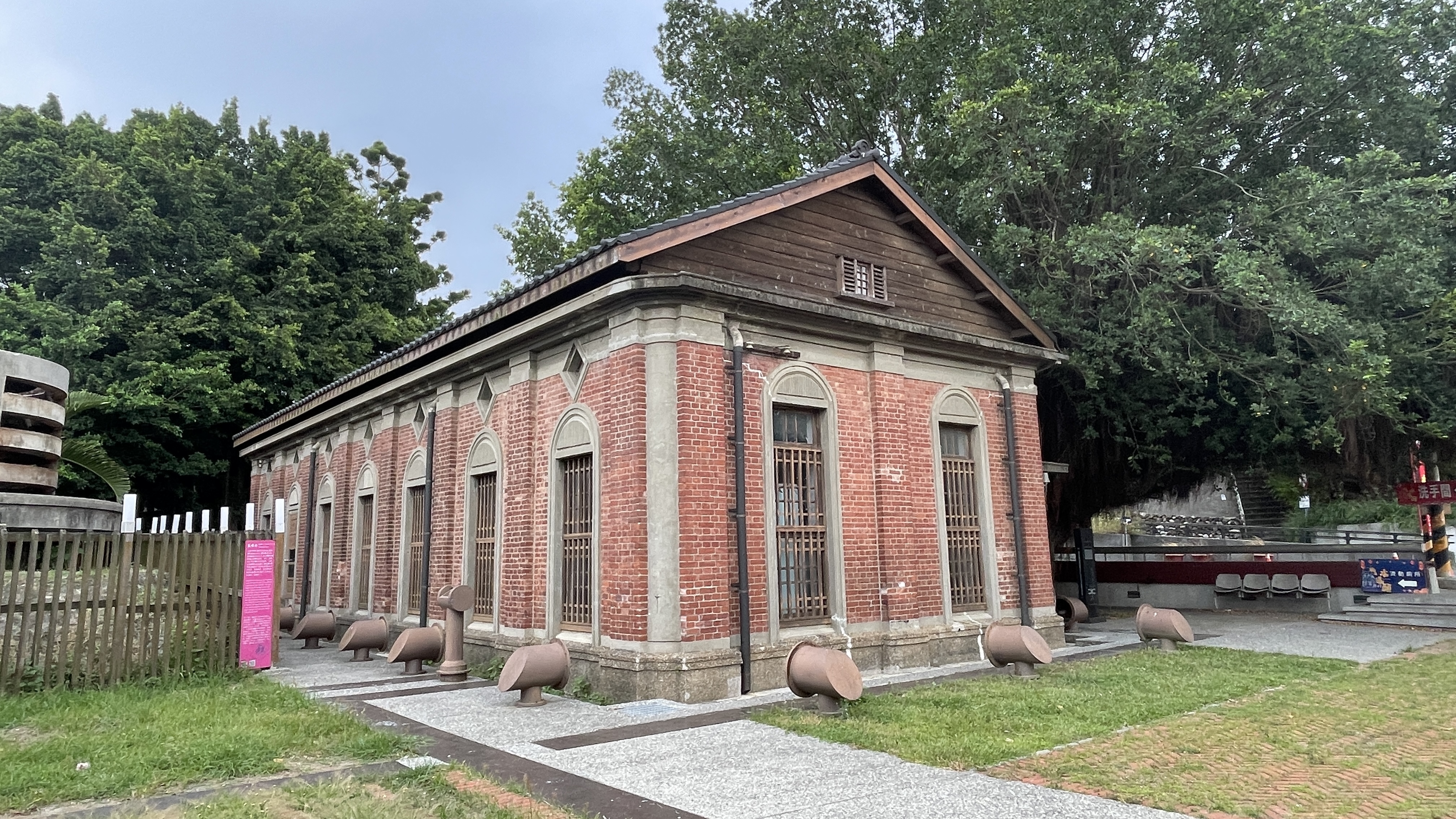
The pump room, erected in 1930 and equipped with water pumps, primarily functions to distribute water between the pool, water tower, and well through the pump. Its walls are constructed of transparent bricks, exemplifying craftsmanship during the Japanese occupation. In 2006, it earned recognition as a county-designated historic site.

Within the park, you'll find three filter ponds, dating back to 1930. These ponds served as purification facilities for tap water, removing impurities through sedimentation. Due to their gradual water collection process, they are often referred to as "slow filter ponds." Today, they have been transformed into picturesque ecological ponds within the park's landscape.

The park also houses two pumping wells, both constructed in 1930. The first pumping well serves as a raw water storage point, holding the unprocessed water sourced from Beigang Creek. The second pumping well, a clean water well, stores chlorinated and disinfected water. In 2006, the Yunlin County Government designated them as county-designated historic sites.

The sedimentation tank, also built in 1930, played a central role in filtering impurities from the water. The purified water would then be directed to the second pumping well and subsequently to the water storage tower. This entire water purification process was carried out within the confines of the park. Remarkably, the original sedimentation tank has been retained and now serves as a war-ready tank, bearing witness to its historical legacy.




Address:
651雲林縣北港鎮民生路1號

January 26, 2023

Yunlin Travel: Beigang Old Street - Lunar New Year travel

Beigang Old Street (北港老街)

Beigang Old Street, located on Zhongshan Road in Beigang Town, Yunlin, has been a significant center of life for the people of Yunlin since the Qing Dynasty. It is not only the oldest old street in Beigang but also the development center of the area. The ancient street has a history of more than 300 years. The buildings on the street are mainly divided into two categories: daily life-related shops such as ginseng medicine shops and clinics, and buildings related to temple visits, including the famous Chaotian Palace in Beigang.

The busiest area in Beigang is Zhongshan Road in front of Chaotian Palace, which was formerly known as Gongkou Street. Although there aren't many ancient houses on both sides of the road, it has a history of more than 300 years since the reign of Emperor Kangxi of the Qing Dynasty. The buildings on Beigang Old Street are mostly made of red bricks, adorned with a large number of Chinese auspicious totems on their facades. The combination of Chinese and Western styles gives the street a gorgeous and interesting atmosphere. When visiting Beigang, it is a must to try the local snacks, such as Beigang peanuts and sesame oil, which are popular souvenirs. Additionally, don't miss out on the famous Rixingtang Bakery. It is said that people from Chiayi come to Beigang or Xingang to order cakes for their weddings.


Beigang Sightseeing Bridge

Beigang Sightseeing Bridge, completed in 1992, connects Chaotian Palace in Beigang Township, Yunlin County, with Narcissus Palace in Xingang Township, Chiayi County. Spanning Beigang Creek, the bridge adopts Nelson's arch design with a red main body. The bridge is supported by green and golden steel cables, resembling a flying dragon. Vehicles are prohibited from entering the bridge. Looking down from the bridge, you can see Riverside Park, which used to be the Beigang cattle market. Along the Beigang River, you can also spot the Beigang Mazu Bridge.


Beigang Chaotian Palace (北港朝天宮)

Beigang Chaotian Palace is the center of belief for the people of Beigang. The prosperity of the goddess Mazu also drives the economic development of the old street and the surrounding businesses. Formerly known as Tianfei Temple or Tianhou Palace, it was renamed Chaotian Palace to commemorate the separation of spirits from the ancestral temple "Chaotian Pavilion" in Meizhou. With a history of 300 years, it is a second-class historic site recognized by the state.


Rixingtang Wedding Cake Shop (日興堂喜餅)

Rixingtang Wedding Cake Shop showcases a Baroque-style building that houses the only remaining theater in Beigang, the Zhenxing Theater. The owner of Rixingtang, Guo Xianyu, cares deeply about local culture and bought the Beigang Zhenxing Theater to preserve the historical building. The Cake Shop operates in the front, while the Tourist Art Museum is located at the back. Established in 1980, Rixingtang initially baked cakes using charcoal, but now they use electric stoves. Mr. Guo Xianyu's perseverance and determination made him the number one Chinese wedding cake maker in Taiwan. The signature Zhuangyuan wedding cake from Rixingtang is known for its mung bean paste filling, crispy green onion, meat floss, stewed pork, egg yolk, and other ingredients prepared in a fixed ratio, particularly the fine and dense taste of the mung bean paste.


Address:

1. Beigang Old Street: 651雲林縣北港鎮中山路
2. Beigang Chaotian Temple: 651雲林縣北港鎮中山路178號
3. Rixingtang Wedding Cake Shop 日興堂喜餅: 651雲林縣北港鎮中山路3號

February 13, 2019

Yunlin Travel: We Accidentally Met President Tsai at Beigang Chaotian Temple

Today, we visited Beigang and were greeted by a large crowd of people. There were long lines stretching from the temple to the bridge at the end of Old Street. We learned that President Tsai Ing-wen would be coming here, so we decided to wait for a while. We caught a glimpse of the president for just a few seconds, and I felt really excited. We were even lucky enough to receive a commemorative coin!

Beigang Chaotian Temple (北港朝天宮)

The Chaotian Temple in Beigang was built in 1700 to honor the sea-goddess Mazu. It is one of the most important temples in Taiwan and holds great significance. Beigang was a significant port in the 17th century.
In 1694, the statue of Mazu was brought from Fujian, China, to Beigang. In 1700, Chen Li-Shum donated a piece of land and raised funds to build the Chaotian Temple. The temple underwent several expansions, with the first one taking place in 1730. However, even that expansion was not enough. Another project began in 1773, and in 1854, the temple was expanded into a palace-like architectural complex.
The temple has undergone several renovations throughout its history. In 1894, a fire damaged the front hall, and in 1904 and 1906, earthquakes had an impact on the building. The temple was reconstructed in 1907, and the project was completed in 1912. From 1963 to 1972, the Golden Furnace, Bell, and Drum Tower were newly constructed, and the main hall was raised from 6 to 15 meters. The demolished parts of the wooden structure are also preserved within the temple.

Between 1918 and 1922, the surrounding roads were widened, and the walls surrounding the temple and the urban area were reconstructed. From 1937 to 1940, burning gold paper was forbidden, and the Gold Furnace was demolished. Some of the temple statues were burnt or kept in private collections. The only remaining gods were Mazu and Wu Wenchang. The statue of Mazu is placed on top of the building. The temple worships many other gods, including Heavenly Mother, Goddess of Mercy, Heavenly Emperors, Wenchang God, Goddess of Childgiving, Land God, and Mazu's parents.

Nearby the temple, there is Beigang Old Street, where you can find a variety of delicious street food. In Beigang, you can also see some old buildings, an old water tower, and the bridge at the end of Old Street, which connects Yunlin County with Chiayi County.


Beigang Chaotian Temple 北港朝天宮, yunlin, taiwan

Beigang Chaotian Temple 北港朝天宮, yunlin, taiwan

Beigang Chaotian Temple 北港朝天宮, yunlin, taiwan

Beigang Chaotian Temple 北港朝天宮, yunlin, taiwan

Beigang Chaotian Temple 北港朝天宮, yunlin, taiwan

Beigang Chaotian Temple 北港朝天宮, yunlin, taiwan

Beigang Chaotian Temple 北港朝天宮, yunlin, taiwan

Beigang Chaotian Temple 北港朝天宮, yunlin, taiwan

Beigang old street, yunlin, taiwan

Beigang old street, yunlin, taiwan

Address:

651雲林縣北港鎮中山路178號北港朝天宮