Showing posts with label amwf. Show all posts

September 10, 2025

Japan Trip - Day 5/6: A Relaxed Day in Kumamoto & Heading Home


Travel Date: 2025/08/13-18

For our last day in Kumamoto, I hadn’t planned anything specific. There was an option to take the tram to explore other places around the city, but the weather was rainy - sometimes light, sometimes heavier, so we decided to spend the day shopping and exploring nearby arcades. Kumamoto city is fantastic for this, everything is conveniently located, and there are so many different stores to visit.

Since we didn’t have time the previous day to buy breakfast, we started with a food hunt. I really wanted to try ramen in Japan, and luckily we found Keika Honten Ramen in Tsuruya Department Store. Both the original and spicy flavors were delicious, though I must admit the “spicy” version wasn’t really spicy by my standards. One thing I loved was that you could choose how long the noodles were cooked, perfect for those who don’t like overly chewy noodles.

After breakfast, we explored the shopping arcades and tried some dango - a chewy, mochi-like treat. The ones we tried were filled with sweet potato and red bean paste, which I enjoyed, though I personally prefer mochi as they are softer. Some dango had even more elaborate fillings, like red bean paste with fruits such as strawberries or kiwis - looked delicious!

Next, we visited 3COINS, a shop recommended by many YouTubers. I was mainly looking for earrings, and the store didn’t disappoint - prices were about a third of what you’d pay in Taiwan for similar styles in Poya. The store wasn’t very large, but I still managed to buy a small frying pan and a bowl. Everything felt like good quality, and since most items are made in China anyway, there’s not much difference in purchasing here versus elsewhere.


After a quick rest back at the hotel, the skies opened up with a heavy rain, so it was perfect timing to relax. My husband took a nap, as he isn’t used to walking long distances for work, unlike us, who are more active. Later in the afternoon, we went back out for more shopping at Sakuramachi Shopping Center. We shopped for shoes for our son, and I got a pair for myself. My husband even found a wallet at 50% off, and with the tax refund, it felt like an amazing deal. Japan is really generous with discounts - 30-50%, sometimes even 70% for seasonal items, unlike Taiwan, where discounts are usually much smaller.

After dropping our shopping bags at the hotel, we headed out again - my husband was hoping to have sushi once more. While shopping near Tsuruya Department Store, we spotted Kura Sushi, but unfortunately it wasn’t open yet - it was scheduled to open at the end of August. 
So, we walked back to Sakuramachi Shopping Mall... yes, once again... and decided to dine at Amakusa Ushibukamaru SAKURA MACHI, the same sushi restaurant we visited on our first day. The quality was excellent, and it was a perfect way to enjoy fresh sushi before ending the day.

Back at the hotel around 9 PM, I spent the evening packing our luggage. What started as half-empty bags soon became fully packed with gifts and souvenirs from our trip.

The next morning, we woke up at 7 AM, tidied up, and checked out. Taking the bus from Sakuramachi to the airport was extremely convenient - the stop is on the first floor, and tickets can easily be purchased at the vending machine. Everything is in English and simple to use. Despite arriving two hours early, the airport was busy, and we barely had enough time after check-in and security before boarding.

Our flight back to Taiwan was smooth, and when we landed in the afternoon, the weather was hot and sunny - typhoon Podul was long gone, making our timing perfect.

One thing I have to mention is the amazing buns and breads in Japan. Whether from supermarkets or convenience stores, they are always packed with filling - over 50% in some cases! This is so different from Taiwan, where buns often have very little filling compared to the bread. During our stay, we tried over 10 different buns and several donuts, and I loved them all - especially honeydew-flavored buns. If you’re a dessert or snack lover, Japan is definitely a paradise for buns and pastries.


Summary

Our six-day adventure in Kumamoto, Japan was a mix of cultural exploration, natural beauty, and shopping delights. A little summary of our trip:
Day 1 – Arrival: Despite flying on the day of Typhoon Podul, our flight went smoothly. We stayed at Daiwa Roynet Hotel, conveniently located near Kumamoto Castle and shopping areas. 
Day 2 – Kumamoto Castle & Jojuen Garden: We explored Kumamoto Castle, including exhibitions on its six floors, and visited Katō Shrine and Inari Shrine nearby. In the afternoon, we took a tram to Suizenji Jojuen Garden, a peaceful, well-maintained traditional Japanese garden with beautiful ponds and shrines.
Day 3 – Aso Volcano & Kamishikimi Kumanoimasu Shrine: We drove to Aso Volcano, enjoyed the crater views, and learned about its unique geology. Later, we visited Kamishikimi Kumanoimasu Shrine, a hidden gem nestled in the forest with moss-covered lanterns and a long stairway, offering a magical, serene atmosphere.
Day 4 – Yamaga Lantern Festival: We drove to Yamaga, explored the Lantern Museum and historic streets, visited Kongōjō-ji and Omiya Shrine, and experienced the Thousand Lantern Dance (unfortunately interrupted by rain). 
Day 5 – Shopping & Free Day: Rainy weather kept us indoors for a shopping spree. Highlights included trying Keika Honten Ramen, tasting dango, and visiting 3COINS for cute and affordable items. Discounts and tax-free shopping made this day a treat for all. 
Day 6 – Return Home: We packed up and took the bus from Sakuramachi to the airport. The flight back to Taiwan was smooth, and the typhoon had passed, making for a perfect ending. 


September 12, 2024

Ishigaki Island And Getting Back Home


Travel Date: 2024/08/11 - 2024/08/14

Instead of the usual flight or ferry, we decided to embark on a less conventional adventure - cruising to Japan. Our journey took us to the vibrant streets of Naha City in Okinawa and the serene beauty of Ishigaki Island. Over the course of three nights and four days, we experienced the unique blend of relaxation and exploration that cruising offers. But as we soon discovered, this mode of travel comes with its own set of surprises.

Join me on a whirlwind 4-day, 3-night cruise to Japan’s serene Okinawa Prefecture, where the reality of just a few hours on land brought both memorable experiences and unique challenges. From the historic Shuri Castle in Okinawa to the tranquil yet limited offerings of Ishigaki Island, I navigated quiet streets, savored fresh sushi, and tackled the quirks of limited time ashore. These posts recount the highlights of our brief land excursions, the nostalgic charm of older taxis, the unexpected challenges of finding food, and the joys of traveling with family. Despite the short visits, each day unfolded with new discoveries that made the journey truly unforgettable.

Kicking Off the Day

After breakfast, our son was eager to play in the swimming pool. Despite his fear of water, he stayed in one spot, clinging to the ground, and his clothes amusingly changed color from blue to a pinkish hue. Traveling with a child truly requires patience!
Time wasn’t as tight on Ishigaki Island compared to the previous day. We disembarked before 2 PM and needed to be back on board by 8 PM. After a day of exploring, dining, and resting, we sailed back to Taiwan. We arrived at 8 AM, but disembarkation wasn’t until after 10 AM, extending the waiting time before finally leaving the cruise. In the flurry of disembarking, I unfortunately forgot to record a video as I had planned—a small regret on an otherwise peaceful and reflective day.

One of the most impressive aspects of Ishigaki Island—and Okinawa overall—was its cleanliness. The streets were spotless, with almost no garbage in sight, despite a lack of trash cans. Vending machines were conveniently available on nearly every street, making it easy to grab a drink. Unlike in Taiwan, drink shops aren’t a common sight in Japan.
We also made a quick stop at a local supermarket. It didn’t have as many options as the one on the previous island, but we still managed to find some drinks.


Ishigaki Island (石垣島)

Ishigaki Island is a serene and culturally rich island in Japan's Okinawa Prefecture, located southwest of Okinawa Hontō. It's part of the Yaeyama Islands and serves as a key transport and business hub in the region. The island is known for its lush landscapes, including Mount Omoto and Kabira Bay, both protected under the Iriomote-Ishigaki National Park.

With a population of around 47,000, Ishigaki blends Japanese and Taiwanese influences, evident in its unique cuisine, which features tropical fruits, spices, and the famous Ishigaki beef. The island is also historically significant, with sites like Miyaradunchi, an Important Cultural Property, reflecting its rich heritage.

Ishigaki is a popular destination for cruise ships, offering access to nearby islands and the Senkaku Islands, a point of territorial contention. The island’s natural beauty, cultural significance, and strategic importance make it a unique spot in Japan's southern archipelago.


Transportation

Getting around the island was straightforward but limited. We took a bus from the cruise terminal to the town center, which cost 200 yen per person, with children riding for free. The last bus back to the cruise ship departs at 7 PM, so timing your return is crucial. The roads felt very safe, drivers were polite, always waiting for pedestrians to cross, and they drove slowly. The absence of scooters made crossing the road feel unpressured and safe, unlike in Taiwan.

From the bus stop, it’s about a 10-minute walk to the popular shopping area. However, food options were sparse, and the shopping mall was small with limited offerings. Perhaps it’s because we’re used to seeing food and drink stalls everywhere in Taiwan, but it felt quite empty here. The first floor focused on food, while the second floor was dedicated to souvenirs.

Food & Shopping

Euglena Mall, formerly known as Ayapani Mall, is the southernmost arcade shopping street in Japan. It features two parallel streets covered with arcades and lined with souvenir shops and local stores. The Ishigaki City Public Market, situated between these streets, offers fresh produce and local specialties. The mall was renamed in 2010 after the naming rights were sold to Euglena, a company with a microalgae facility on the island, to help repay construction loans and fund maintenance.

One of the challenges we faced on Ishigaki Island was finding food. Many shops were closed, and the shopping options were limited. The popular tourist area didn’t have any large shops, and the shopping mall was small with few things available. Sushi train restaurants, which I had hoped to visit, were uncommon, and when we did find food, it was somewhat pricey.

Despite the challenges, we managed to order food with the help of a very friendly restaurant owner. Even though it took a long time due to language barriers and poor internet connectivity, the hospitality made up for the difficulty.

Communicating in English on Ishigaki Island proved to be difficult. The poor internet connection made it even harder, especially when trying to use translation apps. This added a layer of challenge to the overall experience, but with patience, we were able to get by.


Shrines

Our original plan was to visit a stalactite cave, but my husband thought it might be too crowded, so we decided to explore the town and visit its shrines instead.

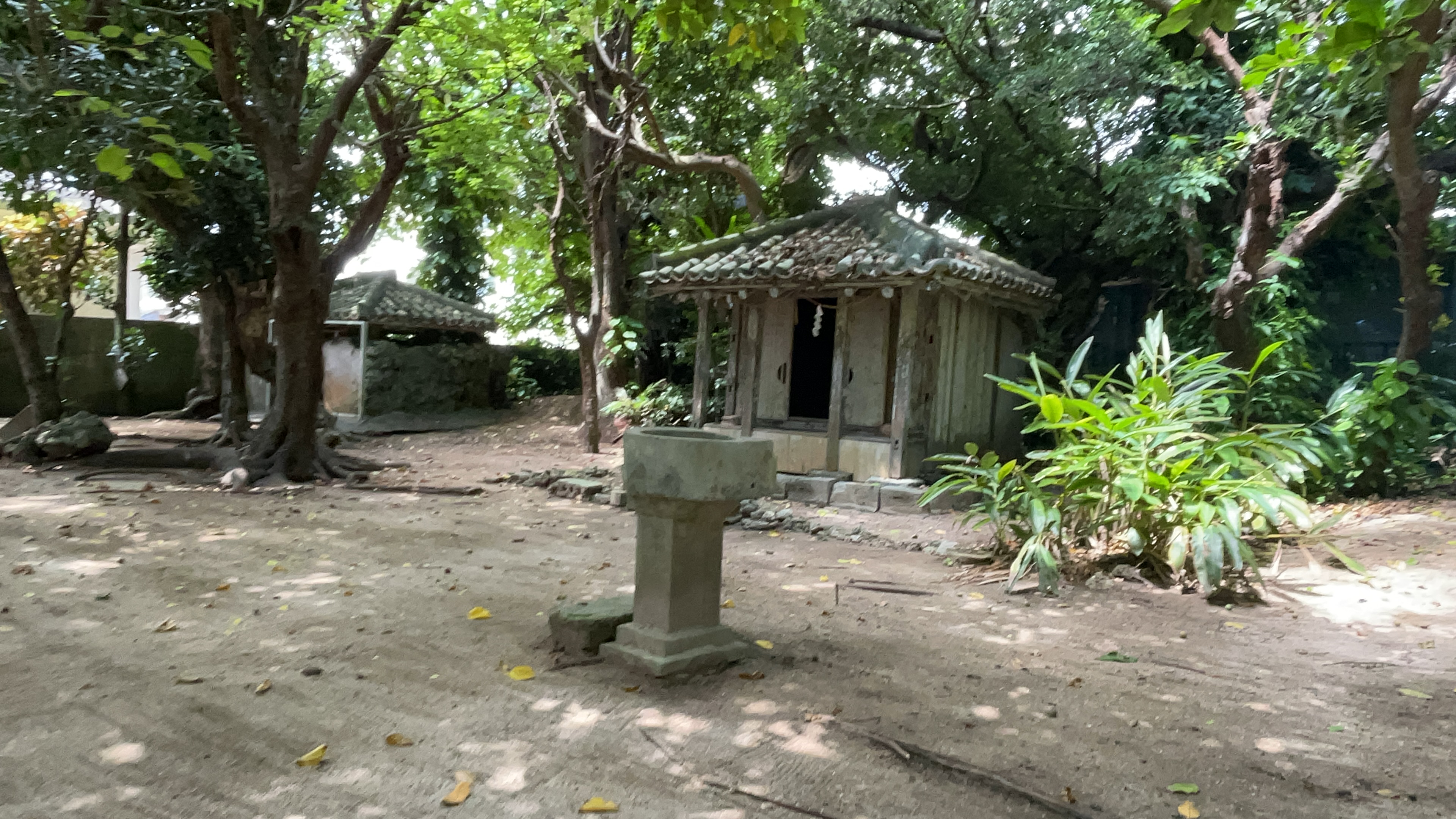
In the 1500s, when Yaeyama farmers resisted the Shuri Royal Government, troops were dispatched to quell the rebellion. As the government’s ships returned to Naha Port, a shrine maiden prayed here for their safe voyage. At the sacred site, you’ll find a torii gate and a worship hall. Behind the stone gate lies a restricted sacred area, off-limits to visitors. The premises are adorned with towering ancient trees, each with a unique shape distinct from those found in Taiwan. There was also an animal in the bushes that startled me when it jumped as I approached, though I didn’t catch what it was.


Our next stop was Gongen-do and Tōrin-ji, which were established simultaneously in 1614 to encourage the construction of temples and shrines. The deities enshrined here are based on the Kumano Gongen, marking the beginning of temple and shrine construction in Yaeyama and representing a valuable cultural heritage.

Tōrin-ji (桃林寺) is a historic Zen Buddhist temple located in Ishigaki City, Okinawa Prefecture. Belonging to the Myōshinji branch of the Rinzai school, the temple is also known by its mountain name, Nankai-san. The principal deity enshrined here is Kannon Bosatsu (Avalokitesvara), and it holds the distinction of being the oldest Buddhist temple in the Yaeyama Islands.

Tōrin-ji was founded in 1614 during the reign of King Shō Nei of the Ryukyu Kingdom, following the advice of the Satsuma Domain to construct religious sites in the Yaeyama region. The temple was established by the Zen monk Kan'ō Saidō, who brought with him a bronze statue of Kannon and three sacred mirrors as offerings. The adjacent Gongen-dō, a shrine dedicated to Kumano Gongen, was also founded at this time.

The temple's main hall initially had a thatched roof, but it was replaced with tiles in 1694, and the Gongen-dō followed suit in 1703. Both structures were severely damaged by a tsunami in 1771 but were subsequently rebuilt in 1772 and 1786, respectively. Notably, the temple was involved in a historical dispute in 1782 when a Shingon temple from Kagoshima attempted to convert Tōrin-ji to Shingon Buddhism, but the Ryukyu government rejected this, affirming its Zen Buddhist identity.

The current main hall was reconstructed in 1968, following various repairs and rebuilds over the centuries due to natural disasters and other events.
Gongen-dō, dedicated to Kumano Gongen, has undergone several restorations, with the most recent significant repair completed in 2008 after damage from Typhoon 13 in 2006. The shrine's copper mirrors, cast in 1772, are the oldest of their kind in Okinawa.
The temple's gate is guarded by two wooden Nio statues carved in 1737, which are the oldest wooden sculptures in Okinawa. These statues were washed away by the 1771 tsunami but were later recovered and restored.


Final Day on the Cruise

Our last morning on the cruise came with a few unexpected changes. We woke up at 7 AM, knowing that the ship would dock at 8 AM. Before we left our room, we received a phone call letting us know that our passports were ready for pickup—a reassuring step as our journey neared its end.

After picking up our passports, we headed for breakfast. The buffet closed earlier than usual, around 9 AM, with cleaning taking place immediately afterward, cutting our breakfast time short. As we waited for our scheduled disembarkation time of 10:40 AM, we also noticed that the toilets were being cleaned and were unavailable for use until we left the ship, which was a bit inconvenient.

Despite heading down a bit earlier, passing through customs and retrieving our luggage took longer than anticipated. By the time we finally walked to the car park and were ready to head back home, it was nearing noon. The entire process, from waking up to driving away, highlighted the patience needed on the final day of a cruise, especially when small inconveniences arise.


September 3, 2024

Okinawa: Exploring History, Shopping, and Quick Tips (Part II)


Travel Date: 2024/08/11 - 2024/08/14

Instead of the usual flight or ferry, we decided to embark on a less conventional adventure - cruising to Japan. Our journey took us to the vibrant streets of Naha City in Okinawa and the serene beauty of Ishigaki Island. Over the course of three nights and four days, we experienced the unique blend of relaxation and exploration that cruising offers. But as we soon discovered, this mode of travel comes with its own set of surprises.

Join me on a whirlwind 4-day, 3-night cruise to Japan’s serene Okinawa Prefecture, where the reality of just a few hours on land brought both memorable experiences and unique challenges. From the historic Shuri Castle in Okinawa to the tranquil yet limited offerings of Ishigaki Island, I navigated quiet streets, savored fresh sushi, and tackled the quirks of limited time ashore. These posts recount the highlights of our brief land excursions, the nostalgic charm of older taxis, the unexpected challenges of finding food, and the joys of traveling with family. Despite the short visits, each day unfolded with new discoveries that made the journey truly unforgettable.

Okinawa (沖縄本島)

Exploring the streets of Okinawa was a surprisingly peaceful experience. The quiet roads, with very few scooters, made crossing the streets a breeze. It was a nice change from Taiwan, where I often feel like I'm taking a risk just crossing the road—sorry, Taiwan, but that’s the truth! We even had a chance to pet a friendly Japanese cat.

We had hoped to visit a fish market, but it was closing at 5 PM. If we had gone straight there from the cruise, we wouldn’t have had time to see anything else. I'm sure the fish would have been an amazing treat, but we decided to explore other places instead.


Shopping at MaxValu: A Taste of Okinawa

After our visit to Shuri Castle, we headed to MaxValu, a popular supermarket chain in Okinawa. It reminded me a lot of PX Mart in Taiwan, but with its own unique offerings. The highlight of our shopping trip was the sushi—fresh, sweet, and far superior to what I've had at Costco or RT Mart in Taiwan. The quiet streets and relaxed atmosphere made the shopping experience even more enjoyable.

There was a wide range of products, including many sweets, but I was on the lookout for unique flavors. Aside from a variety of strawberry options, I didn’t find anything particularly different. We regretted not buying more, especially since Ishigaki Island offered fewer shopping opportunities. So, if you’re in Okinawa, I suggest stocking up on sweets unless you’re specifically after typical gift packages.
Japan definitely offers a much wider variety of dairy products compared to Taiwan. The selection of yogurt and cheese was more abundant than what I'm used to seeing.

One special dessert caught my eye. According to the description, it’s often used as an offering on altars. It's made from rice, soybeans, and sugar, shaped into a lotus flower, and comes in a variety of colors. We also noticed some local cookies made from purple sweet potatoes, but we didn’t try them, so I can’t say if they’re worth the price.

One thing that stood out was how affordable juice is in Okinawa compared to Taiwan. If you’re planning a trip, I highly recommend picking some up—it’s delicious and reasonably priced.
The payment machines in Japan are also quite different from what I'm used to.


Quick Tips & Final Thoughts

Okinawa is well-equipped for tourists, with free public toilets available throughout the island—a convenience that’s much appreciated, especially when you’re short on time. For those with more time, the Yui Rail is a fantastic option for getting around. A one-day pass costs 800 yen, and children up to 12 years old can travel for free. Unfortunately, our tight schedule didn’t allow us to try it, but it’s something I’d recommend for future visits.

Although our time on Okinawa Island was brief, it was packed with memorable moments. From the historical significance of Shuri Castle to the delightful shopping experience at MaxValu, there’s so much to enjoy, even in just a few hours.

After our shopping, we made a quick stop by the beach to enjoy our sushi before heading back to the cruise ship. We returned just in time for dinner, and while the ship offered plenty of entertainment options like a disco and shows, the lack of internet after 10 PM left us with few options to unwind. Traveling with a child also posed its challenges, limiting our ability to fully enjoy the onboard activities. The cruise itself offered various attractions, like a disco and shows, but at 10 PM, the ship set sail for Ishigaki, and soon after, our internet connection was lost. This lack of connectivity might leave some passengers bored or frustrated, especially if they have nothing else to do. Traveling with a child also has its challenges, as it sometimes means you can’t fully engage in all the activities you’d like to.