December 3, 2019

Yunlin Travel: Cotton Fields in Huwei

cotton, huwei, yunlin, taiwan

Last month, we went to Yunlin to eat Sien You Hot Pot for my birthday. Some time ago, I found information about cotton fields in the neighborhood, so I really wanted to go there and see them. The field is not big and is used to showcase the history of cotton. Before visiting, you need to make a reservation, and the visiting time is very limited, from 9-11AM or 2-4PM. The ticket costs 150NTD per person. For me, it was a very interesting place, and I also learned that cotton is not always white! You can find coffee-colored or even green cotton. We also visited a nearby towel factory, but I'll talk about that in the next post.

Organic Cotton Fields (雲端埒活棉花田)

As you know, many of the clothes we wear are made from small white cotton. In Taiwan, there have been very few people planting cotton. However, in the south of the country, there is a record of cotton cultivation. With the opening of cotton imports by the WTO, the price of exotic cotton became low, and Taiwan's cotton agriculture quickly became history. In 2014, some people started to grow organic cotton in Huwei, Yunlin. They wanted to use cotton to reconnect with local memories and inject new vitality into industries and communities.
The flowering period of cotton is from June to September, and each flower is only open for three days. The period from November to March is when the most cotton buds are formed.

Zheng Zongkun was the first person who wanted to cultivate long-forgotten cotton in Huwei. In his forties, he made a career change and decided to leave the air-conditioned office and work in the cotton field. Then, he thought about the fact that this is the hometown of towels, which is an excellent cultural feature. So he decided to overcome all the difficulties and let the cotton that had disappeared in Taiwan for nearly 60 years regain its vitality!
Most of the farmland was planted with peanuts and corn, and most of the villagers used traditional farming methods. In order to create a better environment, Zheng Zongkun chose to cultivate in a more eco-friendly way. He used his own efforts to drive the village towards change. Zheng Zongkun decided to plant the cotton that had been lost in his hometown for many years. When Zheng's father heard about it, he thought it was impossible to find the original species. Zheng Zongkun searched for half a year and finally obtained the seeds through a pipeline. The related planting techniques were unknown, so he continued to gather information and seek advice from others.

Then, he thought about the fact that this is the hometown of towels, which is an excellent cultural feature. So he decided to overcome all the difficulties and let the cotton that had disappeared in Taiwan for nearly 60 years regain its vitality!
Having never done any farming work before, Zheng Zongkun worked in the fields during the day and attended the Peasant University organized by the Yunlin County Government to study organic agriculture. By chance, he found an 80-year-old veteran named Chen Mars in Chiayi, who had an old and worn cotton seeder. It was like finding a treasure. Zheng Zongkun carefully asked the senior for advice and took notes. He wanted to pass on the history of Taiwan's cotton.

The most challenging problem in planting cotton is dealing with pests and diseases. In the past, farmers used pesticides to solve these issues, which often led to pesticide poisoning incidents. If Zheng Zongkun wanted to grow organic cotton, he had to find local methods to combat pests, such as the chafer beetle that loves to eat cotton leaves. He needed to catch them, but if he released them, they would just return. Doing this kind of work every day seemed foolish, but he was unwilling to give up on his organic dream. The following year, he decided to raise some chickens on the cotton farm.
The challenges Zheng Zongkun faced were not limited to pests and diseases. Delicate cotton is also susceptible to damage from wind and rain. Zheng tried different methods to improve the situation and was always open to new ideas.

He combined ecological experiences with the towel industry in the Huwei area, allowing people to understand the ecology of cotton and bringing local children into the cotton field to learn about industrial raw materials. Huwei is a major town in Taiwan known for making towels. Faced with the impact of imported towels from China, the local industry made great efforts to develop new strategies and create various styles of towels to become local specialty products.
By breaking away from the traditional farming practices in Yunlin, the business model proposed the combination of culture and agriculture to upgrade Taiwan's cotton, complete the upstream and downstream of towel production, and add creativity to turn Taiwan cotton into art. With this business model, Yunlin's farmers have come to understand the importance of abandoning pesticides, focusing on cultivating a friendly environment, paying attention to quality, and finding the unique selling points of their products. This approach has created greater value compared to traditional farming methods, proving that competition based solely on production volume is not the best option.


temple, huwei, yunlin, taiwan

temple, huwei, yunlin, taiwan

cotton, huwei, yunlin, taiwan

cotton, huwei, yunlin, taiwan

cotton, huwei, yunlin, taiwan

cotton, huwei, yunlin, taiwan

cotton, huwei, yunlin, taiwan

cotton, huwei, yunlin, taiwan

cotton, huwei, yunlin, taiwan

cotton, huwei, yunlin, taiwan


cotton, huwei, yunlin, taiwan

cotton, huwei, yunlin, taiwan

cotton, huwei, yunlin, taiwan

Address:

632雲林縣虎尾鎮雲端埒活棉花田

November 30, 2019

Tainan Christmas 2019


I love Christmas, so we visited a few places with nice Christmas decorations in Tainan City. 

Shin Kong Mitsukoshi (Tainan City, Ximen Road)

christmas decorations, tainan, taiwan

christmas decorations, tainan, taiwan

christmas decorations, tainan, taiwan

christmas decorations, tainan, taiwan

christmas decorations, tainan, taiwan

christmas decorations, tainan, taiwan

christmas decorations, tainan, taiwan

christmas decorations, tainan, taiwan

Tayih Landis Hotel (Tainan City, Ximen Road)

christmas decorations, tainan, taiwan

Chimei Museum (Rende District)

christmas decorations, tainan, taiwan

christmas decorations, tainan, taiwan

christmas decorations, tainan, taiwan

Far Eastern Store (Tainan City, East District)

christmas decorations, tainan, taiwan

christmas decorations, tainan, taiwan

Shangri-La's Far Eastern Plaza Hotel (Tainan City, East District)

christmas decorations, tainan, taiwan

TS Mall (Tainan City, East District)

christmas decorations, tainan, taiwan

christmas decorations, tainan, taiwan

christmas decorations, tainan, taiwan

christmas decorations, tainan, taiwan

christmas decorations, tainan, taiwan

Tainan City Council (Anping District)

christmas decorations, tainan, taiwan

christmas decorations, tainan, taiwan

christmas decorations, tainan, taiwan

christmas decorations, tainan, taiwan

christmas decorations, tainan, taiwan

November 27, 2019

Pingtung Travel: Sea Turtles and Other Attractions of XiaoLiouQiu

sea turtle, xiaoliuqiu, pingtung, taiwan

For the first time, I visited one of Taiwan's islands, Xiaoliuqiu. It was truly an amazing place with beautiful beaches, a blue ocean, and shells and dead corals scattered on the shore. I even had the chance to see two live corals near the shore. But the most exciting part was encountering sea turtles. They were incredibly beautiful, and it was easy to spot them swimming close to the beach.
The weather in mid-November was already starting to cool down. We had to wear jackets in the morning and at night when going outside. Only during noon was it hot enough for us to go swimming. Unfortunately, we ended up getting sunburned, and our son was scared to get into the water.

On Sunday afternoon, there were many people on the island. However, when we went on Monday, the place was nearly empty, and we could enjoy the island almost by ourselves. The trip cost us about 5000 (excluding transportation to Donggang Harbour). We booked a hotel on the west coast, which was really nice. The price included boat tickets and a scooter rental for 24 hours.
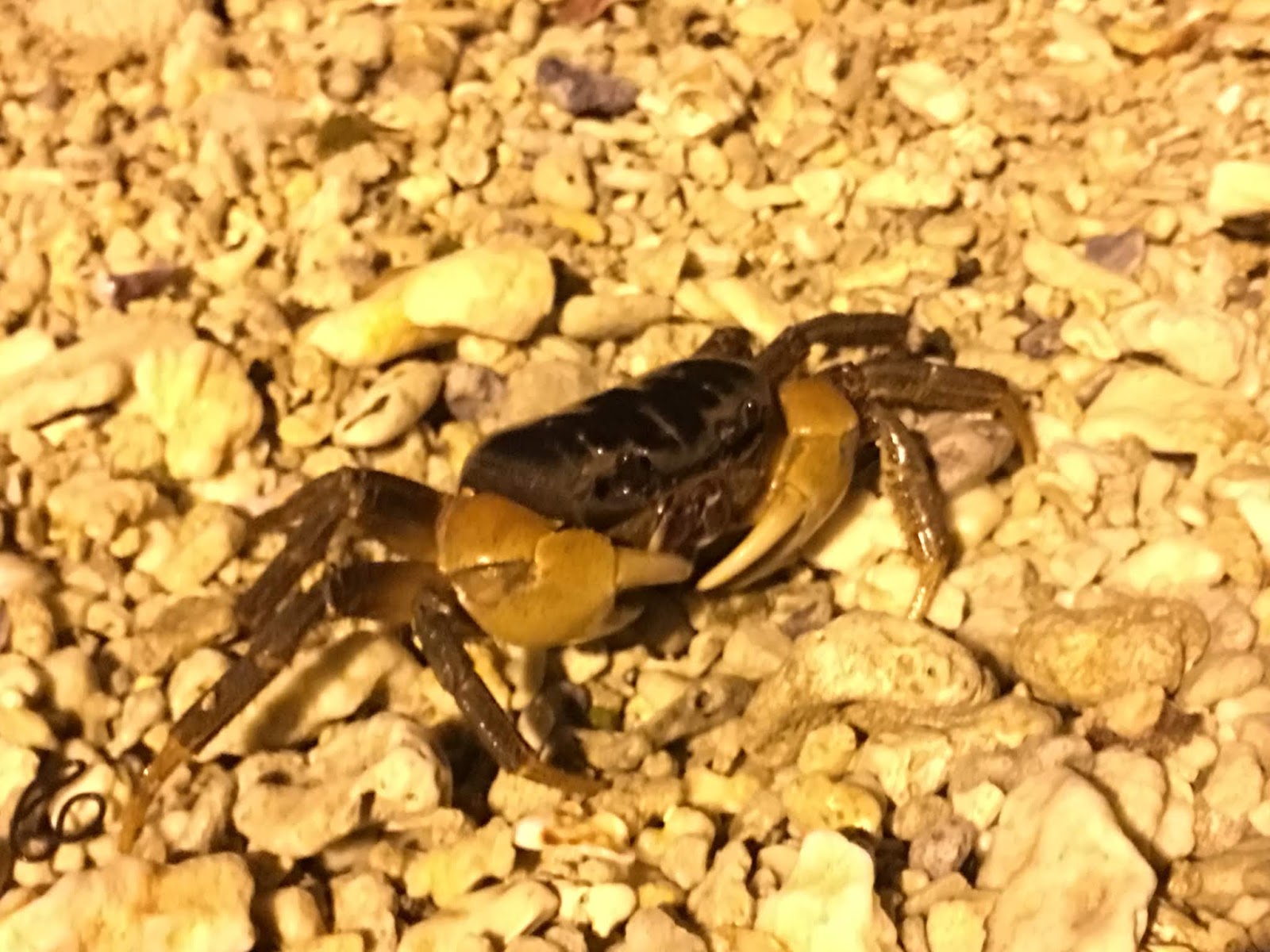
The island is very small, and we drove around it several times. We even went out at night, although it may not be a good idea in some areas as many places are completely dark. On some roads, we noticed signs saying "crab crossing, please slow down." I didn't see any crabs on the road, but according to my husband's past experience, it happens quite often at night. We also went to the beach at night and saw two large crabs and some other sea animals. The next day, we saw a few sea turtles on the beach, swimming very close to us. We also had the opportunity to see different fish and corals.

The biggest attractions on the island are the beaches, Vase Rock, and a few caves. It's a popular place for snorkeling and observing sea turtles. Unfortunately, we didn't visit any caves during our trip. Besides the beaches, we also visited the Lighthouse and Banyan Tree. I had wanted to see the sunrise, but it was difficult to convince my husband to wake up early. Next time, we should find a hotel on the east side of the island instead.
There is a small town in the north, close to the harbor and Vase Rock, where we saw many tourists, especially foreigners.


vase rock, xiaoliuqiu, pingtung, taiwan

vase rock, xiaoliuqiu, pingtung, taiwan

xiaoliuqiu, pingtung, taiwan

lighthouse, xiaoliuqiu, pingtung, taiwan

xiaoliuqiu, pingtung, taiwan

xiaoliuqiu, pingtung, taiwan

crab at sunset, xiaoliuqiu, pingtung, taiwan

sunset, xiaoliuqiu, pingtung, taiwan

Xiao Liuqiu (小琉球)

Xiao Liuqiu (小琉球), also known by several other names, is a coral island in the Taiwan Strait, approximately 13 kilometers southwest of Taiwan Island. It has an area of 6.8 km2 and a population of approximately 13,000 residents, the majority of whom share only 10 surnames. It is one of Taiwan's largest coral islands and the only one with significant population and human activities. The island is also covered with limestone and features red-colored land due to weathered iron oxide and silicon oxide.
Liuqiu is administered as a township of Pingtung County. The name "Liuqiu Islet" (嶼, yǔ) was first used during the Ming Dynasty. Since "Liuqiu Yu" is also the name of the Japanese archipelago, including Okinawa, the island has been nicknamed "Little Liuqiu" since the early 20th century. The island was previously known in English and other European languages as Lambay or Lamay Island, which is thought to be a transcription of a name from one of the Taiwanese aboriginal languages. It was occasionally also known as Golden Lion Island, a calque of its old Dutch name, Gouden Leeuwseylant.

In 1622, the Dutch ship Goude Leeuws or Gouden Leeuw (Golden Lion) hit the island's coral reefs, and its entire crew was massacred by the island's natives. In 1631, the Dutch yacht Beverwijck wrecked on the same reefs, and its survivors battled for two days before also being slaughtered. Hendrik Brouwer, the governor-general of the Dutch East Indies, personally ordered the "punishment and extermination" of the people living on this island. In 1633, an expedition under Claes Bruijn discovered that it was undermanned for the task and accomplished little, except for finding a large cave on the island used by the natives as a shelter in times of trouble. A larger expedition under Jan Jurriansz van Lingga in 1636 corralled the locals into it, sealed its entrances, and filled its air with burning pitch and sulfur for eight days. By the end of the Liuqiu Island Massacre, about 300 people were killed, and 323 were enslaved. The men were sold to plantations in Taiwan and Indonesia, while the women and children were used as wives or domestics in Taiwan.

The first Han inhabitant was a Fujianese fisherman surnamed Chen, who is said to have arrived on the island by accident during a storm in the same year as the Liuqiu massacre. The few remaining native inhabitants were picked off by further slave raids and assaults until 1645 when a Chinese merchant, who leased the island from the Dutch, removed the last 13 aborigines. It was then resettled by Chinese people who built a fishing village there. By the end of Qing control in 1895, there were only 200 people living on the island.
During the Japanese occupation of Taiwan following the First Sino-Japanese War, the island was administered as a village in the Tōkō District of Takao Prefecture. After Taiwan regained control in 1945, the island became a township of Pingtung County. In the early 21st century, Liuqiu transitioned to a tourism-based economy and now receives hundreds of thousands of tourists each year.


beach, xiaoliuqiu, pingtung, taiwan

beach, xiaoliuqiu, pingtung, taiwan

beach, xiaoliuqiu, pingtung, taiwan

beach, xiaoliuqiu, pingtung, taiwan

beach, xiaoliuqiu, pingtung, taiwan

beach, xiaoliuqiu, pingtung, taiwan

polish girl, beach, xiaoliuqiu, pingtung, taiwan

polish girl, beach, xiaoliuqiu, pingtung, taiwan

beach, xiaoliuqiu, pingtung, taiwan

amwf couple, polish-taiwanese couple, beach, xiaoliuqiu, pingtung, taiwan

beach, xiaoliuqiu, pingtung, taiwan

beach, xiaoliuqiu, pingtung, taiwan