This time, we decided to head south and stopped in the small town of Houbi in Tainan, right on the border with Chiayi. What I thought would be a quiet, lesser-known spot turned out to be a bustling garden filled with people, tour buses, and a bit of a challenge finding parking. The parking lot itself is quite large, but there were cars parked along the roads for hundreds of meters. No surprise, though, as the weather was perfect for a day of sightseeing.
A Floral Wonderland at Arwin Therapy Garden
Arwin Therapy Garden in Houbi is open every day from 8:30 AM to 5:00 PM. While many people come here to shop for cosmetics, others visit to enjoy the stunning roses that bloom beautifully during this time of year.
Spanning nearly 15,000 pings (about 49,500 square meters), the garden offers a variety of themed experiences. You'll find the symmetrically designed French Rose Garden, the peaceful English Chakra Herb Garden, and a lush, Amazon-like tropical rainforest zone. Throughout the park, there are also a variety of handcrafted cement art installations showcasing iconic designs.
Inside, you can explore the exhibition hall, where technology meets culture with interactive learning opportunities. You can also listen to guided explanations from friendly staff and discover premium beauty products designed to enhance your skincare routine.
You could easily spend an hour here just enjoying the flowers. There’s also a small, picturesque pond that adds to the charm of the place. This attraction, which opened last year, has drawn many visitors since its soft opening in early February. After undergoing a month-long renovation, it officially reopened on April 20th.
Not only is admission completely free, but the park also features four themed areas, each highlighting the beauty of roses in different styles. With plenty of must-see attractions, it's the perfect destination for flower lovers and photography enthusiasts who want to spend the day capturing stunning moments.
Hidden among the roses, you'll find a collection of miniature European-style houses, handcrafted by renowned Japanese artisan Kato Takayuki. These tiny buildings replicate famous European landmarks, such as: Mont Saint-Michel (France), Provence Cottages (Southern France), English Countryside Houses.
This charming “Miniature European Village” will make you feel like you've stepped right into a fairy tale world.
If you need a break from the sun, head to the Arwin Tourist Factory, an indoor shopping area offering fragrances, handmade soaps, and skincare products from the Arwin brand. It’s a great spot to pick up souvenirs or self-care products!
Behind the tourist factory, you’ll find a life-size replica of Shakespeare’s Wife’s Cottage, the only one of its kind in Taiwan! This charming European-style cottage now serves as a retail shop and is also a wonderful spot for photos.
Houbi’s Arwin Therapy Garden turned out to be a wonderful discovery, a perfect blend of natural beauty, cultural elements, and a touch of European charm. If you love flowers, unique architecture, and relaxing walks, this is definitely a must-visit spot in Tainan.
That’s all for this adventure! Hope you enjoyed this little tour. Stay tuned for more travels and discoveries, let’s see where the road takes us next!
This trip south was filled with the charm of Japanese-era buildings. I tried to find places to see on the Chiayi-Tainan border and stumbled upon Puzi Town. Having lived in Tainan for three years, I had no idea there was such a large area of Japanese buildings nearby. Maybe it was because we rarely visited Chiayi, or I just never checked the small towns around well enough to notice them.
Sometimes I feel that most tourist spots in Taiwan are related to the Japanese era, with fewer remaining from the Qing Dynasty, as much older structures have been destroyed over time. I never actually thought of traveling to Japan, but I really like those wooden buildings, I feel that it would be a dream future house.
When we arrived at the Japanese dormitories area, there was an event preparing to start later on - a market organized for the Dragon Boat Festival. I'm not sure how busy it is without the market, but I think it would be much quieter as it doesn't seem to have many shops around. Compared to the Japanese dormitories in Chiayi City, these are much less known.
Our next stop was Tainan's Houbi District. We once again visited Jingliao Old Street. We came here once during COVID-19, and it was rainy that day. At that time, I thought it was a boring and not well-known area, but today's feeling was so different! It's actually filled with visitors, and there were shops open, food, and drink - totally different from a few years ago. Traveling during COVID-19 wasn't fun at all.
Even though the weather was supposed to be rainy, we actually got plenty of sunshine. It was noon and pretty hot. It's been two years since moving out of Tainan, and the north feels a lot cooler, so I also had a bit of trouble accepting the heat. We visited the old street, an old drug store, a Dutch well, a rice mill, and later on stopped at an elementary school that had two unique buildings left from Japanese times. We also drove to another place, but the octagonal storage was closed, and the dormitory only opens for students during school time, so there wasn't much to see.
Check out more information about our Chiayi trip in my other post [LINK].
Check out Qing-Dynasty relics in Houbi in my other post [LINK].
Jingliao Elementary School Wooden Auditorium (菁寮國小木造禮堂)
Jingliao Elementary School, originally named "Jingliao Public School," was established on March 28, 1911, with Yoshikiyoshi Tani from Fukuoka Prefecture, Japan, serving as the first principal. The school initially operated out of two bamboo thatched huts until a new building was completed on October 11, 1911. Classes were then moved to this new facility, and the official opening ceremony was held on February 20, 1912.
In 1941, following changes in Taiwan's education system, it was renamed "Jingliao Elementary School." After World War II, the school underwent several name changes, eventually becoming "Tainan County Houbi Township Jingliao Elementary School" in 1968. In 2010, the name was updated following administrative changes.
The structures at Jingliao Elementary School represent a blend of Taiwanese, Japanese, and post-war architectural styles. The preservation of the wooden hall, office, and flag-raising platform offers a glimpse into the educational and cultural history of the area. The community’s efforts to maintain these historical buildings reflect their commitment to preserving their cultural heritage.
The Jingliao Small Wooden Auditorium, constructed in 1951, is a single-story structure. Diagonal braces on the sides support the walls, and a gable adorns the front.It underwent renovations in 1994 and 2004, reverting to traditional wooden sliding doors. The architectural style is a mix of Japanese and basilica-like rectangular assembly spaces, featuring a sloped roof covered with steel plates.
The wooden office, built in 1956, features detailed pillars on the entrance porch, a rain shelter eave, and a simple, open layout. It was converted into a parent-teacher association room, staff offices, and a teaching equipment room, retaining significant preservation value after 1996.
The flag-raising platform from the Japanese occupation era remains under lush mahogany trees as a relic of the public school. Legend has it that the original flagpole was dismantled to create weapons during World War II. Built in 1931, the original iron flagpole was replaced with a wooden one after World War II. The platform was actively used until 1982. The base measures 124 cm wide, 107 cm long, and 166 cm high.
After the Jiaxian earthquake in March 2010, the wooden auditorium, offices, and flag-raising platform suffered partial damage. The indoor white plaster walls peeled off, revealing the woven bamboo walls beneath, and these structures are currently under repair.
The structures at Jingliao Elementary School represent a blend of Taiwanese, Japanese, and post-war architectural styles. The preservation of the wooden hall, office, and flag-raising platform offers a glimpse into the educational and cultural history of the area. The community’s efforts to maintain these historical buildings reflect their commitment to preserving their cultural heritage.
Houbi Elementary School Japanese Dormitory (後壁國小日式宿舍)
Initially constructed to house Japanese teachers, it later accommodated Taiwanese faculty after the Japanese left. By 1991, it was abandoned and fell into disrepair. The principal's dormitory and the teacher's dormitory of Houbi Elementary School had long been dubbed "haunted houses" by students due to their dilapidated state. These buildings remained uninhabited for over 15 years, overgrown with grass and left to decay. However, in 2017, renovation plans were set in motion.
Originally built in 1942 in a traditional Japanese style, the wooden dormitory could not be officially listed as a historical building. Nevertheless, a proposal under the Ministry of Culture's private old building plan brought the renovation closer to reality. After approval, 70% of the renovation funds were subsidized by the Ministry of Culture and the Municipal Cultural Bureau, while the remaining 30%, totaling 1.7 million yuan, was self-raised by teachers and students. With materials purchased, the two buildings opposite the entrance of Xiaodong Elementary School have been successfully renovated.
Recognizing its cultural value, the dormitory underwent restoration funded by Taiwan's Ministry of Culture and reopened in 2019 under the management of the Taiwan Puyuan Cultural and Educational Development Association.
The dormitory highlights classic Japanese wooden construction techniques, with a particular emphasis on the use of cypress and other prized wood materials. Its design, characterized by simplicity and elegance, includes sliding wooden doors and a tranquil ambiance typical of Japanese architecture. Despite not being officially designated as a historic building, the dormitory is a valuable cultural asset. It serves as a living museum, providing insights into the architectural and cultural exchange between Japan and Taiwan during the colonial period.
This trip south was filled with the charm of Japanese-era buildings. I tried to find places to see on the Chiayi-Tainan border and stumbled upon Puzi Town. Having lived in Tainan for three years, I had no idea there was such a large area of Japanese buildings nearby. Maybe it was because we rarely visited Chiayi, or I just never checked the small towns around well enough to notice them.
Sometimes I feel that most tourist spots in Taiwan are related to the Japanese era, with fewer remaining from the Qing Dynasty, as much older structures have been destroyed over time. I never actually thought of traveling to Japan, but I really like those wooden buildings, I feel that it would be a dream future house.
When we arrived at the Japanese dormitories area, there was an event preparing to start later on - a market organized for the Dragon Boat Festival. I'm not sure how busy it is without the market, but I think it would be much quieter as it doesn't seem to have many shops around. Compared to the Japanese dormitories in Chiayi City, these are much less known.
Our next stop was Tainan's Houbi District. We once again visited Jingliao Old Street. We came here once during COVID-19, and it was rainy that day. At that time, I thought it was a boring and not well-known area, but today's feeling was so different! It's actually filled with visitors, and there were shops open, food, and drink - totally different from a few years ago. Traveling during COVID-19 wasn't fun at all.
Even though the weather was supposed to be rainy, we actually got plenty of sunshine. It was noon and pretty hot. It's been two years since moving out of Tainan, and the north feels a lot cooler, so I also had a bit of trouble accepting the heat. We visited the old street, an old drug store, a Dutch well, a rice mill, and later on stopped at an elementary school that had two unique buildings left from Japanese times. We also drove to another place, but the octagonal storage was closed, and the dormitory only opens for students during school time, so there wasn't much to see.
Check out more information about our Chiayi trip in my other post [LINK].
Check out Japanese-era relics in Houbi in my other post [LINK].
Jingliao Old Street (菁寮老街)
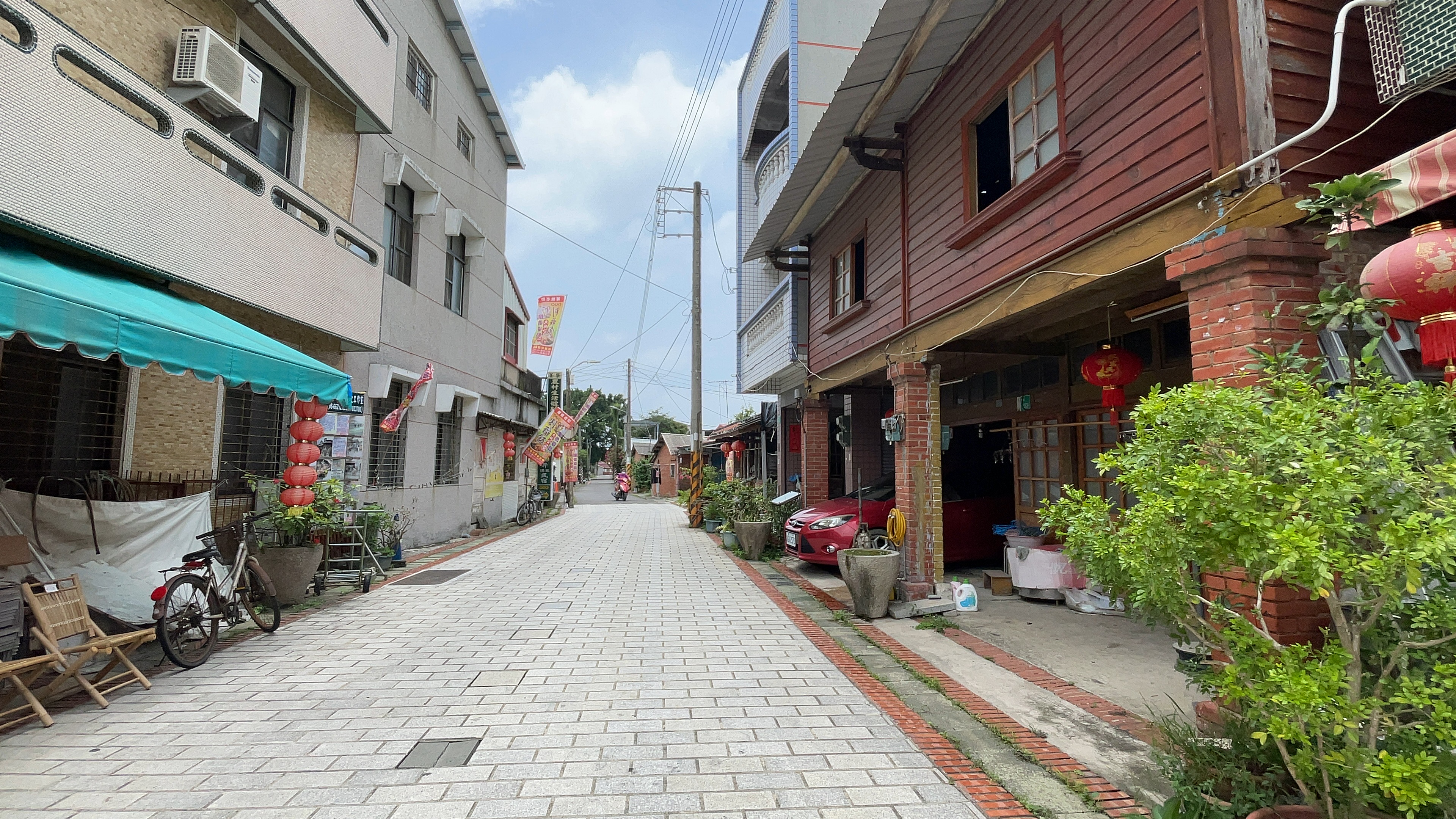
Jingliao was a small village in the mid-Qing Dynasty, known for its dyeing and weaving crops. It served as an important halfway station on the ancient official road between Fucheng (Tainan) and Zhuluo County (Chiayi). It became the most prosperous settlement along the Bazhang River and was commonly known as "Beishi Street." During the Japanese occupation of Taiwan, the street was renovated, and the buildings facing the street were converted into commercial street houses.
The Jingliao Old Street in Houbi District is a historic street that dates back to the Qing Dynasty. It's known for its well-preserved traditional architecture and is a popular destination for tourists interested in experiencing Taiwan's rich cultural heritage. The street is lined with old brick buildings, wooden houses, and storefronts that have been restored to their original condition. You can explore the narrow alleyways, which are filled with shops selling traditional handicrafts, snacks, and souvenirs.
One of the main attractions of Jingliao Old Street is the Jingliao Temple, a Taoist temple dedicated to the god of war, Guan Yu. The temple dates back to the Qing Dynasty and is known for its intricate wood carvings and colorful murals.
Another popular attraction is the Jingliao Ecological Park, which is located just outside of the old street area. The park offers a chance to explore the local flora and fauna, including rare bird species and freshwater turtles.
Jingliao Jin Dexing Pharmacy (菁寮金德興藥舖)
Jingliao Jin Dexing Pharmacy, also known as the Jingliao Ruan Family Ancient House, is a traditional wooden loft-style street house on Jingliao Old Street. It was moved to Jingliao in 1910 and is adorned with exquisite craftsmanship. It is also recognized as one of the top 100 scenic spots in southern Taiwan. In 2005, it was registered as a monument in Tainan City.
The building has changed ownership several times. It originally belonged to a prominent Lin family in Dingtan Village, Lucao Township, Chiayi County. It was later sold to Xu Qian in Houbi. In 1910, the building was dismantled and relocated to its current site in Jingliao, where it was sold to Ruan. Ruan opened a Chinese pharmacy, and the building also became the ancestral residence of the Ruan family. The plaque above the gate beam, "Jin Dexing Qian Ji," was inscribed by the calligrapher Jing Tang in 1925. One of the paintings on the wall, "Twelve Precepts of Tao Zhugong," was written by the owner of the house, Ruan Qian, in 1917.
Bakery Shop (稻稻來)
Next to the ancient house, there's a bakery shop where you can buy freshly baked bread. The aroma around the shop is incredible. Inside, you can also see some ancient artifacts and pictures.
According to a story I found, a man named Wu developed rice bread and taught the community how to make it. Master Wu, born into a poor farming family, began his apprenticeship in his teens, forming an inseparable bond with baking.
With a solid foundation in baking, he started his own business in Baihe after serving in the military, gaining fame with his traditional Chinese wedding cakes and lotus seed pastries. His venture into rice bread was inspired by a divine dream, leading him to help farmers and selflessly teach the community, tirelessly promoting rice bread.
Currently, the rice bread comes in one size, with various flavors priced between 120 and 150 NTD. Made from ground Taiwanese rice, the rice flour lacks gluten, so it is mixed with lotus root powder to provide the necessary texture. No chemicals or artificial flavors are added. Besides rice bread, Master Wu has also developed rice cakes and rice rolls, but only the bread is available at Dao Dao Lai.
Jingliao Wumile Community (無米樂菁寮嫁妝老街)
Jingliao Wumile Community is located in Jingliao Village, Houbi District. The name "Jingliao" traces back to the Qing Dynasty when the area was part of Xiaciaodong North Fort, Chiayi County under the Taiwan Prefecture. The local population largely cultivated "Qingzai" (a type of dye tree), which significantly improved their livelihoods. This widespread cultivation led to the name "Qingzailiao," which eventually became "Jingliao Village." Positioned as a critical midpoint on the north-south transportation route and the bustling Yan Shui Port settlement, Jingliao was a vital junction for transporting and selling goods to Zhuluo County, making it one of the earliest economic hubs in the region.
From the late Qing Dynasty to the 1950s, Beishi Street in Jingliao not only thrived on industries like indigo dyeing, rice farming, and straw weaving but also became famous for its shops selling dowry items. The street was lined with a variety of shops, each industry represented by multiple stores, such as jewelry shops, wedding cake stores, tailoring shops, fabric stores, quilt shops, shoe stores, bicycle shops, furniture factories, taverns, tea houses, eateries, guest houses, rice mills, clock shops, beauty salons, ice fruit stores, barber shops, blacksmith shops, lead bucket shops, wooden barrel makers, grain stores, theaters, open-air theaters, Western medical clinics, Chinese medicine pharmacies, hardware stores, grocery stores, department stores, brick factories, construction contractors, large vegetable markets, credit unions, light railways, public baths, and more.
The 2005 documentary "Wumile" brought nationwide attention to Jingliao, highlighting the lives of local farmers like Kun Bin Bo, Huang Ming Bo, and Wen Lin Bo. This exposure helped transform the community into a rural cultural tourism hub, steadily establishing Jingliao's resources in "people," "culture," "land," "industry," and "scenery" while also focusing on elder care responsibilities. Community members have contributed their time and money to shape a beautiful blueprint for their hometown, turning Jingliao’s rural lifestyle into a cultural tourism attraction and fostering rural regeneration.
Dutch Well (荷蘭井)
According to village memories, this Dutch Well has been around for a long time. In the past, local mothers would carry their children to the well to do laundry and use the well water for washing their faces and hands. The Dutch well, believed to have been dug during the Dutch colonial period, is five meters deep, making it a familiar landmark for Jingliao villagers.
Next to the ancient Dutch well stands a traditional Minnan three-section building belonging to the Huang family, who have lived in Jingliao for generations and now welcome guests to stay. Given its proximity to the well, the homestay has been aptly named "Dutch Well Spring Homestay."
Fushia Rice Mill (福家碾米廠)
Fushia Rice Mill is a nearly century-old traditional rice mill, now in its fourth generation of operation. Decades ago, rice mills were common, as they were essential for family income. However, with changing times, the availability of repair parts for rice mills has dwindled, large rice mills have replaced traditional ones, and imported rice has overshadowed local Taiwanese rice. Knowledgeable rice millers have become rare, yet they are highly respected for their skills. Recognizing issues by sound, they know how to clean, maintain, and repair these traditional machines, which are now considered invaluable. Fushia Rice Mill's machinery, made entirely of durable cypress wood, offers a rare glimpse into early Taiwanese rural life.
Hi! I'm Żaneta, a Polish girl living in Taiwan :) I love cooking and baking. I have both a travel blog and a cooking blog, as well as a YouTube channel. You're welcome to find me on my social media - feel free to ask questions or just chat! ~