Showing posts with label city gate. Show all posts

May 4, 2024

Kaohsiung Travel - Day2! Zuoying Old Town


Travel Date: 2024/04/06
* It was pretty long post, thus I separated it into 2 parts - check out part 1 - LINK *
Check out also our first day travel, where we visited Tianliao Moon World, Stone Temple and Yangyu Mud Pond and Wushanding Mud Volcanoes

Afterwards, we went to find the ancient walls and gates of Zuoying, which at the time was called Fongshan Town. I like visiting places like this, I always enjoy the architecture. The wall is super big and you can take a walk above. The city walls were built during the Qing Dynasty, in the year 1722.

In the 17th century, Zuoying's strategic location on the Kaohsiung plain made it a crucial juncture, shielded by Turtle Mountain and Snake Mountain. When Taiwan was annexed by the Qing dynasty in 1684, they recognized its defensive potential, establishing Fengshan County seat there. But, rebellions erupted. Chu Yi-kuei's revolt in 1721 exposed Zuoying's vulnerability. Forced to fortify, Liu Kwang-shi built mud walls and moats. Years later, during Lin Shuang-wen's rebellion in 1787, the walls crumbled. Officials deemed the city cursed, relocating the county seat. Yet, invasions persisted. Tsai Chien breached Zuoying's defenses in 1805, prompting consideration to return the city. In 1824, Yang Liang-bin's revolt spurred action. Through public and official contributions, a robust stone wall arose by 1826, a testament to unity. Yet, misfortune seemed to shadow Zuoying. Rumors swirled of the governor's death, casting doubt on the city's fate. Fearful residents shunned the new city. It lay dormant until 1853 when the Qing government mandated its revival. Temples, administrative offices, and defense posts defined Zuoying's landscape. Under Japanese rule, Zuoying's military importance soared. It became a naval port, and the city served as a military district. Post-World War II, Zuoying retained its strategic significance. The gates endured, earning historic acclaim. In 1991, the remaining wall underwent restoration, preserving Zuoying's storied past.


East Gate:


The East Gate, also known as the Fongyi Gate (鳳儀門), is the best-preserved among the four gates of the walled city. A portion of the wall connected to the East Gate still remains. However, during its time as part of the military district, the gate lacked maintenance, allowing vines to grow on it. The gate underwent renovation after the military camp relocated. The North Gate, also called the Gongchen Gate (拱辰門), features two inscribed boards. One on the outside reads "Gongchen Gate," while the one on the inside reads "North Gate" (北門). The gate is adorned with sculptures of door gods named Shenshu (神荼) and Yulü (鬱壘). Nearby, the "Gongchen Well" (拱辰井), constructed approximately 200 years ago near the North Gate, was relied upon by local residents during Qing rule. However, it is no longer functional, and the post-war Republic of China government opted to demolish it. An iron lid now covers the remaining hole, which even bears zebra crossing marks due to the lack of careful preservation. The South Gate, known as the Ciwun Gate (啟文門), sits at the center of a traffic circle after the removal of its connecting walls. Like other gates, the South Gate was constructed with granite. In a 1961 renovation, reinforced concrete was added to the gate's four corners, and the stairways leading to the top were renewed. The West Gate, also referred to as the Dianhai Gate (奠海門), no longer exists, having been destroyed during the Japanese rule period. Evidence of its existence was scarce until a Japanese map of the region was discovered. In 2004, a monument was unveiled by then-mayor of Kaohsiung Frank Hsieh to commemorate the West Gate.

North Gate:


We also went to Lotus Pond, but unfortunately, the Dragon and Tiger Pagoda was under renovation, so we couldn't revisit this place. It was also getting late, and it was closing time for the temple, so that ended our trip. We drove back to the accommodation. That was the last part of our Kaohsiung trip, welcome to also see my previous post if you haven't where I introduce attractions of mountainous areas of Kaohsiung. 


Address:
1. East Gate: 813高雄市左營區城峰路
2. North Gate: 813高雄市左營區鳳山縣舊城

June 5, 2020

Tainan Travel: Remains of Tainan's Fucheng Town

History of Fucheng Town

The earliest castle in the Tainan area was a rough but fire-resistant walled city built in 1625 by the Dutch East India Company. A bamboo fence was also constructed around the city streets. The city was situated near the Deqing River to the north and east, the Taijiang River to the west, and the southern part of Pulumin. However, due to a plague outbreak, the bamboo fence eventually collapsed. In 1652, an anti-charge incident led by Guo Huaiyi broke out in Taiwan, prompting the Dutch East India Company to build the Promenade the following year.
Since the Ming Dynasty, Tainan has served as the administrative center of Taiwan. However, during the Qing Dynasty, the government did not prioritize the construction of a city in Taiwan. As a result, the lives of the residents were not adequately protected, and the security of the government office was not guaranteed. Despite repeated petitions from local officials, the Taiwan government did not establish fortifications for 40 years.

Fucheng City, formerly known as Tainan Fucheng City, played a significant role in the history of Taiwan. It was established in 1723 during the Yongzheng period and had a total of 14 gates. However, after Taiwan's separation, the city gradually fell into disrepair. During the urban development period in Taiwan, some of the city walls were demolished to make way for new roads. The city remained intact for about 194 years until its demolition around 1917. The scope of Taiwan's Fucheng City mainly covered the area east of Ximen Road in the central and western districts of Tainan City, as well as a small part of the nearby East, South, and North Districts. The area from Ximen Road to the old settlement of Anping District and Taijiang Inner Sea was excluded.

In 1721, Zhou Zhongyi began constructing a wooden fence around the city. Initially, there were only seven gates built, and the western part of the city was not completely enclosed, leaving the Great West Gate standing alone without connection to the wooden gate. In 1733, efforts were made to strengthen the city's defense. A large fort was built in the position of Xiaobeimen (Small North Gate), later known as Xiaoximen (Small West Gate). Four enemy stations were established outside Daximen (Great West Gate), and two enemy stations were placed at Xiaobeimen. In 1735, the seven gates were replaced with stone gates, and fifteen nests were built. Shrubs with toxic juice were planted in 1759 to further enhance Fucheng's defense. In 1805, the three suburbs of Fucheng were covered with a wooden fence. Fucheng Dadongmen (Great East Gate) also expanded to the East District and Yongkang, increasing the perimeter of the city wall to 8.64km.

In June and August 1867, severe storms caused significant damage to the city. In 1874, the last construction project of Tainan City was carried out. After Japan's rule over Taiwan, the concept of urban planning was introduced. The city walls were considered hindrances to urban development and were no longer necessary for defense. Consequently, most of the city walls in Tainan were gradually demolished during this time. The only remaining parts are Dadongmen, Dananmen, Xiaoximen, and Yingyuemen. The remnants of the city include a small area around the East Gate and a section around the Great South Gate.

Great South Gate (大南門 (寧南門))

The Great South Gate (大南門 or 寧南門) of Fucheng was built in 1725 and is one of the 14 gates of the Taiwanese capital during the Qing Dynasty. Located in the central and western districts of Tainan City, it is a three-level monument. Among the five original gates in Tainan, Ningnan Gate is the only one that remains in Taiwan. Dabeimen, Xiaobeimen, Xiaodongmen, and Xiaonanmen have already disappeared. After World War II, the Great South Gate Tower still stood, but the mid-ridge collapsed after heavy rain in 1963. It was then rebuilt in 1977 and is now equipped with Yuecheng. The inner door of the gate bears three characters, and the outer door reads "South Gate." Behind the door is the Jianxing National Middle School.
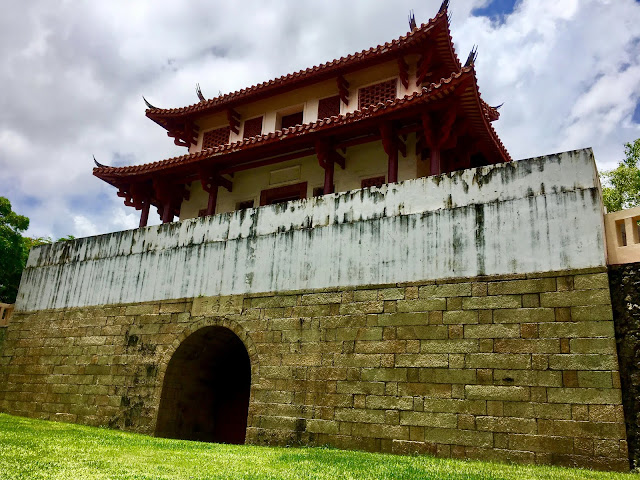
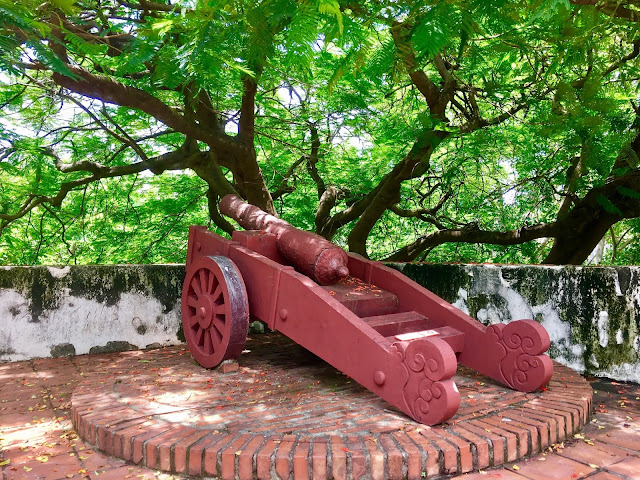
Great south gate 大南門, Tainan City, Taiwan

Great south gate 大南門, Tainan City, Taiwan

Great south gate 大南門, Tainan City, Taiwan

Great south gate 大南門, Tainan City, Taiwan

City wall (台南府城城垣遺跡)

The remains of the Taiwan Fucheng City Wall can be found on Shulin Street, connecting to National Tainan Girl's Senior High School. These remains were restored using ancient methods and closely resemble their original appearance. One section deliberately exposes the internal structure of the wall for observation. This well-preserved section is about 80 meters long and four meters high. From its appearance, it is evident that the wall was constructed using concrete and ancient methods. Given that very few traces of the old city wall can be seen in Tainan today, these remains hold significant historical value.

Fucheng City Wall, Tainan City, Taiwan

Fucheng City Wall, Tainan City, Taiwan

Duiyue Gate (兌悅門)

Duiyue Gate, also known as the Rocky Gate, was built in 1836. It is located on Xinyi Street and is the only remaining gate. In the past, there were waterways here with ships carrying stones. With the evolution of history and changes in topography, the importance of the city gate has shifted. Tainan had 14 gates in the past. The old city gate and the Wenqing new store on Xinyi Street represent the old town. Several specialty shops have opened on Xinyi Street, making it another historic street in Tainan with a classic appearance.

Duiyue Gate 兌悅門, Tainan City, Taiwan

Duiyue Gate 兌悅門, Tainan City, Taiwan

Xunfang Fortress (臺灣府城 巽方砲台)

Xunfang Fortress, also known as Fangjing Town, is located in the eastern part of Tainan City. It is one of the two towers built during the construction of the East Gate and is the only remaining inland turret in Tainan. The fort was built in 1836 during the Qing Dynasty to protect the inhabitants outside Dadongmen. The turret is made of coral reefs and triple concrete. It has a square shape with arches in the middle and banners on top. Stairs lead to the top of the building, and the original watchtower is still present. The turret is located in the southeast of the city and corresponds to the "巽" position in the Eight Diagrams. During the Japanese occupation, the city was destroyed and the fort was abandoned. After 1949, the Xunfang Fortress was occupied and rented by a Buddhist temple. It is currently used as a pavilion and a storage facility within the temple grounds. As a result, numerous Buddhist scriptures can be found on the fort's front.

Xunfang Fortress 臺灣府城 巽方砲台, Tainan City, Taiwan

Xunfang Fortress 臺灣府城 巽方砲台, Tainan City, Taiwan

Yingchunmen (臺灣府城-東門城(迎春門) )

Yingchunmen, also known as Taiwan's Fucheng Dadongmen, was built in 1725 and was the first of the 14 gates of the Taiwanese capital during the Qing Dynasty. It is the largest existing gate in Taiwan. The Great East Gate was originally built with wooden floors. In 1736, the wooden gate was replaced with a masonry gate. In 1786, the Lin Shuangwen incident broke out in Taiwan, leading to the renaming of the city to Sanhe and the conversion of Dongdong Gate into a two-story tower. Surrounding corridors and additional gates and towers were constructed to strengthen Fucheng's defense capabilities. The area around Dadongmen was densely populated, with residents living alongside the stone walls of the city gate. The city tower was rebuilt in 1975, preserving its ancient features with minor changes to the window design. The government reconstructed Dadongmen to its original form in 1977, and in 1985, it was designated as a three-level monument.

Dadongmen, Tainan City, Taiwan

Small East Gate (小東門段城桓殘蹟)

When City was built in 1735, the Xiaodongmen section included Zhengdong Dongshan Temple, Dadongmen, Muzha from Dadongmen, and continued to the right camp. It turned northeast to Xiaodongmen, then went north, and approached the city guard camp near the Great North Gate. Therefore, the Xiaodongmen section consists of two parts between Dadongmen City and Dabeimen City.
The Small East Gate (小東門段城桓殘蹟) is the only remaining section of the city of Taiwan. It is a remnant of the Xiaodongmen section of the Sanhe soil, stretching about 200 meters from Xiaodong Road in the north and about 65 meters in the south. It is hidden beneath dense woods. In 1966, when National Cheng Kung University acquired the campus of Guangfuying District, the southern section of the city was demolished to construct the campus wall.

Small East Gate 小東門段城桓殘蹟, Tainan City, Taiwan

Small East Gate 小東門段城桓殘蹟, Tainan City, Taiwan

Small East Gate 小東門段城桓殘蹟, Tainan City, Taiwan

Chenggong Hall (成功堂舊址)

The remnants of Chenggong Hall in Taiwan's Fucheng Town were established in 1788, with only a few remnants remaining today. Two large sections are reserved as three-level monuments, while another small section is listed as a municipal monument. The city was originally made of clay but was reinforced with triple soil to withstand heavy rains during Tainan's spring and summer. The remaining section is 64 meters long and 5 meters high. In 1982, National Cheng Kung University dismantled about 100 meters of this section to build new classrooms.

Address:

1. South Gate: 700台南市中西區臺灣府城 大南門
2. City Wall: 700台南市中西區台南府城城垣遺跡
3. Duiye Gate: 700台南市中西區文賢路信義街兌悅門
4. Xunfang Fortress: 701台南市東區光華街10號臺灣府城 巽方砲台
5. Yingchunmen: 701台南市東區東門路一段243號臺灣府城-東門城(迎春門) 
6. Small East Gate: 701台南市東區大學路1號小東門段城桓殘蹟

August 18, 2019

Historic places of Tainan City East District

Tainan is the oldest city in Taiwan and is commonly known as the "Capital City" due to its more than 200 years of history as the capital of Taiwan under the rule of Koxinga and later the Qing Dynasty. The city's complex history of resurgence, redefinition, and renewal has earned it the popular nickname "Phoenix City." As Taiwan's oldest urban area, Tainan was established by the Dutch East India Company as a ruling and trading base known as Fort Zeelandia during the Dutch colonial period. The city's previous name, Tayouan, is believed to be the origin of the name "Taiwan."

Tainan is also regarded as one of Taiwan's cultural capitals, renowned for its rich folk cultures, including its famous street food and traditional cuisine. It has diligently preserved Taoist rituals and a wide range of living local traditions that encompass various aspects of life, from childbirth to funerals. The city is home to Taiwan's first Confucian school-temple, constructed in 1665, as well as remnants of the Eastern and Southern gates of the old city and numerous other historical landmarks.

Xunfang Fortress (臺灣府城 巽方砲台)

Xunfang Fortress, also known as Fangjing Town, is located in the eastern part of Tainan City. It is one of the two towers built during the construction of the East Gate and is the only remaining inland turret in Tainan.
The fortress was built during the Qing Dynasty in 1836 to protect the residents outside Dadongmen. It is constructed using coral reefs and triple concrete. The fortress has a square plane, with arches in the middle and banners on top. There are stairs leading to the top of the building and an original watchtower on the fort. Positioned in the southeast of the city, the fortress corresponds to the "Xun" position in the Eight Diagrams.
During the Japanese occupation, the city was heavily damaged, and the fortress was abandoned. After 1949, the Xunfang Fortress was occupied and rented by a Buddhist temple. Today, it serves as a pavilion and warehouse within the temple premises. As a result, there are many Buddhist scriptures displayed on the front of the fort.

Small East Gate (小東門段城桓殘蹟)

When City was constructed in 1735, the Xiaodongmen section encompassed several areas. Starting from Zhengdong Dongshan Temple, it extended from Dadongmen to Muzha and continued towards the right camp. From there, it turned northeast towards Xiaodongmen, then proceeded northwards, leading to the vicinity of the city guard camp and the Great North Gate. Therefore, the Xiaodongmen section refers to the two segments between Dadongmen City and Dabeimen City.

In the city of Tainan, the Xiaochengmen section is the only remaining part of the city and serves as a significant historical remnant. It represents a portion of the Xiaodongmen section of the Sanhe City Wall. The Xiaochengmen section stretches approximately 200 meters in length from Xiaodong Road in the north to around 65 meters in the south. It is hidden within dense woods. In 1966, when the National Cheng Kung University acquired the campus in the Guangfuying District, the southern section of the city wall was demolished to make way for the construction of the campus wall.

small east gate, tainan city, taiwan

small east gate, tainan city, taiwan

small east gate, tainan city, taiwan

small east gate, tainan city, taiwan

Former Tainan County Governor's Residence (原臺南縣知事官邸)

The former Tainan County Governor's Residence is a significant cultural asset in Tainan City. Originally serving as the official residence of the governor of Tainan County during the Japanese Occupation, it later became the official residence of the governor of Tainan Prefecture after the restructuring. The building had a dual purpose, serving as a residence and the "Imperial Pos" for the governor's inspection and the royal family.

After World War II, the building briefly housed the General Administration of Salt Affairs and Land Administration Office. In the 1980s, it was used as a civil defense command post and the Eastern District Office. The Tainan City Government Staff Consumer Cooperative Association was added to the front. Recognizing its historical significance, the building was designated as a municipal historic site in 1998.

Since 2006, the Governor's Residence has undergone several phases of renovation and maintenance. The Taiwan Artists Ensemble Cultural Foundation won the bid to transform it into the "Governor's Residence Concert Hall," which officially opened on October 8, 2011. Additionally, a Western restaurant called "Guandi Western Restaurant" was opened on the first floor in cooperation with Lang Yubin starting from June 28, 2012.

The Governor's Residence, a two-story British colonial-style building, features arcades on the front and back. The middle and both sides of the building protrude in an octagonal shape. The exposed bricks of the arcades and arch columns create a distinctive visual appearance, with the remaining parts painted in red and white. The interior showcases detailed carvings on the wooden handrails of the stairs, as well as unique designs on the wooden covers of curtains and door curtains. The original arc gable above the entrance was destroyed after the war and has been replaced with a simpler gable.

The residence is also known as the "Clock Tower" due to different interpretations. Some attribute the name to the presence of a clock that used to tell the time within the building, while others believe it originated from the circular shape of the original arc gable, which nearby residents mistook for a clock.

former tainan county governor residence, tainan city, taiwan

former tainan county governor residence, tainan city, taiwan

Former Tainan Minister's Residence (原臺南廳長官邸)

The former official residence of the Tainan Minister, which had been abandoned for a long time, has now been restored. Originally used as the "Minister of Internal Affairs Office," the building underwent various transformations over the years. After the restructuring of Tainan County into the Tainan Office in 1901, it became the dormitory for the Tainan Office Director, the Supreme Chief Executive of the Tainan District. From 1901 to 1920, six ministers lived in the residence. With the abolition of the local administrative system, the building transitioned into the official residence of the Minister of the Interior under the state system.

Following World War II, the building served as the residence of a senior official of the Republic of China government and was guarded by plainclothes personnel. Later, the National Tainan No. 1 High School took over the building and used it for various purposes. The land was eventually allocated to the Tainan City Government. The original main entrance on the west side of the residence was divided, and a two-story reception area was added to the principal's dormitory. The adjacent land on the east side was divided, leading to the construction of a two-story dormitory building for Tainan No. 1 Middle School. Over time, the area of the former Tainan Office Chief's residence gradually diminished. The main part of the mansion has been utilized as a dormitory for the school's faculty and staff. About 20 years ago, the last faculty member residing in the building relocated to the United States, leaving it vacant. The southern Japanese-style building within the complex experienced two fires, resulting in the complete destruction of the original structure, with only bricks and remnants remaining.

The building was designated as a municipal monument on July 16, 2001. Prior to its restoration, the structure was in a state of near-collapse. The restoration process commenced in 2010, and repairs to the emergency protection scaffolding, porch, and other elements were completed in 2016.

The building features a fusion of Japanese and Western architectural styles. The western pavilion located on the north side of the building likely served as an office and reception space, while the southern pavilion functioned as a living area. Unfortunately, the pavilion on the south side was destroyed by fire, leaving only partial remains. The mansion's roof is adorned with Japanese-style cement tiles, while the walls are constructed from bamboo and mortar. Ventilation holes are present on the raised base, and an external corridor surrounds the building. Originally, there was a porch at the west entrance, but it was demolished by Tainan No. 1 High School in 2008 as part of an effort to improve the environment and prevent dengue fever. When the building was restored in 2015, it was reconstructed to resemble its original form.

former tainan minister residence, tainan city, taiwan

Yingchunmen (臺灣府城-東門城(迎春門) )

Yingchunmen, also known as Taiwan's Fucheng Dadongmen, was built in 1725 as one of the 14 gates of the Taiwanese capital during the Qing Dynasty. It is the largest existing city gate in Taiwan.

The Great East Gate was initially constructed with wooden floors, but in 1736, the wooden gate was replaced with a masonry gate. In 1786, the Lin Shuangwen incident broke out in Taiwan, and as a result, the city was renamed Sanhe in 1788. The Dongdong Gate was converted into a two-story tower, and additional gates and towers were constructed in the surrounding corridors to enhance the defense capabilities of Fucheng. Many houses are located around Dadongmen, and the residents live near the stone walls of the city gate.

In 1895, the Japanese attacked Tainan Fucheng from three sides, and on October 22, the Japanese army entered the city. Since then, the city has faced the fate of demolition, and the city gate has fallen into disrepair. In 1901, the government issued a plan for urban correction, and Dadongmen was intended to be preserved as a ring green park.

After World War II, Dadongmen was occupied by illegal buildings, and the tower was demolished in 1952. In August 1955, Typhoon Ayres brought heavy rains, leading to the collapse of the tower and the destruction of houses nearby, resulting in a tragedy where ten people were buried. Only the pedestal of Dadongmen remained.

In 1975, the city tower was rebuilt, preserving its ancient features. While the shape of the windows has changed, the government reconstructed Dadongmen in its original form in 1977. In 1985, the government designated Dadongmen as a three-level monument.

The Dadongmen City Tower is a two-story structure with a robust mountain design featuring orange cylinders. All four sides of the tower are white, and the second floor is adorned with octagonal and fan-shaped windows. It remains the largest existing city gate in Taiwan. The city gate of Dadongmen is constructed with long strips of granite. The city base is grand, and the doorway is centered. The west side arch is engraved with "Yingchunmen," while the east side features a stone banner titled "Donganmen".

yingchunmen gate, tainan city, taiwan

Old City Wall Remains (成功堂舊址)

Taiwan's Fucheng Town was indeed established in 1788, and today only a few remnants of the town remain. Two of these remnants are large in size and have been designated as three-level monuments for preservation, while another smaller section is listed as a municipal monument.
Originally, the town was constructed using clay as the primary material. However, due to the heavy rains during Tainan's spring and summer seasons, additional layers of soil were added for protection. The remaining section of the town is approximately 64 meters long and 5 meters high.
In 1982, the National Cheng Kung University dismantled a portion of this city section, approximately 100 meters in length, in order to construct new classrooms. This removal affected the historical remains of the town.

Address:

1. Xunfang Fortress: 701台南市東區光華街10號臺灣府城 巽方砲台
2. Small East Gate: 701台南市東區大學路1號小東門段城桓殘蹟
3. Former Tainan County Governor's Residence: 701台南市東區衛民街1號原臺南縣知事官邸
4. Former Tainan Minister's Residence: 701台南市東區育樂街197巷2號原臺南廳長官邸
5. Yingchunmen: 701台南市東區東門路一段243號臺灣府城-東門城(迎春門) 
6. Old Wall Remains: 701台南市東區勝利路294號成功堂舊址

August 6, 2019

Historic places of Tainan City West Central District (part II)

Tainan is the oldest city in Taiwan and is commonly known as the "Capital City" due to its more than 200 years of history as the capital of Taiwan under the rule of Koxinga and later the Qing Dynasty. The city's complex history of resurgence, redefinition, and renewal has earned it the popular nickname "Phoenix City." As Taiwan's oldest urban area, Tainan was established by the Dutch East India Company as a ruling and trading base known as Fort Zeelandia during the Dutch colonial period. The city's previous name, Tayouan, is believed to be the origin of the name "Taiwan."

Tainan is also regarded as one of Taiwan's cultural capitals, renowned for its rich folk cultures, including its famous street food and traditional cuisine. It has diligently preserved Taoist rituals and a wide range of living local traditions that encompass various aspects of life, from childbirth to funerals. The city is home to Taiwan's first Confucian school-temple, constructed in 1665, as well as remnants of the Eastern and Southern gates of the old city and numerous other historical landmarks.

Great South Gate (大南門 (寧南門))

Great South Gate (大南門 or 寧南門) of Fucheng was constructed in 1725 and is one of the 14 gates that once surrounded the capital city of Taiwan during the Qing Dynasty. It is situated in the central and western district of Tainan City. The gate is a three-level monument and is the only remaining gate in Taiwan among the original five gates of Tainan. Dabeimen, Xiaobeimen, Xiaodongmen, and Xiaonanmen have all disappeared.

After World War II, the Great South Gate Tower remained standing, but the mid-ridge collapsed due to heavy rain in 1963. The gate was restored with a new roof in 1977. There are three characters inscribed on the inner door, and the outer door is labeled as the South Gate. Behind the gate is the Jianxing National Middle School.


great south gate, tainan city, taiwan

great south gate, tainan city, taiwan

great south gate, tainan city, taiwan

great south gate, tainan city, taiwan

great south gate, tainan city, taiwan

great south gate, tainan city, taiwan

Stone Monuments Forest (碑林)

Stone Monuments Forest (碑林), also known as "Dabeilin," is one of the ten scenic spots in Tainan's historical buildings and is considered a historic site in Taiwan. Notably, the stone monuments, including the "Reconstruction of the Monument of Taiwan's Fucheng," have been designated as cultural assets of antiquity.

The Nanmen Stone Monument Forest was created during the Japanese occupation of Taiwan. In 1935, 45 ancient monuments were collected for display at the Taiwan Expo. In 1977, 15 ancient monuments were moved from Chihkan Tower, and three additional ones were added. Today, the monument forest houses 63 ancient monuments. These monuments can be categorized into six groups: Jigong monument, construction monument, architectural monument, donation monument, tombstone monument, and display monument.


stone monuments forest, tainan city, taiwan

stone monuments forest, tainan city, taiwan

stone monuments forest, tainan city, taiwan

Film Center (南門電影書院 | 台南放送局)

Film Center (南門電影書院 | 台南放送局) is another notable attraction within the park. Originally completed in 1932 as the Nanmen Film Academy, it served as the Tainan Broadcasting Bureau. The building exhibits a Western-style architectural design, standing out in the quaint Nanmen Park.
During the Japanese occupation period, the center was responsible for broadcasting. People who wanted to listen to the radio had to register with the association and pay a monthly fee.

In recent years, Nanyi University has collaborated with the municipal government to establish the "Southern Taiwan Film Academy in Tainan City," focusing on film and television-related activities such as education, co-production, information inquiry, and film screenings. The museum showcases various artifacts related to the film industry, and classic movies are regularly screened in the 24-seat theater. It is a great place to immerse oneself in the nostalgia of the past film and television styles.


film center, tainan city, taiwan

film center, tainan city, taiwan

film center, tainan city, taiwan

film center, tainan city, taiwan

film center, tainan city, taiwan

film center, tainan city, taiwan

City Wall (台南府城城垣遺跡)

City Wall  remnants of Taiwan Fucheng City Wall can be found on Shulin Street, connecting to National Tainan Girl's Senior High School. The remains have been restored using ancient methods and resemble their original appearance. In one section, the internal structure of the wall has intentionally been left exposed for observation. The school section spans eighty meters in length and stands four meters tall, representing the best-preserved portion. The wall was constructed using concrete and traditional methods, and the scarcity of remaining traces of the old city wall in Tainan makes these remains highly valuable.


old city wall, tainan city, taiwan

old city wall, tainan city, taiwan

Fahua Temple (法華寺)

Fahua Temple (法華寺) has its origins in the former residence of Li Maochun, who arrived in Taiyi with Zheng Jing during the final years of the Ming Dynasty. Li Maochun unintentionally acquired the name Li Bodhisattva, and he planted a bamboo tree in the location of his residence, creating a garden for Buddhist practice. Li Maochun and Ming Zheng were friends with Chen Yonghua, who served in the army. After Li Maochun's passing, his best friend converted the former residence into a temple dedicated to the Bodhisattva.

Fahua Temple was constructed in 1684 through the fundraising efforts of Jiang Yuying. In 1698, Song Yongqing of Fengshan County led a donation campaign to build a three-in-one temple. The front hall is dedicated to Nanji Emperor, also known as the Temple of Fire. The nave is dedicated to Guanyin Bodhisattva, while the apse is dedicated to the Bodhisattva. Additionally, there is a Zen room in the backyard where bamboo and flowers are cultivated. In 1713, the temple's abbot installed a cast bell that was hung from the clock tower. Unfortunately, the Fahua Temple was destroyed in an earthquake in 1721. The restoration was completed between 1743 and 1764.

In 1942, the temple underwent refurbishment. The Japanese, who built the Tainan Airport, demolished the tomb of Li Maochun and relocated his remains to the temple tower. During World War II, most of the temple's buildings were burned. In the 1940s, the abbot Changchang Master initiated a reconstruction effort that lasted until 1959. Although most of the temple's buildings were reconstructed to resemble wood-like structures, they were built in accordance with traditional architectural styles due to their historical significance and overall regulations. In 1985, the temple was listed as a Three-Level Monument.

fahua temple, tainan city, taiwan

fahua temple, tainan city, taiwan

fahua temple, tainan city, taiwan

fahua temple, tainan city, taiwan

fahua temple, tainan city, taiwan

Kuilou Academy (奎樓書院)

Kuilou Academy (奎樓書院), also known as Kuilou College, was established in 1726. It originated from the "Kui Xingtang" and "Zhongshe Academy." Through donations from Qingbao, the "Zhongshe Academy" was formed, which included structures like Kuixingtang and Cangshengtang. It was recognized as one of the four major colleges in Fucheng, alongside Chongwen, Haidong, and Penghu. Although referred to as a college, Kuilou Academy served as a place for scholars to gather and discuss literature and poetry history, distinguishing it from other lecture-based colleges. The academy was originally located next to the patrol station. During the Japanese occupation period, the road was relocated to its current site, but the main building was destroyed during World War II. After reconstruction, the academy assumed its present appearance and was repurposed as a kindergarten classroom.


kuilou academy, tainan city, taiwan

Address:

1. Great South Gate: 700台南市中西區寧南門
2. Stone Monuments Forest: 700台南市中西區樹林街二段碑林
3. Film Center: 700台南市中西區南門路38號台南放送局
4. City Wall: 700台南市中西區台南府城城垣遺跡
5. Fahua Temple: 700台南市中西區法華街100號法華寺
6. Kuilou Academy: 700台南市中西區府前路一段90巷34弄25號奎樓書院