Showing posts with label merchant house. Show all posts

June 12, 2019

Tainan Travel: Visiting Anping ~ Old Street and historical buildings

It's our second time visiting Anping. Two years ago, we visited the five most popular places that can be visited with a single ticket. This time, I wanted to see some places we missed before. We visited Sio House (Salt Museum)Oyster Shell KilnTemple, Old Streetforts and castle and some smaller ancient buildings. Some places are free to visit, while others have an entrance fee of 50 NTD. Anping is one of my favorite places to visit, as it is full of history and street food can be found everywhere. In March 2012, Anping was named one of the Top 10 Small Tourist Towns by the Tourism Bureau of Taiwan. The older place name, Tayouan, comes from a nearby Taiwanese aboriginal tribe and was given by the Dutch and Portuguese. Han immigrants later renamed the area "Anping" after the Anping Bridge in Fujian. Soon after Qing rule was established in 1683, the name "Taiwan" (臺灣) was officially used to refer to the entire island with the establishment of Taiwan Prefecture.

Anping Old Street (安平老街)

In the middle of the Ming Dynasty, smugglers from Mainland China, Japan, as well as European businessmen such as Portugal, Spain, and the United Kingdom came to Anping to trade with each other and with the Pingpu people. During that time, the city street Yanping Street was formed. Yanping Street (延平老街) is the first street built in Anping during the Dutch era 300 years ago and was the first street in Taiwan to be given a name. The street was designed as part of the city's planning during the Qing Dynasty and is 2-3 meters wide, mainly for pedestrians. Anping Old Street has many alleys, but at that time, the length of the city street seemed to be only from the 104th Lane of Yanping Street to the east, leading to Shimen Elementary School.

The houses on this street are mainly built with red bricks in a Western style. On the street, you can also see Wind Lion Gods (風獅爺) on the roofs of buildings and Sword Lions (劍獅) on the lintels of doors. Wind Lion Gods (Shisa) are Chinese guardian lions often seen in pairs, believed to protect against evil spirits. They are placed on roofs or gates, with the left lion traditionally having a closed mouth (warding off evil spirits) and the right one having an open mouth (keeping good spirits). Sword Lions are lion heads biting a sword, used to ward off evil spirits. They are a common decoration in the Anping area.

Anping Old Street and nearby streets are filled with street food and can get very crowded. Nearby, there is a famous douhua shop that is usually packed with people (while many other shops are empty).

anping old street, tainan, taiwan

anping old street, tainan, taiwan

anping old street, tainan, taiwan

anping old street, tainan, taiwan

anping old street, tainan, taiwan

anping old street, tainan, taiwan

anping old street, tainan, taiwan

anping old street, tainan, taiwan

anping old street, tainan, taiwan

Tianhou Temple  (安平開臺天后宮)

Tianhou Temple (安平開臺天后宮) was built in 1668 and is said to be the oldest Mazu Temple in Taiwan. The statues of the gods were brought from Fujian, China by Koxinga. The temple has been demolished by the Japanese and rebuilt several times, most recently in 1976 and 1994. The main statue of the god is said to be more than a thousand years old. Mazu is credited with miracles around the temple, such as leading Anping's initial settlers, protecting from bombing during World War II, producing sweat, and safeguarding the temple during a fire in 1990.
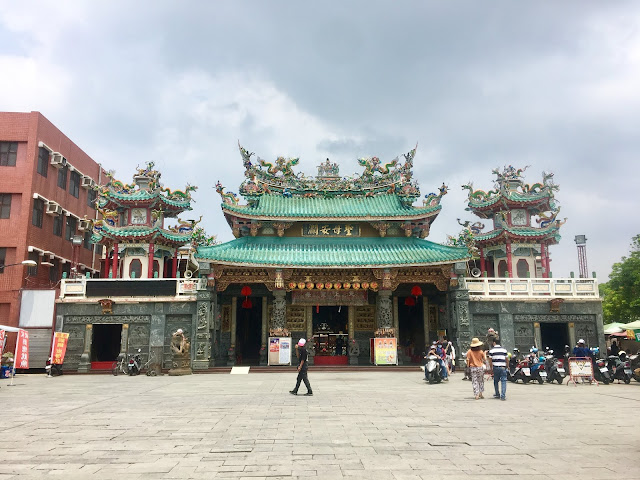
See also: Tianhou Temple

tianhou temple, tainan, taiwan

Julius Mannich Merchant House (東興洋行)

Julius Mannich Merchant House (東興洋行) was built in 1867 by a German businessman. It was used for the trade of camphor and sugar and represented the shipping business. The business closed during the Japanese period due to the opium and camphor monopoly. The Japanese then took over the building and converted it into Tainan Hall in 1901. In 1920, it became Anping Police Station. In 1984, the building was taken back by the Tainan Government. Nowadays, it serves as the Foreign Trade Memorial Hall, where visitors can learn more about the 300-year history of trade in Anping and things related to Germany.

merchant house, tainan, taiwan

merchant house, tainan, taiwan

merchant house, tainan, taiwan

Zhu Yuying Residence (朱玖瑩故居(因鹽玖定))

Zhu Yuying Residence (朱玖瑩故居(因鹽玖定)) was the former residence of Zhu Yuying, a calligraphy teacher from China. Inside the building, there is a calligraphy exhibition hall displaying book works by Zhu Yuying, and visitors can also practice their writing skills.

See also: Fort Zeelandia

zhu yuying residence, tainan, taiwan

zhu yuying residence, tainan, taiwan


zhu yuying residence, tainan, taiwan

Haishan Hall (海山館)

Haishan Hall (海山館) was built in 1684 and served as a dormitory during the Qing Dynasty. It was abandoned during the Japanese era and later converted into a residential building during the Republic of China era. The building is decorated with many lions, showcasing the architecture of Anping at that time. This place worships the gods of heaven and five officials. The interior of the building is empty, and not many people visit this place.

haishan hall, tainan, taiwan

haishan hall, tainan, taiwan


Address:
1. Yanping Street, Anping District, Tainan City, 708
2. No. 33號, Guosheng Rd, Anping District, Tainan City, 708
3. No. 3, Lane 233, Anbei Road, Anping District, Tainan City, 708
4. No. 108, Gubao Street, Anping District, Tainan City, 708
5. 708, Tainan City, Anping District, 效忠街52巷3號

June 4, 2019

Tainan Travel: Visiting Anping ~ Sio House and History of Salt

It's our second time visiting Anping. Two years ago, we visited the five most popular places that can be visited with a single ticket. This time, I wanted to see some places we missed before. We visited Sio House (Salt Museum)Oyster Shell KilnTemple, Old Streetforts and castle and some smaller ancient buildings. Some places are free to visit, while others have an entrance fee of 50 NTD. Anping is one of my favorite places to visit, as it is full of history and street food can be found everywhere. In March 2012, Anping was named one of the Top 10 Small Tourist Towns by the Tourism Bureau of Taiwan. The older place name, Tayouan, comes from a nearby Taiwanese aboriginal tribe and was given by the Dutch and Portuguese. Han immigrants later renamed the area "Anping" after the Anping Bridge in Fujian. Soon after Qing rule was established in 1683, the name "Taiwan" (臺灣) was officially used to refer to the entire island with the establishment of Taiwan Prefecture.

Sio House Salt Museum (夕遊-出張所)

During the Japanese occupation, the Sio House Salt Museum served as an important salt affairs office responsible for storage, sales, and inspection. The museum is located near a beach and park, covering an area of 100 pings (330 m2). Inside the exhibition hall, you can find colored salt in 366 different colors, including a color associated with your own birthday. Each color has its meaning, which you can inquire about from the staff (Chinese only). Additionally, you can taste colored baked quail eggs and try breaking the shells using a wooden millet. There is also a DIY lesson on making your own douhua (Tofu pudding).


sio house, salt, anping, tainan, taiwan

sio house, salt, anping, tainan, taiwan

sio house, salt, anping, tainan, taiwan

sio house, salt, anping, tainan, taiwan

sio house, salt, anping, tainan, taiwan

History of salt production in Taiwan 

When salt production began in Taiwan, it was not possible to test the salt. However, residents in coastal areas obtained salt by boiling seawater or trading with merchants from mainland China. Those who didn't live near the coast used spring water to obtain salt. In 1648, the Dutch East India Company imported crushed stone from mainland China to build a salt granule (crystallized pool). They opened a salt mine, but the salt produced there was bitter and unsellable. Until the end of Dutch rule, Taiwan relied on imported salt from mainland China, except for local residents who made their own sea salt.

In 1661, when Zheng Jun arrived in Taiwan, he actively expanded agricultural land. Additionally, in 1665, Ming Zheng joined the army and Chen Yonghua taught people to build hills, reconstructing the abandoned salt fields and improving the salt-making method. They opened three salt fields with a total of 2,744 plaques.

During the Japanese rule in Taiwan, the salt sales network was disrupted when the monopoly system was abolished in 1895. Most salt farmers switched to sun-drying fields as salt produced in Taiwan couldn't be sold smoothly. The area of salt fields was reduced from 640 to 203. In 1899, the Governor's Office of Taiwan restored the monopoly system with the "Taiwan Salt Monopoly Rules," and the salt field area in Taiwan returned to its Qing Dynasty size, capable of exporting salt to Japan. Salt production exceeded 100,000 metric tons in 1914 and reached up to 170,000 metric tons in two years.
See also: Fort Zeelandia

sio house, salt, anping, tainan, taiwan

sio house, salt, anping, tainan, taiwan

sio house, salt, anping, tainan, taiwan

sio house, salt, anping, tainan, taiwan

Taiwan Salt Co.

During World War I, the demand for industrial salt increased with the development of the Japanese industry. In 1919, the Taiwan Governor's Monopoly Bureau established "Taiwan Salt Co., Ltd." for salt production, while Dainippon Salt Co., Ltd. was responsible for salt export to Japan. The demand for industrial salt further increased in the 1930s due to the rise of the Japanese chemical industry. The Monopoly Bureau established a plan to construct 47,000 metric tons of industrial salt over four years.

In 1938, the company established the South Japan Salt Industry Co. and opened a total of 6,000 industrial salt fields in Chiayi, Tainan, and Kaohsiung. A factory was set up in Anshun, Tainan in 1942, and the output reached 530,000 metric tons. In 1947, the Taiwan Provincial Chief Executive's Office of Monopoly received all the salt assets of the Japanese in Taiwan and established the Tainan Salt Industry Company to continue the monopoly system. In 1952, six salt fields were set up, and the Taiwan salt industry entered a state-run period. Even after the war, Japan had a demand for Taiwanese salt, leading to the signing of the "Taiwan Salt Sales Day Contract" in 1950 for a total of 360,000 tons.

In 1980, low-capacity salt fields were closed, and the overall trend of salt field area and production in Taiwan was on the rise. In 1962, it surpassed the level of Japanese occupation for the first time, with a total annual output of 560,000 metric tons and large-scale exports. From 1953 to 1966, the average annual export of salt to Japan was 200,000 metric tons. However, the output at this time only met 30% of Taiwan's industrial salt demand, resulting in high salt prices. Efforts were made to reduce production costs and increase competitiveness, including cooperation with the French company Midi in the 1970s. Although some improvements were made, Taiwan's climate ultimately limited the success of the plan. In 2002, all salt fields were closed, and the Taiwan Salt Company became a private company after the withdrawal of official shares in November of the same year. The salt monopoly was also abolished.

The remains of salt companies in Anping

The Taiwan Salt Japanese-style dormitory (安平靜苑) was established in 1919. At that time, numerous factories, warehouses, offices, and dormitories were built around the salt washing factory on the bank of Yanghang Canal. You can also visit the Merchant house and Anping tree house. The Merchant house was originally constructed as a trading company and later served as an office and warehouse for the Japan Salt Company. After World War II, it became an office for the Tainan Salt Company but was eventually abandoned. In 1979, the Tainan Municipal Government transformed the building into a museum with the sponsorship of Chi Mei. The building is now overgrown with trees, and in 2004, bridges and wooden roads were built to allow visitors to explore the area.

Taiwan Salt Japanese-style dormitory, anping, tainan, taiwan

Taiwan Salt Japanese-style dormitory, anping, tainan, taiwan

Taiwan Salt Japanese-style dormitory, anping, tainan, taiwan

Taiwan Salt Japanese-style dormitory, anping, tainan, taiwan

Taiwan Salt Japanese-style dormitory, anping, tainan, taiwan
 
Taiwan Salt Japanese-style dormitory, anping, tainan, taiwan

Taiwan Salt Japanese-style dormitory, anping, tainan, taiwan

Taiwan Salt Japanese-style dormitory, anping, tainan, taiwan

Address:

1. Sio House Salt Museum:  708台南市安平區古堡街196號安平鹽神白沙灘公園
2. Japanese Style Dormitory: 708台南市安平區安北路233巷1弄12號台鹽日式宿舍
3. Former Tait & Co. Merchant House: 708台南市安平區古堡街108號英商德記洋行