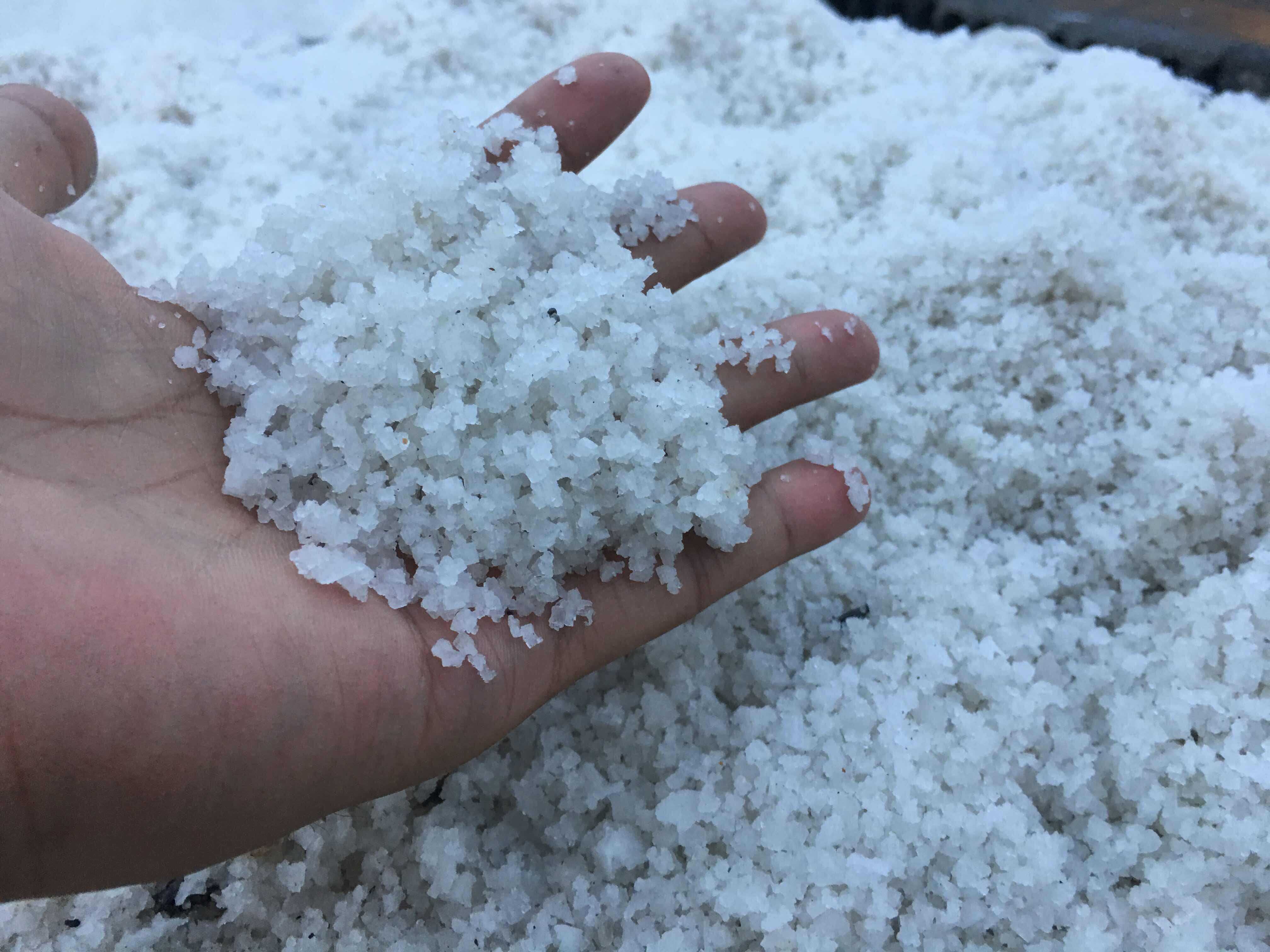
Showing posts with label salt. Show all posts

November 9, 2019

Tainan Travel: Taijiang National Park and Luerhmen Mazu Temple

Again, we traveled with my Polish friend and her family, and this time they wanted to visit Tainan. Initially, I wanted to go to Anping, but they chose to visit Taijiang National Park. We planned to take a boat trip, but there were too many people, and we would have had to wait for at least 1-2 hours. So, I decided to bring them to the Salt Fields instead. They had never been there before and really liked it. It's also a nice place for kids to play, as there are six fields that visitors are allowed to enter.
This wasn't our first time in the national park. Some time ago, we drove around the area. Without taking a boat trip, the view is not particularly special—just water with trees and some birds. We had also previously visited Sicao Fort and Luerhmen Mazu Temple, so I finally put it all together in one blog post.

Taijiang National Park (台江國家公園)

Taijiang National Park (台江國家公園) was officially established on December 28, 2009. It includes the Annan District of Tainan City and the coastal area of Qiqi District, including Sicao, Luermen, the former Anshun Yantian, the seven-share lagoon, and the sea to Dongji Island in Penghu County.
Unlike other national parks, which are primarily governed by the central government, Taijiang National Park was initiated by the local government, specifically the Tainan City Government. On June 29, 2009, the Ministry of the Interior approved a plan to establish the name "Taijiang River" to facilitate international marketing. Taijiang National Park covers an area of 39,310 hectares (118,912,754 ping).

Originally, the area was an inland sea and lagoon in southwest Taiwan until the 18th century when the lagoon gradually became land. The sandbar on the outer side of the lagoon integrated with the land. Additionally, the Taijiang River has played a significant role in history, with events such as Zheng Chenggong's entry into the Inner Sea through the Luermen Waterway and the unexpected attack on the earlier Dutch colonizers, establishing Taiwan as a dominant society for the Han people.

In 1624, the Dutch East India Company decided to relocate their destroyed Wuhu City to Taiwan and build a city on Daegu Island. After 8 years and 4 months, it was finally completed at the end of 1632. The city, serving as a trade and administrative center, was named Zeelandia, now known as "Anping Fort." In the opposite corner of the northern line (汕) tail island, the Dutch chose to build a walled city known as "Zeeburg." The structure was a three-story tower with the lower two floors measuring 6 meters wide and the upper floor 9 meters wide. It featured six cannons, and the wall was 2.5 meters thick. However, this town was damaged by a strong typhoon in 1656 and was never rebuilt, allowing Zheng Chenggong to take advantage of the situation. In 1661, Zheng Chenggong's army entered the Taijiang River through the Luermen Waterway, landing on the northern line.

Over time, due to siltation in the Luermen River and the development of land on both sides of the saltwater creek, the river channel narrowed, leading to a significant decrease in drifting sand. The construction of Wushantou Reservoir and Zengwen Reservoir further impacted the area. In recent years, the construction of the offshore fishing port and the multi-purpose port Anping Shanggang, as well as the burial of the Tainan Science and Technology Industrial Zone wastewater discharge pipe at the north side of the saltwater creek outlet, created a "jetty effect."
With changes in the environment and increasing labor costs, the aquaculture and salt industries faced challenges in the 1970s, leading Taiwan Salt to plan to stop salt production in the 1990s. The younger generation perceived farming as hard, risky, and unstable, resulting in a gradual abandonment of farming and the deterioration of fish farms. However, this decline in traditional coastal industries allowed the natural environment to recover, leading to a gradual diversification of biological ecology.

taijiang national park, annan, tainan, taiwan

taijiang national park, annan, tainan, taiwan

taijiang national park, annan, tainan, taiwan

taijiang national park, annan, tainan, taiwan

taijiang national park, annan, tainan, taiwan

taijiang national park, annan, tainan, taiwan

Sicao Fort (四草砲臺)

Sicao Fort (四草砲臺) is located in the Annan District of Tainan City and is a second-class monument since August 1985. The building is one of the 17 turrets built by Yao Ying of the Taiwan Armed Forces during the Qing dynasty. The remaining part has become the small wall of Zhenhai.
To strengthen Taiwan's coastal defense during the first Opium War, Yao Ying of the Taiwan Armed Forces built Zhenhai City, commonly known as Sicao Fort, in 1840, alongside the construction of Anping Small Fort in Anping.

Due to the urgency of the defense at that time, the fortification was initially made of bamboo rafts and sacks, with a 30-foot (about 96-meter) long retaining wall and ten gun piers. The trench surrounding the fort was filled with 20,000 hidden bamboo sticks, 800 nail barrels, 800 nail boards, and two iron shovels.
However, after the garrison was transferred and the port of Sicao was abandoned, the fort fell into disrepair and was damaged. After World War II, in 1951, Zhenhai Elementary School was built on the west side of the remaining wall. The remaining section of the fort's wall became part of the school's outer wall. In 1969, a section of the wall collapsed due to a typhoon but was later restored in 1977.

The fort is constructed with pebbles, triple soil, and long slabs. The figure-shaped blastholes on the wall were designed to change the angle.
Opposite the fort is Sicao Temple, and behind the temple lies "Hailing Jiacheng," the remains of Dutch soldiers killed by Zheng Jun under the leadership of Chen Ze during the Dutch rule in Taiwan.

See also: Anping Fort

sicao fort, annan, tainan, taiwan

sicao fort, annan, tainan, taiwan

Salt Fields 

I have been to the salt fields a few times, and it's always a wonderful experience. The sunset view here is truly beautiful. It's also a lot of fun for kids to play here. During this visit, there was even a parrot show, so we could see plenty of beautiful colorful birds flying above the fields. If you want to learn more about the salt history and salt fields, you can visit my other blog posts.


salt fields, beimen, tainan, taiwan

salt fields, beimen, tainan, taiwan

salt fields, beimen, tainan, taiwan

salt fields, beimen, tainan, taiwan

Luerhmen Mazu Temple (正統鹿耳門聖母廟)

Luerhmen Mazu Temple (正統鹿耳門聖母廟) is an Orthodox Temple in the Annan District of Tainan. It's a temple dedicated to the Virgin Mary. According to the book "Taiwan Tucheng Orthodox Luermen Temple," there was already a Mazu Temple in the area as early as Zheng Chenggong's arrival in Taiwan. At that time, there were three temples—one dedicated to Dianxian Zunwang in the front hall, one for the worship of Mazu in the Zheng Hall, and one for Buddha in the apse. Another story suggests that after Zheng Chenggong came to Taiwan, he rebuilt the temple to express his gratitude to God and added two side rooms to worship the three Mazu statues that came with the ship. After World War II, Xiangong built the temple's gate in 1947 and promoted the opening of the temple. In 1975, the temple was rebuilt at its current location.

luerhmen mazu temple, annan, tainan, taiwan

luerhmen mazu temple, annan, tainan, taiwan

luerhmen mazu temple, annan, tainan, taiwan

luerhmen mazu temple, annan, tainan, taiwan

Address:

1. Taijiang National Park: 709台南市安南區四草大道118號台江國家公園
2. Sicao Fort: 709台南市安南區顯草街一段381號四草砲臺
3. Salt Fields: 727台南市北門區西南郊復育鹽田
4. Luerhmen Mazu Temple: 70958台南市安南區城安路160號正統鹿耳門聖母廟

June 4, 2019

Tainan Travel: Visiting Anping ~ Sio House and History of Salt

It's our second time visiting Anping. Two years ago, we visited the five most popular places that can be visited with a single ticket. This time, I wanted to see some places we missed before. We visited Sio House (Salt Museum), Oyster Shell Kiln, Temple, Old Street, forts and castle and some smaller ancient buildings. Some places are free to visit, while others have an entrance fee of 50 NTD. Anping is one of my favorite places to visit, as it is full of history and street food can be found everywhere. In March 2012, Anping was named one of the Top 10 Small Tourist Towns by the Tourism Bureau of Taiwan. The older place name, Tayouan, comes from a nearby Taiwanese aboriginal tribe and was given by the Dutch and Portuguese. Han immigrants later renamed the area "Anping" after the Anping Bridge in Fujian. Soon after Qing rule was established in 1683, the name "Taiwan" (臺灣) was officially used to refer to the entire island with the establishment of Taiwan Prefecture.

Sio House Salt Museum (夕遊-出張所)

During the Japanese occupation, the Sio House Salt Museum served as an important salt affairs office responsible for storage, sales, and inspection. The museum is located near a beach and park, covering an area of 100 pings (330 m2). Inside the exhibition hall, you can find colored salt in 366 different colors, including a color associated with your own birthday. Each color has its meaning, which you can inquire about from the staff (Chinese only). Additionally, you can taste colored baked quail eggs and try breaking the shells using a wooden millet. There is also a DIY lesson on making your own douhua (Tofu pudding).


sio house, salt, anping, tainan, taiwan

sio house, salt, anping, tainan, taiwan

sio house, salt, anping, tainan, taiwan

sio house, salt, anping, tainan, taiwan

sio house, salt, anping, tainan, taiwan

History of salt production in Taiwan 

When salt production began in Taiwan, it was not possible to test the salt. However, residents in coastal areas obtained salt by boiling seawater or trading with merchants from mainland China. Those who didn't live near the coast used spring water to obtain salt. In 1648, the Dutch East India Company imported crushed stone from mainland China to build a salt granule (crystallized pool). They opened a salt mine, but the salt produced there was bitter and unsellable. Until the end of Dutch rule, Taiwan relied on imported salt from mainland China, except for local residents who made their own sea salt.

In 1661, when Zheng Jun arrived in Taiwan, he actively expanded agricultural land. Additionally, in 1665, Ming Zheng joined the army and Chen Yonghua taught people to build hills, reconstructing the abandoned salt fields and improving the salt-making method. They opened three salt fields with a total of 2,744 plaques.

During the Japanese rule in Taiwan, the salt sales network was disrupted when the monopoly system was abolished in 1895. Most salt farmers switched to sun-drying fields as salt produced in Taiwan couldn't be sold smoothly. The area of salt fields was reduced from 640 to 203. In 1899, the Governor's Office of Taiwan restored the monopoly system with the "Taiwan Salt Monopoly Rules," and the salt field area in Taiwan returned to its Qing Dynasty size, capable of exporting salt to Japan. Salt production exceeded 100,000 metric tons in 1914 and reached up to 170,000 metric tons in two years.
See also: Fort Zeelandia

sio house, salt, anping, tainan, taiwan

sio house, salt, anping, tainan, taiwan

sio house, salt, anping, tainan, taiwan

sio house, salt, anping, tainan, taiwan

Taiwan Salt Co.

During World War I, the demand for industrial salt increased with the development of the Japanese industry. In 1919, the Taiwan Governor's Monopoly Bureau established "Taiwan Salt Co., Ltd." for salt production, while Dainippon Salt Co., Ltd. was responsible for salt export to Japan. The demand for industrial salt further increased in the 1930s due to the rise of the Japanese chemical industry. The Monopoly Bureau established a plan to construct 47,000 metric tons of industrial salt over four years.

In 1938, the company established the South Japan Salt Industry Co. and opened a total of 6,000 industrial salt fields in Chiayi, Tainan, and Kaohsiung. A factory was set up in Anshun, Tainan in 1942, and the output reached 530,000 metric tons. In 1947, the Taiwan Provincial Chief Executive's Office of Monopoly received all the salt assets of the Japanese in Taiwan and established the Tainan Salt Industry Company to continue the monopoly system. In 1952, six salt fields were set up, and the Taiwan salt industry entered a state-run period. Even after the war, Japan had a demand for Taiwanese salt, leading to the signing of the "Taiwan Salt Sales Day Contract" in 1950 for a total of 360,000 tons.

In 1980, low-capacity salt fields were closed, and the overall trend of salt field area and production in Taiwan was on the rise. In 1962, it surpassed the level of Japanese occupation for the first time, with a total annual output of 560,000 metric tons and large-scale exports. From 1953 to 1966, the average annual export of salt to Japan was 200,000 metric tons. However, the output at this time only met 30% of Taiwan's industrial salt demand, resulting in high salt prices. Efforts were made to reduce production costs and increase competitiveness, including cooperation with the French company Midi in the 1970s. Although some improvements were made, Taiwan's climate ultimately limited the success of the plan. In 2002, all salt fields were closed, and the Taiwan Salt Company became a private company after the withdrawal of official shares in November of the same year. The salt monopoly was also abolished.

The remains of salt companies in Anping

The Taiwan Salt Japanese-style dormitory (安平靜苑) was established in 1919. At that time, numerous factories, warehouses, offices, and dormitories were built around the salt washing factory on the bank of Yanghang Canal. You can also visit the Merchant house and Anping tree house. The Merchant house was originally constructed as a trading company and later served as an office and warehouse for the Japan Salt Company. After World War II, it became an office for the Tainan Salt Company but was eventually abandoned. In 1979, the Tainan Municipal Government transformed the building into a museum with the sponsorship of Chi Mei. The building is now overgrown with trees, and in 2004, bridges and wooden roads were built to allow visitors to explore the area.

Taiwan Salt Japanese-style dormitory, anping, tainan, taiwan

Taiwan Salt Japanese-style dormitory, anping, tainan, taiwan

Taiwan Salt Japanese-style dormitory, anping, tainan, taiwan

Taiwan Salt Japanese-style dormitory, anping, tainan, taiwan

Taiwan Salt Japanese-style dormitory, anping, tainan, taiwan
 
Taiwan Salt Japanese-style dormitory, anping, tainan, taiwan

Taiwan Salt Japanese-style dormitory, anping, tainan, taiwan

Taiwan Salt Japanese-style dormitory, anping, tainan, taiwan

Address:

1. Sio House Salt Museum:  708台南市安平區古堡街196號安平鹽神白沙灘公園
2. Japanese Style Dormitory: 708台南市安平區安北路233巷1弄12號台鹽日式宿舍
3. Former Tait & Co. Merchant House: 708台南市安平區古堡街108號英商德記洋行

October 27, 2017

Preserving Tradition: The Art of Salt Harvesting in Tainan

sunset view at Jingzijiao Wapan Salt Fields, beimen, tainan, taiwan

Jingzijiao Wapan Salt Fields (井仔腳瓦盤鹽田)

On our visit to Tainan, we made sure to explore the Jingzijiao Wapan Salt Fields (井仔腳瓦盤鹽田), which is the oldest manual salt production site in Taiwan with a 200-year tradition.

The salt fields are renowned for their picturesque scenery, particularly during sunset, making it a popular spot for photographers. I observed and learned from their photography techniques, despite the cold weather. Many people come here to witness the beauty. The place is open to visitors at all times and admission is free. If you arrive early enough, you can also see around three workers tending to the fields.

The production of salt in Taiwan's coastal areas predates the formal salt production period. Initially, residents boiled seawater to obtain salt or traded with merchants from mainland China. In 1648, the Dutch East India Company imported crushed stones required for salt granulation from mainland China and established salt mines. However, the salt produced here was bitter and unsellable, so Taiwan relied on salt imports from mainland China until the end of Dutch rule. Only local residents continued to produce their own sea salt.

In June 1895, Japan began ruling Taiwan, and the monopoly system was abolished the following month. However, the sudden change resulted in the disintegration of Taiwan's original salt sales network. The salt produced here faced difficulties in finding buyers, and many salt farmers transitioned to sun-drying fields. Consequently, the area of the salt fields reduced from 640 to 203. During World War I, with the growth of Japanese industry, there was an increased demand for industrial salt. To meet this demand, the Taiwan Governor's Monopoly Bureau established the "Taiwan Salt Co., Ltd." in 1919, responsible for salt production, while Dainippon Salt Co., Ltd. handled salt exports to Japan.
sunset view at Jingzijiao Wapan Salt Fields, beimen, tainan, taiwan

sunset view at Jingzijiao Wapan Salt Fields, beimen, tainan, taiwan

Originally, the salt fields were located in Fengshan but were relocated twice due to flooding. Since their establishment in the north of Tainan in 1818 by salt farmers, they have remained in the same location. The area used to be called Yongdong Field. In 1952, the site was redesigned and transformed into a central-style tiled-paved salt field. Another notable attraction in the area is the salt mountain, which visitors can climb to the top, although there may be an entrance fee.

In 2002, many salt fields closed due to high costs, leading to the abandonment of several sites. The management office of the Yunjianan Binhai National Scenic Area has made significant efforts to attract tourists to the area, providing an opportunity for people to experience the traditional salt-making and salt-picking practices.
Salt production involves drawing seawater into salt pans and allowing it to evaporate under the sun for 3-5 days. The salt fields we visited are created by manually laying broken pottery and tile debris onto the crystallizing pond. This method produces purer and clearer salt. Tile-paved salt fields heat up faster, allowing for quicker salt production, while sand-paved salt fields have a slower process but can yield more salt at a lower cost.

During our visit, we observed people working in the fields, which provided us with insights into the local culture. There are also several shops in the area, offering different types of salt and traditional food. Additionally, visitors can climb the viewing tower to enjoy a higher vantage point and take in the surroundings.
The small salt hills surrounded by water and the reflection of the sunset create a truly breathtaking sight. This place has become a unique and captivating landscape. Children can also play in the salt fields, akin to playing with snow. There are two salt fields where they can freely explore and have fun.

sunset view at Jingzijiao Wapan Salt Fields, beimen, tainan, taiwan

Jingzijiao Wapan Salt Fields, beimen, tainan, taiwan


amwf couple, polish taiwanese couple, Jingzijiao Wapan Salt Fields, beimen, tainan, taiwan

Jingzijiao Wapan Salt Fields, beimen, tainan, taiwan

Address:

727台南市北門區西南郊復育鹽田