Showing posts with label wude hall. Show all posts

September 16, 2020

Tainan Travel: Xinhua ~ Old Street, Wude Hall and Japanese Dormitories

Last updated: 2022/12/13

Xin Hua Old Street (新化老街)

Xinhua Old Street was ranked first among the top ten historical buildings in Nanying and second among the top 100 historical buildings in Taiwan. Originally, it consisted of two old streets, Zhongzheng Road (West Side Street) and Zhongshan Road (Nanbian Street). The intersection of these two roads is called "Sanjiao Chung," which used to function as a post station for collecting goods from mountainous areas. The old street house on Zhongshan Road was widened in 1995 but was eventually demolished during the project, leaving only the old street houses on Zhongzheng Road. The street houses on both sides of the old street differ in age by approximately 17 years, showcasing the coexistence of two architectural styles.

During the Japanese colonial period in Taiwan, in 1920, the Xinhua County Office was established after the Tainan Prefecture. As part of an "urban correction" project, Zhongzheng Road was expanded from 6 meters to 12 meters. In 1921, Lin Maoji, a cloth merchant, spent 3,000 yuan to invite a craftsman nicknamed "躼佑 Shouzai" to construct a Western-style building (now No. 435 Zhongzheng Road), which inspired neighboring businesses to follow suit. Around 1926, the west side of present-day Zhongzheng Road underwent reconstruction into Western-style buildings. On the other hand, the street houses on the east side were demolished and rebuilt in 1937 during road widening and drainage ditch construction. The peasant association provided an interest-free loan of 2,000 yuan for the remodeling. Construction on the southern section of Dongbian Street (the street houses on the east side of Zhongzheng Road) began in 1928, and the Chaotian Palace, originally located there, was also forced to relocate to its current site. This reconstruction project involved 10 craftsmen from various locations, and it was completed around 1937.

In 1995, the Xinhua Township Office devised an urban reconstruction plan to widen Zhongshan Road from 12 meters to 15 meters, resulting in the demolition of the original street houses. However, Professor Wang Mingheng, an architecture professor at Cheng Kung University, spearheaded the preservation movement for old streets, gaining support from local cultural and historical workers. In 1998 and 1999, the "Xinhua Town Cultural and Historical Studio" and "Xinhua Old Street Cultural Outlook" were established. On January 25, 1999, a "Public Hearing Meeting on the Development, Preservation, and Broadening of Old Streets" was held, with 22 households in favor of preservation, 5 households against it, and 8 households undecided. Subsequently, Xinhua Old Street undertook numerous maintenance and beautification projects with funding obtained from government agencies. In 2001, the Xinhua Branch of the First Bank demolished three street houses on both sides and planned to construct a new building. However, after an extended period, no construction began, and the demolished street houses were used solely as a parking lot.

The street houses on the west side are characterized by brick arcade columns, wooden floor slabs, and Baroque-style parapets. In contrast, the street houses on the east side exhibit a two-story modernist design. Their facades are usually divided into three bays and adorned with geometric cast iron railings. Additionally, all the street houses have balconies. In comparison, the facade decoration of the street houses on the east side is simpler than that of the street houses on the west side.

Xinhua Old Street 新化老街, Tinan, Taiwan
Xinhua Old Street, August 2021


Xinhua Old Street 新化老街, Tinan, Taiwan
August 2021

Xinhua Old Street 新化老街, Tinan, Taiwan
August 2021

Xinhua Old Street 新化老街, Tinan, Taiwan

Xinhua Old Street 新化老街, Tinan, Taiwan
December 2022

Wude Hall (新化武德殿)

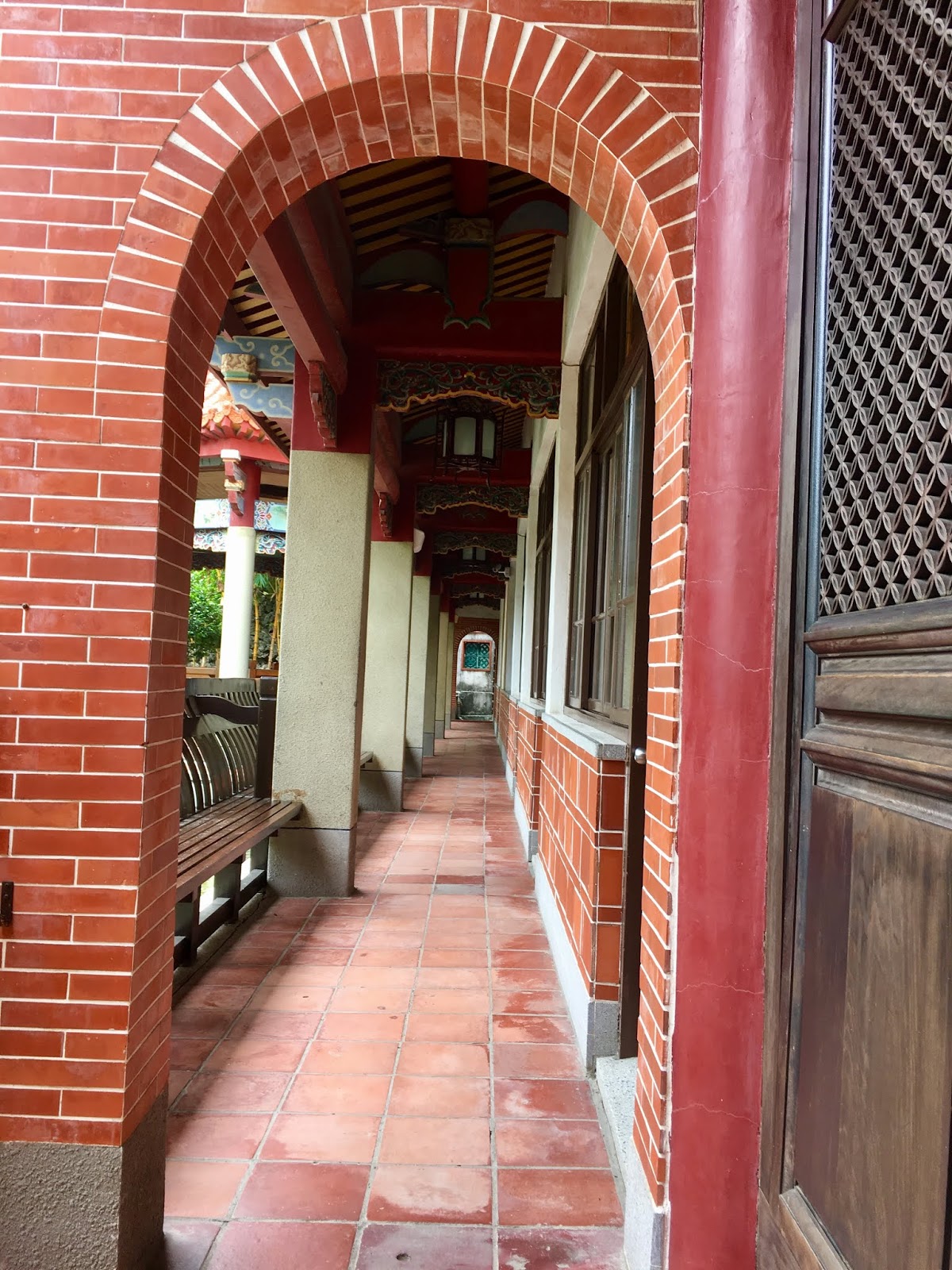
Xinhua Wude Hall was constructed between 1925 and 1928. Initially, it served as a malaria prevention and control office. In 1936, it was converted into a martial arts field for military police, students, and youth groups to practice judo and kendo. After Taiwan's recovery, it was repurposed as a dormitory for police families. In 2006, it was officially registered as a historic building and underwent restoration until 2012.
The building combines traditional Japanese shrine and temple elements with modern structures. It still showcases four original springs. It is the only Wude Hall in Taiwan that retains a spring floor. The building is constructed with Taiwanese red cypress and features architectural elements such as the "rain panel" wall and the "bull's eye window" of Baroque architecture, distinguishing it from other Wude halls.

Originally, Xinhua Township had planned to demolish the building but later changed course and designated it as a historical building. The residents living in it relocated to other places, and the building underwent renovation. Reconstructing the original porch was challenging since it had been demolished. However, in 2010, an old photo provided by Kang Zhaoming helped in reconstructing the porch's appearance, and in 2011, the steel bar of the porch base was discovered. The porch was rebuilt on its original site, and the old fire brigade hall, which obstructed the facade, was demolished.

Wude Hall 新化武德殿, Xinhua, Tainan, Taiwan

Wude Hall 新化武德殿, Xinhua, Tainan, Taiwan
August 2021

Damuji Cultural Park (大目降文化園區)

Xinhua was originally a settlement of the Pingpu people in Siraya. It was previously called "Damujiang," a transliteration of Tavocan in the Siraya language, meaning "land of mountains and forests." The Siraya people are the earliest ethnic group recorded in written records in Tainan, Taiwan, and have an inseparable connection to the shaping and development of the history and culture of Greater Tainan. The Damuji Cultural Park was initially a police dormitory but has been transformed into a comprehensive park after restoration. It features various attractions, including Wudedian, Japanese-style dormitory groups, Japanese gardens, story halls, and Damuyo Square.
During the Kangxi period of the Qing Dynasty, the name "Damujiang Village" was found in the "Taiwan County Chronicle," and the name "Damujiang Street" appeared during the Jiaqing period. Various inscriptions engraved with "Damujiang" can also be found in the area. The name "Xinhua" emerged in 1920 during the Japanese occupation period when Xinhua County in Tainan Prefecture was established. The Xinhua Village in the late Qing Dynasty does not refer to the current Xinhua. After the war, it was renamed Xinhua Town, Tainan County. On December 25, 2010, it was renamed Xinhua District following the merger of Tainan County and City.

Yang Gui, a highly respected literary writer in Xinhua, Tainan, was the first person whose works were included in textbooks. The Yang Kui Literature Memorial Hall was rebuilt from the old building of the former Land Affairs Office next to the Street Office Hall. The museum houses numerous items, images, precious works, and historical materials that Yang Kui frequently used during his lifetime. Apart from being open for visits, the venue also hosts art and cultural activities from time to time.

The air-raid shelter was a building attached to the Xinhua County Office during the Japanese occupation period. It faced the possibility of being demolished but was preserved by local residents who recognized its significance as a common historical memory worth saving.

Damuji Cultural Park 大目降文化園區, Xinhua, Tainan, Taiwan
August 2021

Damuji Cultural Park 大目降文化園區, Xinhua, Tainan, Taiwan

Damuji Cultural Park 大目降文化園區, Xinhua, Tainan, Taiwan

Damuji Cultural Park 大目降文化園區, Xinhua, Tainan, Taiwan

Damuji Cultural Park 大目降文化園區, Xinhua, Tainan, Taiwan

Damuji Cultural Park 大目降文化園區, Xinhua, Tainan, Taiwan

Damuji Cultural Park 大目降文化園區, Xinhua, Tainan, Taiwan
December 2019

Damuji Cultural Park 大目降文化園區, Xinhua, Tainan, Taiwan
December 2019

Damuji Cultural Park 大目降文化園區, Xinhua, Tainan, Taiwan
December 2022

Damuji Cultural Park 大目降文化園區, Xinhua, Tainan, Taiwan
December 2022

Damuji Cultural Park 大目降文化園區, Xinhua, Tainan, Taiwan
Air raid shelter

Former Xinhua District Council House (新化街役場)

The Council House building was constructed in 1934 and served as a public office for Xinhua Street during the Japanese occupation period. After the war, it became the Xinhua Town Office until the new building was completed in 1996. In 1999, the building faced the threat of demolition due to the construction of an underground parking lot in the area. However, thanks to the efforts of protestors, it was decided in 2000 to move the building to the nearby Qingguo Market parking lot during the construction period. The building was initially pulled by manpower and later using heavy machinery. Before the actual relocation, a total of 66 days were spent on preparatory work, including adding a ground beam to stabilize its structure and re-paving Zhongxiao Road to ensure smooth movement. To reduce the weight, all the roof tiles were unloaded, and it was discovered that each concrete roof tile was glazed and printed with the words "new case charter," indicating that these tiles were specially made for the new street. After the completion of the parking lot competition in 2002, the building was moved back to its original site. Internal renovations and surrounding greening work began, and the project was completed in March 2005. Office and computer room facilities were added, and the street building was transformed into a restaurant. The Xinhua Street Office was ranked fourth in the 2001 selection of historical buildings and was later declared a historic building on November 18, 2002.

Former Xinhua District Council House 新化街役場, Tainan, Taiwan

Former Xinhua District Council House 新化街役場, Tainan, Taiwan
August 2021

Hutoupi Reservoir (台南市新化區同義宮)

The Hutoupi Reservoir Scenic Area is built around Hutoupi Reservoir, the oldest reservoir in Taiwan. It was constructed in 1846 and covers an area of 27 hectares. Originally, the Hutoupi Reservoir was used for irrigating over 500 hectares of farmland. The road surrounding the reservoir spans 4.8 km.
The Huyue suspension bridge was built in 1905 and connects to a small isle in the center where a pavilion is built for tourists to enjoy the landscape.

In 1906, the area suffered significant damage due to an earthquake, which took six months to repair. A memorial stone was erected during that time. In the following year, the reservoir area became one of the twelve scenic panoramas.
In 1939, it was named the Hutoupi Scenic Area, also known as Little Sun Moon Lake. The area has a tropical monsoon climate and boasts rich animal and plant ecology. Hutoupi derives its name from the shape of the surrounding mountains, which resembles a tiger's face.
The site is also renowned for its campgrounds, which are divided into three categories: wooden pallets, boarding houses, and camping car spaces. Hutoupi Lake was ranked fourth by the Daily View website among Taiwan's top ten campsites.

Address:

1. Xinhua Old Street: 71204台南市新化區中正路336-441號新化老街
2. Xinhua District Office: 712台南市新化區中正路500號南市歷史建築地標
3. Japanese Dormitories: 712台南市新化區和平街53號台南新化日式宿舍
4. Wude Hall: 712台南市新化區和平街45巷3號新化武德殿


August 9, 2019

Historic places of Tainan City West Central District (part III)

Tainan is the oldest city in Taiwan and is commonly known as the "Capital City" due to its more than 200 years of history as the capital of Taiwan under the rule of Koxinga and later the Qing Dynasty. The city's complex history of resurgence, redefinition, and renewal has earned it the popular nickname "Phoenix City." As Taiwan's oldest urban area, Tainan was established by the Dutch East India Company as a ruling and trading base known as Fort Zeelandia during the Dutch colonial period. The city's previous name, Tayouan, is believed to be the origin of the name "Taiwan."

Tainan is also regarded as one of Taiwan's cultural capitals, renowned for its rich folk cultures, including its famous street food and traditional cuisine. It has diligently preserved Taoist rituals and a wide range of living local traditions that encompass various aspects of life, from childbirth to funerals. The city is home to Taiwan's first Confucian school-temple, constructed in 1665, as well as remnants of the Eastern and Southern gates of the old city and numerous other historical landmarks.

Former Tainan Shrine Office (原臺南神社事務所)

Former Tainan Shrine Office is located in the Central and Western District of Tainan City. It was designated as a municipal monument on March 7, 2004, and after renovation, it was used as a library for Zhongyi Elementary School. Although referred to as a shrine office, it may have served as a resting place for the outer garden of Tainan Shrine. The building was constructed in 1936 during the Japanese occupation period. After 1945, it was used as the dormitory for the principal of Zhongyi Elementary School and as a kindergarten school building attached to the school. After undergoing renovation in 2010, it was transformed into the library of Zhongyi Elementary School. The building's construction is similar to that of Wude Hall.

former tainan shrine office, tainan city, taiwan

Wude Hall (原臺南武德殿)

Wude Hall  is a pavilion constructed in 1936 by the Great Japan Wude Association to promote martial arts. It was the largest Wude Hall in Taiwan and exhibited superior design and construction quality. The Great Japan Wude Association was established in 1895 to promote martial arts, and in 1906, the "Taiwan Branch of the Great Japan Wude Association" was officially established, actively promoting martial arts in Taiwan. After World War II, the building served as an auditorium for Tainan City High School and Zhongyi Elementary School. It was designated as a municipal monument in 1998. The original architectural style of Wude Hall follows that of traditional Japanese temple buildings. It is a two-story structure with spacious and open sides, and the main entrance is located on the second floor.

wude hall, tainan city, taiwan

wude hall, tainan city, taiwan

Shitao Ye Memorial Hall (葉石濤文學紀念館)

Shitao Ye Memorial Hall is dedicated to Ye Shitao (1925-2008), a Taiwanese literary writer known for his novels and reviews. On December 6, 2009, a bronze statue commemorating Ye Shitao was unveiled at the lakeside of Kaohsiung Literature Museum in Kaohsiung City's Central Park. The Ye Shitao Literature Memorial Hall was opened in Tainan in 2012.

Confucius Temple (臺南孔廟)

Confucius Temple (臺南孔廟) in Tainan was constructed in 1665 and is the earliest Confucian Temple in Taiwan. The temple covers an area of 9,000 square meters with a construction area of 2,170 square meters. During the early Qing Dynasty, it served as the primary educational institution for Taiwanese children. The Tainan Confucius Temple was designated as a national first-class monument in 1983. Originally, only Dacheng Hall, also known as the First Masters Temple, was established to worship Confucius. Later, Minglun Hall was added for lectures. Classes and exams were conducted monthly, and meals were provided based on merit. A major examination was held every three years, and outstanding candidates were selected for governmental positions. In 1685, Zhou Chang and Jiang Yuying initiated the temple's reconstruction, adding plaques like Kaisheng in the north and the sacred gate in the south. Subsequently, Dianchi and Zhaizhai were constructed. In 1700, Wang Zhilin oversaw the temple and built Minglong Hall and Longting Library behind Dacheng Hall. The Qisheng title was changed to Chongsheng in 1723, and the temple underwent multiple repairs. From 1749 to 1751, under the initiative of the overseeing priest Yang Kaiding, the Confucius Temple was rebuiltwith significant restoration efforts. In 1777, the Gonggongfang was constructed outside Dongdachengfang, and the Daxuan Temple added the Fuxing Department to the west. This period marked the peak of the Tainan Confucius Temple. However, the temple suffered considerable damage from earthquakes during the Jiaqing and Tongzhi eras.

During the Japanese occupation period, the Governor's Office of Taiwan issued the "Public School Order" and the "Public School Rules" in 1898, establishing the "Tainan Public School" within the Confucius Temple. In 1904, it was renamed "The First Public School in Tainan." In 1916, the temple was renovated, and the Wenli monument was added on the southeast side. The temple was also affected during World War II. After the war, the Tainan Municipal Government raised funds for renovation, which took place in 1953, 1977, and 1979.

confucius temple, tainan city, taiwan

confucius temple, tainan city, taiwan

confucius temple, tainan city, taiwan

confucius temple, tainan city, taiwan

confucius temple, tainan city, taiwan

Wenchang Court

Wenchang Court is a three-story courtyard located in the Confucius Temple complex. It features a unique three-door hatchback, making it the only temple of this style in Taiwan. The right entrance is Dachengmen, followed by Dacheng Hall, and finally Chongsheng.

Dachengfang

Dachengfang, also known as Dongdachengfang, serves as the main entrance to the Tainan Confucius Temple. It was built in 1715 and bears the inscription "Taiwan First School" on its exterior. In 1917, the building underwent renovation, and the current structure is a replica. Additionally, a monument on the north side of Dongdachengfang displays the inscription "Wenwu officials, soldiers, civilians, etc." Xi Dacheng Square was constructed in 1749 but has been closed since the war.

Dianchi

Dianchi and Yigong Square can be found between Dachengfang and Dachengmen. The eastern side of the trail is called Dianchi, while the western side is Yigong. The structures were built in 1715 and were once surrounded by a wall.


Limen and Yilu

Limen and Yilu are located between Dachengfang and Dachengmen. The east side of the trail is Limen, the west side is Yilu. It was built in 1715. In the past it was surrounded by a wall.

Dacheng Hall

Dacheng Hall, located in Dachengmen, is the tallest building within the Confucius Temple complex. It sits on a raised platform and is supported by twelve pillars and three-sided load-bearing walls. The ridge of the hall features nine pagodas adorned with double dragons and Tibetan prayer tubes. In front of the temple, there is a terrace where ritual dances are performed. The central shrine is dedicated to Confucius, while the sides are dedicated to Yan Zi, Zi Si, Zeng Zi, Mencius, and the twelve philosophers (Xunzi, Ran Yong, Duan Muci, Zhong Yu, Bu Shang, You Ruo, Qi Bo Niu, Zai Ji). The ceremonial library and the instrument library are located on the north side, east and west, respectively.

Chongsheng

Chongsheng is the ancestral hall located on the north side of Dacheng Hall. It is an open hall supported by 18 pillars, and the central shrine is dedicated to Confucius' five generations of ancestors. To the east of Chongsheng Temple is the Chengshu Academy, and to the west is the classic library. They were originally named Ming and Xiangxian before 1749, but their purpose was later changed to store musical instruments and classics. Yicheng College served as the music bureau of the Tainan Confucius Temple and is believed to have existed since the temple's founding.

Gate of virtue

Gate of Virtue is a wide entrance consisting of three central open spaces and two side rooms. The central gate is titled, and inside the door is the "Ming Lun Tang" and Wenchang Pavilion.

Minglun Hall and Wenchang Pavilion

Minglun Hall and Wenchang Pavilion are significant structures within the Confucius Temple complex. Mingluntang Hall serves as a lecture hall for Confucianism and is supported by a wooden frame with four pillars at the front. Wenchang Pavilion is a three-story building dedicated to Wenchang Emperor. The first floor is square and houses the main deity, while the second floor is round. The third floor is octagonal and dedicated to Kuixing, the deity of examinations. Wenchang Pavilion was closed in 2004 due to structural damage but reopened in 2009.

confucius temple, tainan city, taiwan

confucius temple, tainan city, taiwan


confucius temple, tainan city, taiwan

confucius temple, tainan city, taiwan

confucius temple, tainan city, taiwan

Former Tainan Weather Observatory (原台南測候所)

The meteorological observation building in Tainan was constructed in 1898 during the Japanese occupation. It was recognized as a monument by the Tainan City government in 1998 and later upgraded to a national monument in 2003. The building consists of two structures: a circular structure and a wide chimney tower. It is one of the few large-scale buildings from the early days of the government and played a significant role in the advancement of modern meteorological observations in Taiwan. Meteorological observations are crucial for understanding Taiwan's economy and ensuring the well-being of its people.

The circular structure has a diameter of approximately 15 meters and a construction area of 180 square meters. On top of the circular building is a central circular tower wind meter with a diameter of around 3 meters. The chimney tower stands about 6.5 meters tall. The circular structure is centered around the wind meter, and the remaining area is covered with roof tiles. The outer steel bars are arranged radially in eighteen directions. Inside the building, there are six rooms divided by an east-west aisle, and the official office building, along with the upper central round tower wind meter, reaches a height of 11.6 meters. The sloping roof is made of black tiles, and the eighteen girders made of roofing steel strips are erected from the upper edge of the inner ring wall of the central round tower. During the late 19th century, this building was not only the tallest structure in Tainan but also a prominent landmark rarely seen in Taiwan at that time.

After several renovations, the structure of the current meteorological observatory has not changed significantly, although the original red brick and tile coating has been replaced with a more modern style. In 1945, the original Tainan Weather Station was renamed the "Tainan Meteorological Bureau" and resumed ground observations two years later. Over the years, it underwent several renaming processes and was ultimately designated as the "Central Meteorological Bureau Tainan Meteorological Station" in 1977. The office space at the observatory was relocated to a new building nearby due to the aging of the construction and equipment in 1989. In 1998, the observatory ceased its observing operations.


weather observatory, tainan city, taiwan

Shuiliu Guanyi Old Street (水流觀音老街)

Shuiliu Guanyi Old Street is a historic street in Tainan known for its well-preserved old buildings. The street is named after the Shuiliu Guanyin Temple, which is dedicated to Guanyin, the Buddhist goddess of mercy. The temple was constructed during the Qing Dynasty and serves as a popular place of worship for both locals and visitors. The surrounding old street is filled with various shops, eateries, and traditional craft stores, offering a glimpse into Tainan's history and culture. It is a favored destination for those interested in exploring the city's heritage.

shuiliu guanyi old street, tainan city, taiwan

Tainan Wu Garden (台南吳園) 

Tainan Wu Garden (台南吳園), originally known as "Purple Spring Garden (紫春園)," is situated in the West Central District of Tainan. The garden was built around 1828 by Wu Shangxin, a prominent salt magnate. It is renowned as one of the Four Great Gardens of Taiwan, along with the Lin Family Mansion and Garden in Wufeng, Beiguo Garden in Hsinchu, and Lin Family Mansion and Garden in Banqiao. Wu Garden was initially acquired by Wu Shangxin when he purchased the garden of He Bin, an interpreter during the Dutch rule who played a role in the fall of Fort Zeelandia.

During the Japanese rule, the fortunes of the Wu family declined, leading to the confiscation of the garden by Tainan Prefecture. In 1911, the Former TainanAssembly Hall was constructed along the southern edge of the Wu Garden, along with the famous Four Seasons Inn on its southeastern side. The Tainan Library was built in 1920 on the northwestern corner, and the Tainan Municipal Swimming Pool was added in 1922 on the northern edge of the garden. In 1974, the Four Seasons Inn, Tainan Library, and Tainan Municipal Bathhouse were sold to the Far East Department Store, which currently operates its Park Branch store on the premises. In 1994, there were plans for commercial development on the garden grounds, but these plans were ultimately dropped, and the garden has been preserved to this day as a testament to Tainan's rich history.

wu garden, tainan city, taiwan

wu garden, tainan city, taiwan

wu garden, tainan city, taiwan

wu garden, tainan city, taiwan

wu garden, tainan city, taiwan

wu garden, tainan city, taiwan

wu garden, tainan city, taiwan

wu garden, tainan city, taiwan

Address:

1. Former Tainan Shrine Office: 700台南市中西區忠義路二段2號原臺南神社事務所
2. Wude Hall: 700台南市中西區忠義路二段2號原臺南武德殿
3. Shitao Ye Memorial Hall: 700台南市中西區友愛街8-3號葉石濤文學紀念館
4. Confucius Temple: 700台南市中西區南門路2號臺南孔廟
5. Former Tainan Weather Observatory: 700台南市中西區公園路21號原台南測候所
6. Tainan Wu Garden: 700台南市中西區民權路二段30號台南吳園