Showing posts with label Xinpu (新埔). Show all posts

November 5, 2023

Hsinchu Travel: Sun-Dried Persimmons - A Must-See Experience in Taiwan


Travel Date: 2023/11/04

Despite it being the beginning of November, the weather was pleasantly warm. The day welcomed us with a clear blue sky and a temperature of 30 degrees Celsius. However, it appears that this might be the last week of summer in Taiwan. Next weekend, a cold front is expected to arrive, bringing cooler, windier, and rainy weather, with temperatures ranging between 17 and 23 degrees only.
While we don't reside in Hsinchu, we find ourselves traveling here more often than around Miaoli where we are currently living. 
Once again, we rode a scooter, as it's easier to park. It was an hour's drive, but we were able to visit not only Xinpu but also Hukou. I'll share more about Hukou Old Street in my next post: HERE

Also check out my video

Weiweijia Persimmon Orchard (味衛佳柿餅工廠)

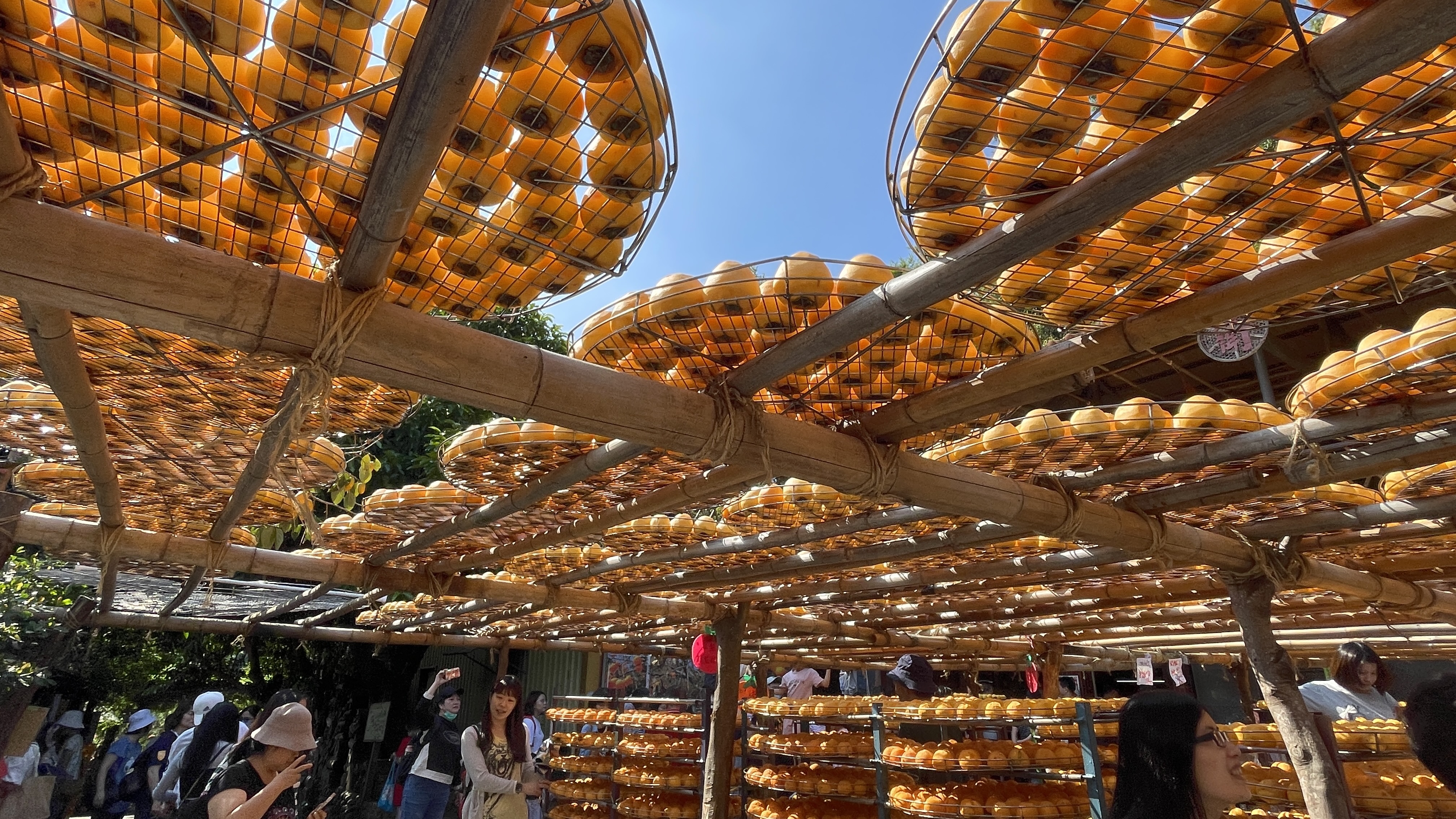
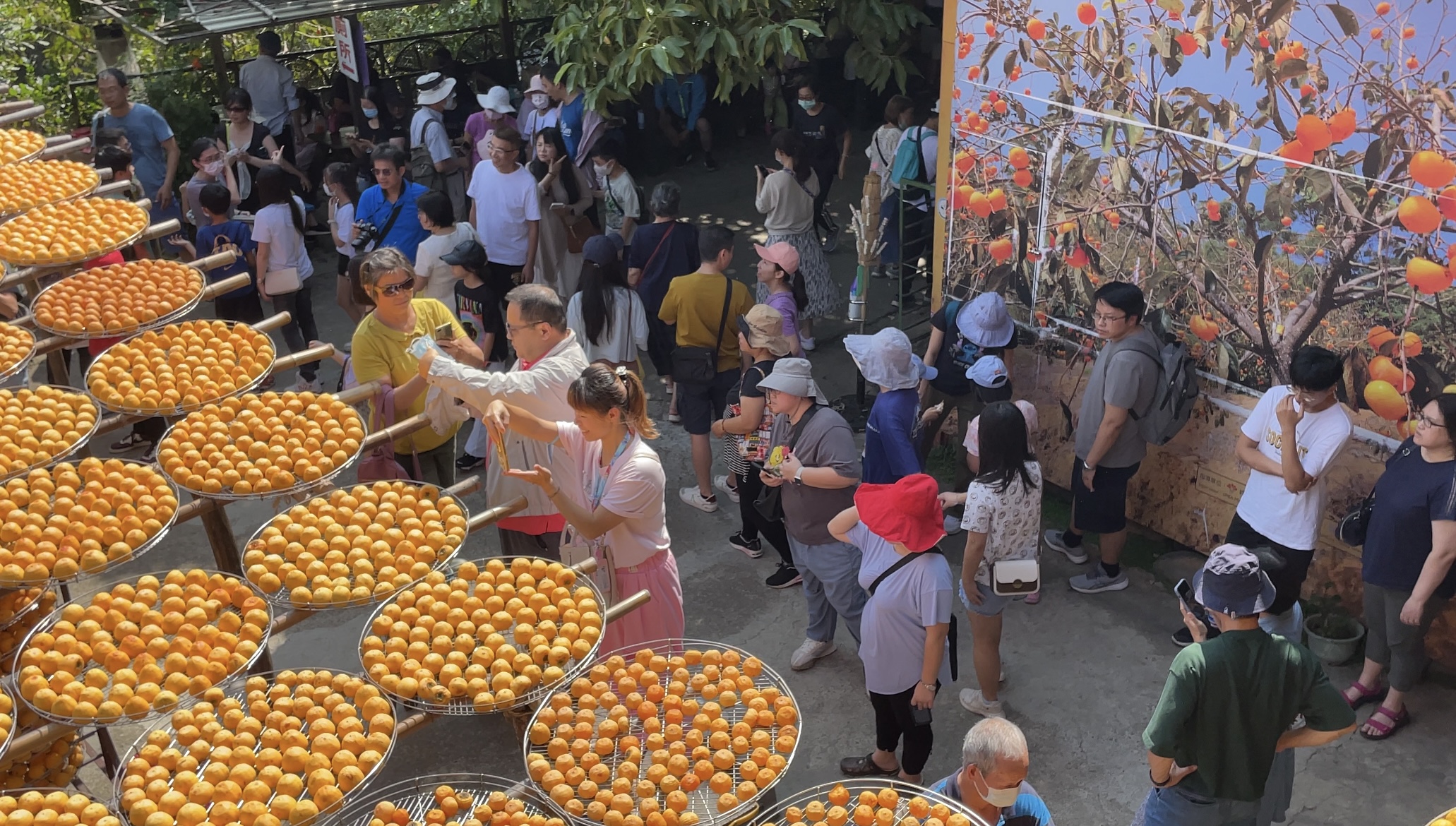
We've had the pleasure of visiting the Weiweijia Persimmon Orchard in 2018 and again last autumn, with this year's visit being particularly rewarding. The decision to return this November was fruitful as the orchard was abundant with persimmons... and visitors.

The boss generously treated us to persimmon popsicles (Thank you a lot 老闆,非常感謝您!). They were incredibly delicious, and I highly recommend trying them! The taste even inspired me to consider making a persimmon cake, although I'm unsure of the outcome. I'm also an enthusiast of dried persimmons. In my opinion, they surpass the fresh ones, but perhaps taste may vary among different varieties of fruits.

The history of dried persimmons, known as "柿餅" in Xinpu (新埔), spans three centuries. This delicacy is a specialty of the Hakka (客家) people, and Xinpu contributes up to 80% of Taiwan's dried persimmon production. The weather conditions in Xinpu village, especially during the autumn season, with its hilly terrain and dry winds, create the ideal environment for making dried persimmons.

While Weiweijia Persimmon Orchard welcomes tourists throughout the year for free, the prime persimmon season typically spans from the end of September to January. The best visits are on sunny days with clear blue skies, allowing for a stunning view of the orange fruits drying under the open sky.

Various spots within the orchard offer perfect photo opportunities - whether standing under the drying persimmons, using platforms for a close-up view, or even from an elevated vantage point. Although there used to be an area where visitors could wear a farmer's hat and pose with baskets of persimmons, I'm unsure if this feature is still available. I haven't seen it this year, but back in 2018.
For a fee of 200NTD, visitors can paint their own design on a bag using natural paints. This artistic activity adds a personal touch to the experience.

The process of making dried persimmons is a labor-intensive, traditional craft. The fruits are picked from the trees when they're around 70-80% ripe to facilitate peeling. The orchard showcases the fruits waiting to be picked, and workers, accustomed to visitors taking pictures, occasionally pause their work to smile for photographs.

Following the picking, the fruits undergo a meticulous process involving hand or machine peeling, charcoal grilling for sterilization, and subsequent drying in the sun for 3-4 days. Workers then carefully press the fruits into their distinctive shape. After an additional 3-4 days, the persimmons are disinfected in a baking chamber before being packed for sale.

Super recommend to visit!


Address:
305新竹縣新埔鎮旱坑路一段283巷53號味衛佳柿餅教育農園

October 2, 2022

Hsinchu Travel: Persimmon Season in Taiwan


It's been 4 years since we last came here. It has been 3 years living in the South, so I missed that autumn feeling, except for the cold weather, haha. In my memories, this place was really beautiful, with fruits drying around. This year, however, it's not that great. Due to unfavorable weather and lack of rainfall, there aren't many persimmons. In the past, there were at least four times more persimmons drying in front of houses. This year, many of them were fake, just for tourists to take pictures.

Weiweijia Persimmon Orchard (味衛佳柿餅工廠

The most famous place for drying persimmons is Weiweijia Persimmon Orchard in Xinpu, Hsinchu. It's a Hakka specialty and has a three-century-old tradition. Xinpu produces up to 80% of these fruits in Taiwan. The weather in Xinpu village is the best for making dried persimmons. The hilly terraces and dry wind in the autumn season create the perfect conditions. From September to December, the fruits are picked and dried. Depending on the month, different types of persimmons are grown.

Persimmons need to be picked from the trees when they are about 70% ripe, otherwise they will be too weak to be peeled. After picking, all the fruits are washed and peeled by hand or machine. The peeled fruits need to be charcoal grilled to be sterilized and prevent them from turning blue due to oxidation. After sterilization, the fruits are placed under the sunshine in windy and dry weather. Persimmons are dried for about 3-4 days, then workers press them to form the desired shape. After another 3-4 days, the fruits are put in a baking chamber for disinfection. The ready persimmons are packed for sale.

That's not the only thing that disappointed me. In the afternoon, we went to Hinchu city because there is only one food that I missed and couldn't find in Tainan - boiled mochi. We went around Chenghuang Temple where a street stall is selling them. At first, we felt fine, as the prices of food didn't change here. But after we made the purchase, we noticed that the size was just half of what it used to be. Haha, I can't blame them; everything is getting more expensive now.


Address:

Weiweijia Persimmon Orchard: 305新竹縣新埔鎮旱坑路一段283巷53號

April 27, 2019

Hsinchu Travel: Tea Farms and Hukou Old Street


It's nice weather today, so after finishing baking my cakes, we went outside. Initially, we wanted to see the Yellow Trumpet Flowers blossom in Xinpu. Yesterday, we saw a pink trumpet tree in bloom, so I thought it was already the season. After driving there, we discovered that there were no flowers yet and we needed to wait for one more month. Since there wasn't much to see in Xinpu, we decided to visit Hukou Old Street.

We drove along a mountain road, where we saw many bald cypresses, cherry blossoms, and tea farms. Those hills were covered with plenty of tea trees, which made the view really beautiful. It's a pity we didn't come here earlier. Now, the bald cypresses have lost almost all their leaves and don't look very attractive. Some of the Taiwanese cherries growing there have already blossomed, and the tea was also in bloom. 
In the past, Hukou was a military base. On the nearby roads, you can also see a few old tanks.

tea farms, hsinchu, taiwan

tea farms, hsinchu, taiwan
      
tank, hsinchu, taiwan

tank, hsinchu, taiwan

Hukou Old Street (湖口老街)

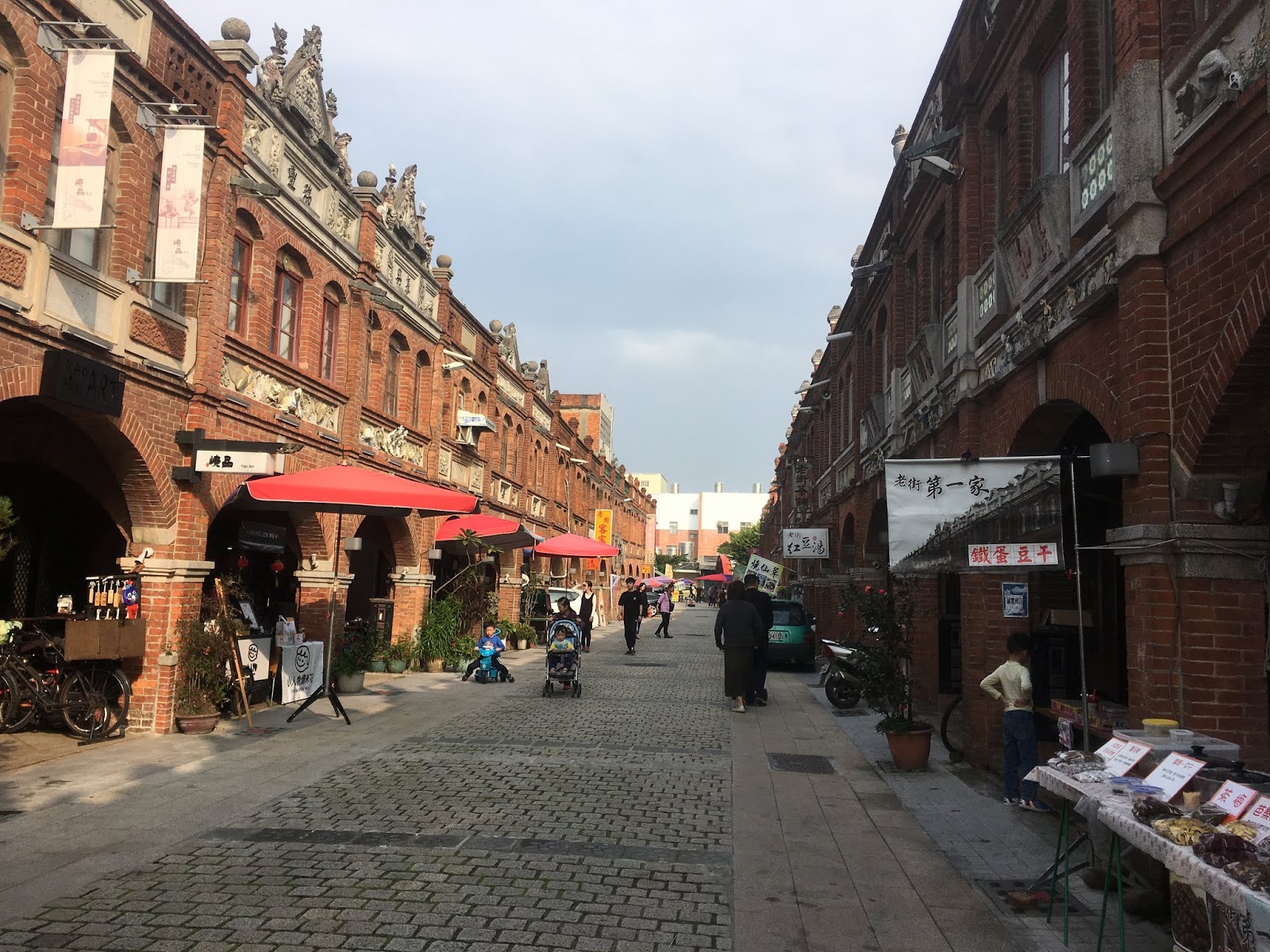
Hukou Old Street was built during the Japanese era, around the 1890s, with Japanese and Baroque styles. The rise and fall of this old street is related to the railway. The railway in Hukou was built in 1892, which promoted local development. After entering the Japanese period, the railway route from Taipei to Taoyuan was drastically changed, but the section from Dahukou to Hsinchu didn't change much. In 1908, the entire line was finished, making Dahukou a commercial town in Hsinchu. In 1916, Hukou Old Street was built in the southeast of the station.

The Japanese thought that the slope of the road between Hukou and Yangmei was too steep, which made the railroad unstable. The Hukou station moved closer to the coast due to the newly completed Ocean Line. The construction of the new railroad led to the decline of commercial activity on the street.
The railway is what divided Hukou between Old Hukou and New Hukou. In Old Hukou, you can see an old street, temple, church, and old theater. New Hukou is a newer area with modern houses built around the station. In Hukou, all the old buildings were preserved, and you can see a similar style to Daxi Old Street. The nearby temple has some pig decorations for Chinese New Year.

At the end of the street, you will also find San Yuan Temple. In 1904, two people donated land and raised funds to build the temple. The project was completed in 1919, despite funding difficulties. This Temple is dedicated to the Three Officials: water, earth, and heaven. The Sanyuan Palace also houses other gods like Guanyin Bodhisattva, Mazu, Yinsheng Nangniang, Wenchang Emperor, Wucai When, and Bogong. In May 2001, this Temple was announced as a county monument.

When we visited the old street, it was quite empty. Only a part of it had a few shops, and not many people were walking around. Nearby, you can also see an old church that was built where the original train station was. In recent years, the Old Street has undergone renovations and a greening project. The stone road, building archways, and shop pavilion were all renovated, but it didn't help much, and the street remains quite empty.


hukou old street, hsinchu, taiwan
 
hukou old street, hsinchu, taiwan
 
hukou old street, hsinchu, taiwan
 
hukou old street, hsinchu, taiwan
 
hukou old street, hsinchu, taiwan

hukou old street, hsinchu, taiwan

hukou old street, hsinchu, taiwan

Address:

303新竹縣湖口鄉湖口老街

April 6, 2019

Hsinchu Travel: Xinpu ~ Exploring Historic Sites of Hakka Heritage

Xinpu, located in the northern part of Hsinchu County, is a small town known for its Hakka culture and traditional architecture. One of the most famous activities in Xinpu is the drying persimmons festival, which showcases the local agricultural heritage.
Originally inhabited by the Pingpu indigenous people, Han Chinese settlers arrived in Xinpu during the Yongzheng period (1723-1735). In the early 19th century, Xinpu developed into a bustling distribution center for key commodities such as rice, sugar, and camphor. This led to an influx of Hakka people who settled in the area.

Yimin Temple (褒忠義民廟)

Today, visitors can still admire ancient Hakka buildings that have been preserved in Xinpu. One notable structure is the Yimin Temple (褒忠義民廟), also known as the Rewarding Loyalty Pavilion. The temple was initially small but expanded over time, eventually becoming the wealthiest temple in Taiwan during the Japanese occupation. According to legend, the temple was built on the site of a tomb belonging to the loyalist Bu Zhiyi.


historical buildings, xinpu, hsinchu, taiwan


historical buildings, xinpu, hsinchu, taiwan

Liu's Family House (劉氏雙堂屋) 

Liu's Family House (劉氏雙堂屋) was built in 1781. In 1755, Liu Ruige's wife and their three sons (Yanzhuan, Yanzhen, and Yanqi) moved to Taiwan and settled in the Yanghai Township (Xiangshan area). Liu's eldest son built the courtyard house, which came to be known as the "double house." The architectural style of the building highlights the significance of the ancestral hall, with the family living around it.

During that time, buildings were constructed using earth and thatched roofs. In 1919, three rows of horizontal houses were added, giving rise to the name "two hall and six horizontals." The building covers an area of 30,000 m2 and features 99 rooms. In 1983, to commemorate Liu Ruige, the large Liu's Family cemetery known as "Ruige Garden" was established on the hill behind the house. The site was designated as a county monument in 2006.

historical buildings, xinpu, hsinchu, taiwan

historical buildings, xinpu, hsinchu, taiwan

historical buildings, xinpu, hsinchu, taiwan

historical buildings, xinpu, hsinchu, taiwan

Chen's Ancestral Hall (陳氏宗祠) 

Chen's Ancestral Hall (陳氏宗祠) was built in 1868. The original building was destroyed in 1895 but was rebuilt three years later. The main structure of the hall faces south and follows a two-story pillow-seized temple style. It consists of a front hall, left and right houses, and a small patio at the rear. Inside the main hall, there is a small gallery dedicated to the ancestors of the Chen family. The building showcases wood and stone carvings, paintings, and other architectural features representing Hakka culture. It was designated as a county monument in 2004.

historical buildings, xinpu, hsinchu, taiwan

Lin's Family Temple (林氏家廟)

Lin's Family Temple (林氏家廟) was constructed between 1913 and 1917. The temple was built by Lin Linzi, who raised funds for its construction. Two brothers living in the back street donated the land for the temple. The building is a two-scale ancestral hall facing Daping Mountain. The main hall serves as a space for ancestral worship, while the left and right horizontal houses are designed as open halls. The building became a county monument in 2006.

historical buildings, xinpu, hsinchu, taiwan


historical buildings, xinpu, hsinchu, taiwan

Liu's Ancestral Temple (劉家祠) 

Liu's Ancestral Temple (劉家祠) was built in 1867. During its construction, disputes over ownership halted the project. Work resumed in 1990 and was completed in May 1991. The building features a single entrance, three horizontal buildings, and one enclosure. Its roof and horizontal houses exhibit a rare architectural style in Taiwan. The ancestral hall serves as the main ritual space for Liu Jiaxuan. The front part of the building is made of bricks, while other sections use stone. It was designated as a county monument in 2006.

historical buildings, xinpu, hsinchu, taiwan

historical buildings, xinpu, hsinchu, taiwan

Fan's Family Temple (范氏家廟) 

Fan's Family Temple (范氏家廟) was funded by Fan Riwang in 1858-1860. The ancestors of Fan Riwang originally came from Jiaying Prefecture and settled in Xinpu Streets. It is the earliest ancestral hall established in the area. The building consists of five wide rooms, with the central three rooms forming a gallery. The main hall is dedicated to ancestral worship and features a wooden structure divided into two spaces. The left and right walls are made of mud bricks, and beneath the shrine, a land dragon is enshrined, showcasing a distinct Hakka architectural feature. It became a county monument in 2006.

historical buildings, xinpu, hsinchu, taiwan

Zhang's Family Temple (張氏家廟) 

Zhang's Family Temple (張氏家廟) was built in 1868. The temple is a two-story building that was burned down by the Japanese army in 1895. It was reconstructed in 1907 and transformed into a two-dimensional scale. The architectural style is similar to Liou's Ancestral Temple. The building consists of five open rooms, with the main hall dedicated to ancestral worship. On the left side of the hall, there is a picture of Zhang Yunlong, the benefactor who funded the temple. It was designated as a county monument in 2004.

historical buildings, xinpu, hsinchu, taiwan

Zhu Family Temple (朱氏家廟) 

Zhu Family Temple, originally built in 1846, started as a house but was later transformed into a temple to honor Zhu Jingong due to the favorable feng shui of the location. The temple features a two-horizon courtyard with five open rooms. The entrance is a double-open door, and the walls of the left and right houses are made of red bricks, while the front building is constructed with stone. The courtyard walls are built with red bricks, and the doorstep is made of stones. It was designated as a county monument in 2009.

historical buildings, xinpu, hsinchu, taiwan

Wu Zhuoliu Former Residence (吳濁流故居) 

Wu Zhuoliu Former Residence, built in 1840, belonged to Wu Zhuoliu, also known as Wu Jiantian, a prominent Hakka figure born in 1900. He was a public school teacher, poet, and novelist, having written over 3,000 Chinese poems in his lifetime. Wu Zhuoliu founded the "Taiwan Literature and Art" magazine and established the Taiwan Literature Award and Wu Zhuoliu Literature Award. The residence is a traditional Hakka-style courtyard building with multiple stories. It features stone carvings, wood carvings, paintings, and clay sculptures as decorations. The building became a county monument in 2009.

historical buildings, xinpu, hsinchu, taiwan

Pan's Residence (新埔潘屋) 

Pan's Residence, built in 1861, has an interesting history. In 1815, Pan Yuxian purchased the land and built a house, which served as the prototype for Pan's Residence. In 1861, his sons rebuilt it using red bricks and granite to enhance its defensive capabilities, reflecting the security and social conditions of that era. Pan's Residence is a three-story building with a single outer courtyard and double inner courtyards. The walls of the central courtyard are open, allowing for air circulation, and various brick-shaped windows are incorporated into the walls. It became a county monument in 2006.

historical buildings, xinpu, hsinchu, taiwan

Elementary School Principal's Dormitory (新埔國小校長宿舍) 

The Elementary School Principal's Dormitory, constructed in 1902, is the only Japanese-style building in Xinpu. It is a wooden structure with an area of 25m2, dating back to the Japanese era. Originally serving as the residence for the president of Xinpu, it was later inhabited by the second president, Lu Renxiang, until 2000. Due to neglect, the building fell into disrepair and became dilapidated. However, with the efforts of the Xinpu Town Office, it was restored in 2011 and converted into the Xinpu Ancestral Museum. It was designated as a county monument in 2010.

historical buildings, xinpu, hsinchu, taiwan

Address:

1. Yimin Temple: 305新竹縣新埔鎮義民路三段360號
2. Liu's Family House: 305新竹縣新埔鎮義民路二段460巷42號劉氏雙堂屋
3. Chen's Ancestral Hall: 305新竹縣新埔鎮中正路510號陳氏宗祠
4. Lin's Family Temple: 305新竹縣新埔鎮成功街136巷16號林氏家廟
5. Liu's Ancestral Temple: 305新竹縣新埔鎮和平街230號劉家祠
6. Fan's Family Temple: 305新竹縣新埔鎮成功街116巷7號范氏家廟
7. Zhang's Family Temple: 305新竹縣新埔鎮和平街347巷22號張氏家廟
8. Zhu Family Temple: 305新竹縣新埔鎮和平街158號朱氏家廟
9. Wu Zhuoliu Former Residence: 305新竹縣新埔鎮吳屋伙房至德堂
10. Pan's Residence: 305新竹縣新埔鎮和平街170號新埔潘屋
11. Elementary School Principal's Dormitory: 305新竹縣新埔鎮中正路366號新埔國小校長宿舍