July 14, 2024

Tainan Travel: Houbi's Qing Dynasty Treasures

Travel date: 2024/06/08

This trip south was filled with the charm of Japanese-era buildings. I tried to find places to see on the Chiayi-Tainan border and stumbled upon Puzi Town. Having lived in Tainan for three years, I had no idea there was such a large area of Japanese buildings nearby. Maybe it was because we rarely visited Chiayi, or I just never checked the small towns around well enough to notice them. 
Sometimes I feel that most tourist spots in Taiwan are related to the Japanese era, with fewer remaining from the Qing Dynasty, as much older structures have been destroyed over time. I never actually thought of traveling to Japan, but I really like those wooden buildings, I feel that it would be a dream future house.
When we arrived at the Japanese dormitories area, there was an event preparing to start later on - a market organized for the Dragon Boat Festival. I'm not sure how busy it is without the market, but I think it would be much quieter as it doesn't seem to have many shops around. Compared to the Japanese dormitories in Chiayi City, these are much less known.

Our next stop was Tainan's Houbi District. We once again visited Jingliao Old Street. We came here once during COVID-19, and it was rainy that day. At that time, I thought it was a boring and not well-known area, but today's feeling was so different! It's actually filled with visitors, and there were shops open, food, and drink - totally different from a few years ago. Traveling during COVID-19 wasn't fun at all.
Even though the weather was supposed to be rainy, we actually got plenty of sunshine. It was noon and pretty hot. It's been two years since moving out of Tainan, and the north feels a lot cooler, so I also had a bit of trouble accepting the heat. We visited the old street, an old drug store, a Dutch well, a rice mill, and later on stopped at an elementary school that had two unique buildings left from Japanese times. We also drove to another place, but the octagonal storage was closed, and the dormitory only opens for students during school time, so there wasn't much to see. 

Check out more information about our Chiayi trip in my other post [LINK].
Check out Japanese-era relics in Houbi in my other post [LINK].

Jingliao Old Street (菁寮老街)

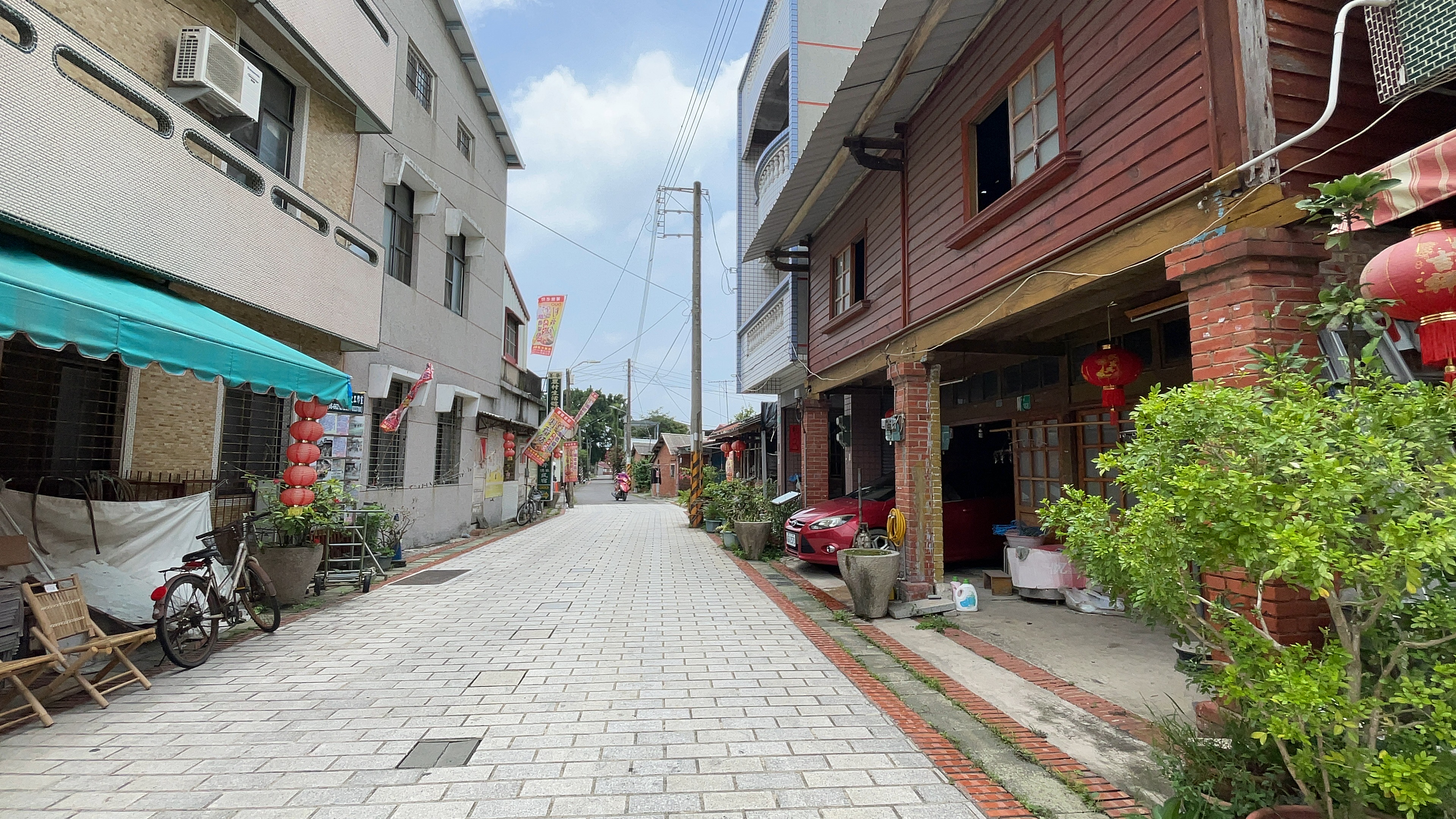
Jingliao was a small village in the mid-Qing Dynasty, known for its dyeing and weaving crops. It served as an important halfway station on the ancient official road between Fucheng (Tainan) and Zhuluo County (Chiayi). It became the most prosperous settlement along the Bazhang River and was commonly known as "Beishi Street." During the Japanese occupation of Taiwan, the street was renovated, and the buildings facing the street were converted into commercial street houses.

The Jingliao Old Street in Houbi District is a historic street that dates back to the Qing Dynasty. It's known for its well-preserved traditional architecture and is a popular destination for tourists interested in experiencing Taiwan's rich cultural heritage. The street is lined with old brick buildings, wooden houses, and storefronts that have been restored to their original condition. You can explore the narrow alleyways, which are filled with shops selling traditional handicrafts, snacks, and souvenirs.

One of the main attractions of Jingliao Old Street is the Jingliao Temple, a Taoist temple dedicated to the god of war, Guan Yu. The temple dates back to the Qing Dynasty and is known for its intricate wood carvings and colorful murals.
Another popular attraction is the Jingliao Ecological Park, which is located just outside of the old street area. The park offers a chance to explore the local flora and fauna, including rare bird species and freshwater turtles.


Jingliao Jin Dexing Pharmacy (菁寮金德興藥舖)

Jingliao Jin Dexing Pharmacy, also known as the Jingliao Ruan Family Ancient House, is a traditional wooden loft-style street house on Jingliao Old Street. It was moved to Jingliao in 1910 and is adorned with exquisite craftsmanship. It is also recognized as one of the top 100 scenic spots in southern Taiwan. In 2005, it was registered as a monument in Tainan City.

The building has changed ownership several times. It originally belonged to a prominent Lin family in Dingtan Village, Lucao Township, Chiayi County. It was later sold to Xu Qian in Houbi. In 1910, the building was dismantled and relocated to its current site in Jingliao, where it was sold to Ruan. Ruan opened a Chinese pharmacy, and the building also became the ancestral residence of the Ruan family. The plaque above the gate beam, "Jin Dexing Qian Ji," was inscribed by the calligrapher Jing Tang in 1925. One of the paintings on the wall, "Twelve Precepts of Tao Zhugong," was written by the owner of the house, Ruan Qian, in 1917.


Bakery Shop (稻稻來)

Next to the ancient house, there's a bakery shop where you can buy freshly baked bread. The aroma around the shop is incredible. Inside, you can also see some ancient artifacts and pictures.
According to a story I found, a man named Wu developed rice bread and taught the community how to make it. Master Wu, born into a poor farming family, began his apprenticeship in his teens, forming an inseparable bond with baking.

With a solid foundation in baking, he started his own business in Baihe after serving in the military, gaining fame with his traditional Chinese wedding cakes and lotus seed pastries. His venture into rice bread was inspired by a divine dream, leading him to help farmers and selflessly teach the community, tirelessly promoting rice bread.

Currently, the rice bread comes in one size, with various flavors priced between 120 and 150 NTD. Made from ground Taiwanese rice, the rice flour lacks gluten, so it is mixed with lotus root powder to provide the necessary texture. No chemicals or artificial flavors are added. Besides rice bread, Master Wu has also developed rice cakes and rice rolls, but only the bread is available at Dao Dao Lai.


Jingliao Wumile Community (無米樂菁寮嫁妝老街)

Jingliao Wumile Community is located in Jingliao Village, Houbi District. The name "Jingliao" traces back to the Qing Dynasty when the area was part of Xiaciaodong North Fort, Chiayi County under the Taiwan Prefecture. The local population largely cultivated "Qingzai" (a type of dye tree), which significantly improved their livelihoods. This widespread cultivation led to the name "Qingzailiao," which eventually became "Jingliao Village." Positioned as a critical midpoint on the north-south transportation route and the bustling Yan Shui Port settlement, Jingliao was a vital junction for transporting and selling goods to Zhuluo County, making it one of the earliest economic hubs in the region.

From the late Qing Dynasty to the 1950s, Beishi Street in Jingliao not only thrived on industries like indigo dyeing, rice farming, and straw weaving but also became famous for its shops selling dowry items. The street was lined with a variety of shops, each industry represented by multiple stores, such as jewelry shops, wedding cake stores, tailoring shops, fabric stores, quilt shops, shoe stores, bicycle shops, furniture factories, taverns, tea houses, eateries, guest houses, rice mills, clock shops, beauty salons, ice fruit stores, barber shops, blacksmith shops, lead bucket shops, wooden barrel makers, grain stores, theaters, open-air theaters, Western medical clinics, Chinese medicine pharmacies, hardware stores, grocery stores, department stores, brick factories, construction contractors, large vegetable markets, credit unions, light railways, public baths, and more.

The 2005 documentary "Wumile" brought nationwide attention to Jingliao, highlighting the lives of local farmers like Kun Bin Bo, Huang Ming Bo, and Wen Lin Bo. This exposure helped transform the community into a rural cultural tourism hub, steadily establishing Jingliao's resources in "people," "culture," "land," "industry," and "scenery" while also focusing on elder care responsibilities. Community members have contributed their time and money to shape a beautiful blueprint for their hometown, turning Jingliao’s rural lifestyle into a cultural tourism attraction and fostering rural regeneration.



Dutch Well (荷蘭井)

According to village memories, this Dutch Well has been around for a long time. In the past, local mothers would carry their children to the well to do laundry and use the well water for washing their faces and hands. The Dutch well, believed to have been dug during the Dutch colonial period, is five meters deep, making it a familiar landmark for Jingliao villagers.
Next to the ancient Dutch well stands a traditional Minnan three-section building belonging to the Huang family, who have lived in Jingliao for generations and now welcome guests to stay. Given its proximity to the well, the homestay has been aptly named "Dutch Well Spring Homestay."


Fushia Rice Mill (福家碾米廠)

Fushia Rice Mill is a nearly century-old traditional rice mill, now in its fourth generation of operation. Decades ago, rice mills were common, as they were essential for family income. However, with changing times, the availability of repair parts for rice mills has dwindled, large rice mills have replaced traditional ones, and imported rice has overshadowed local Taiwanese rice. Knowledgeable rice millers have become rare, yet they are highly respected for their skills. Recognizing issues by sound, they know how to clean, maintain, and repair these traditional machines, which are now considered invaluable. Fushia Rice Mill's machinery, made entirely of durable cypress wood, offers a rare glimpse into early Taiwanese rural life. 


Address:
1. Jingliao Jin Dexing Pharmacy: 731台南市後壁區191號
2. Bakery Shop 稻稻來: 731台南市後壁區墨林里189號
3. Dutch Well: 台南市後壁區
4. Fushia Rice Mill: 台南市後壁區菁寮里菁寮11號

July 9, 2024

Exploring the Cultural and Historical Riches of Puzi City


Travel date: 2024/06/08

This trip south was filled with the charm of Japanese-era buildings. I tried to find places to see on the Chiayi-Tainan border and stumbled upon Puzi Town. Having lived in Tainan for three years, I had no idea there was such a large area of Japanese buildings nearby. Maybe it was because we rarely visited Chiayi, or I just never checked the small towns around well enough to notice them. 
Sometimes I feel that most tourist spots in Taiwan are related to the Japanese era, with fewer remaining from the Qing Dynasty, as much older structures have been destroyed over time. I never actually thought of traveling to Japan, but I really like those wooden buildings, I feel that it would be a dream future house.
When we arrived at the Japanese dormitories area, there was an event preparing to start later on - a market organized for the Dragon Boat Festival. I'm not sure how busy it is without the market, but I think it would be much quieter as it doesn't seem to have many shops around. Compared to the Japanese dormitories in Chiayi City, these are much less known.

Our next stop was Tainan's Houbi District. We once again visited Jingliao Old Street. We came here once during COVID-19, and it was rainy that day. At that time, I thought it was a boring and not well-known area, but today's feeling was so different! It's actually filled with visitors, and there were shops open, food, and drink - totally different from a few years ago. Traveling during COVID-19 wasn't fun at all.
Even though the weather was supposed to be rainy, we actually got plenty of sunshine. It was noon and pretty hot. It's been two years since moving out of Tainan, and the north feels a lot cooler, so I also had a bit of trouble accepting the heat. We visited the old street, an old drug store, a Dutch well, a rice mill, and later on stopped at an elementary school that had two unique buildings left from Japanese times. We also drove to another place, but the octagonal storage was closed, and the dormitory only opens for students during school time, so there wasn't much to see. 

Check out Japanese-era relics in Houbi in my other post [LINK].
Check out Qing-Dynasty relics in Houbi in my other post [LINK].

Puzi City (朴子市)

Formerly known as Pho-a-kha (樸仔脚), Puzi City (朴子市) is a county-administered city in Chiayi County, Taiwan. In 1920, during Japanese rule, it was renamed Puzi Street (朴子街) and governed under Tōseki District, Tainan Prefecture. This captivating destination, steeped in history and cultural heritage, has evolved from a modest settlement into a central hub in the coastal region. 
Puzi City, known in Taiwanese as Phoh-tsú-tshī, is located in western Chiayi County and has grown around the temple dedicated to Mazu, fostering its development.

In 1945, the area was reorganized as Puzi Town in Tainan County. It was incorporated into Chiayi County in 1950, and in 1992, following the relocation of the Chiayi County Council, it was upgraded to a county-administered city. The establishment of the Chiayi HSR station and BRT has increased commuter traffic to Chiayi City.
The settlement was recorded in Dutch documents as "Causieu". During the Qing Dynasty, it was renamed Puzi Jiao. The area was initially sparsely populated with a few farmhouses. In 1682, a statue of Mazu was brought from Meizhou and enshrined in Puzi, leading to the establishment of the Peitian Temple. The town developed around this temple, which remains central to the city's identity.

Key historical events and developments:
- 1898: Establishment of Puzi language school
- 1901: Puzi Street uprising led by Huang Maosong
- 1911: Puzi Line of the Suantou sugar factory railway opened
- 1934: Construction of the Puzi Water Tower, a significant landmark
- 1945: Post-WWII reorganization into Tainan County's Puzi Town
- 1950: Integration into Chiayi County
- 1992: Upgraded to a county-administered city

Puzi Water Tower (朴子水道配水塔)

The Puzi Water Distribution Tower, also known as the "Puzi Water Tower" or "Shuidaotou," is a public water supply facility located in Puzi City. It was established in 1933 during the Japanese occupation under the administration of Huang Madian, the then mayor of Puzi Street, and completed in 1936. This structure played a crucial role in improving the drinking water hygiene for Puzi Street residents at the time. Due to its historical and cultural significance, it was designated as a cultural asset in 2014.
Initially registered as a historical building on September 7, 2006, it was later designated as a county-designated historic site on November 4, 2014. Today, it stands as an important landscape landmark in Puzi City.

Located at the east end of Puzi Market and south of Niuchou Creek (now Puzi Creek), the water distribution tower was built to address the poor public health conditions and lack of an established epidemic prevention system during the Japanese colonial period. Residents primarily relied on wells for water. In 1933, Huang Madian began constructing a facility to purify and distribute water from sewers. The tower was one of several structures, including intake wells, sand slide wells, raw water pump wells, pump chambers, distribution wells, sedimentation tanks, filtration tanks, and more. The entire project was completed in 1936.
However, due to sedimentation and pollution, groundwater wells were later used. In 1974, after the merger with the Taiwan Provincial Water Supply Company, water was sourced from the Wushantou Reservoir.

The tower is built in a European style using concrete RC structure. It stands 35 meters high and can hold 450 tons of water. The structure comprises three parts:
- Top: Decorative tower with a hexagonal dome shape.
- Middle: Circular water tank.
- Bottom: RC structure with four ring beams and ten pillars, reinforced with radial mesh columns.

The Puzi Waterway Water Distribution Tower, once the tallest building in Puzi, became a landmark and a significant tourist attraction. It also served as a lookout point accessible via an escalator. Currently, the tower is not open to the public due to structural concerns, including cracks in the columns. Restoration efforts are planned to preserve this historical structure.

Chiayi Shuidaotou Cultural and Creative Settlement (水道頭文創聚落)

Chiayi Shuidaotou Cultural and Creative Settlement located in Puzi City is the first cultural and creative settlement point in Chiayi County. The core building of this settlement is the Shuidaotou, also known as the Puzi Water Distribution Tower. Built in 1936 during the Japanese era, this structure served as a public water supply facility. 

Adjacent to the tower is a group of Japanese-style buildings that once served as residences for police officers and teachers during the Japanese era. These buildings now form the Chiayi Shuidaotou Cultural and Creative Settlement, the largest cluster of Japanese-style architecture along the Chiayi coast. Currently managed by the Chiayi County Cultural and Tourism Bureau, the settlement hosts various cultural and creative workshops, exhibitions, and interactive performances.

Hidden in the bustling alleys of Puzi City, the Puzi Waterway Japanese Dormitory District retains a rich Japanese atmosphere. This area includes the old principal's dormitory of Dongshi Junior High School at Shantong Road 14 and extends to numbers 16 and 18, as well as eight other dormitories along Zhongzheng Road. These buildings served as police and teacher residences during the Japanese era.
The area has been renovated and planned to enhance its historical and cultural value.
The area is filled with Japanese-style features such as stone lanterns and traditional Japanese gardens. The dormitory area now hosts various cultural and creative stores offering handmade food, crafts, and beverages. It's an ideal spot for those who appreciate quiet Japanese-style environments, perfect for a peaceful date or visit.
The settlement is open to visitors from Wednesday to Sunday, 11 AM to 5 PM, and offers various cultural and creative experiences. The space includes a permanent exhibition area and public interaction zones. 

The renovation project took nearly four years and cost 75 million yuan to refurbish the first batch of Japanese-style dormitories. It successfully completed investment promotion and officially opened to the public in February 2018. The types of stores that have established themselves in the Shuidaotou Cultural and Creative Cluster include pottery, life crafts, local culture and history, coffee, and light food establishments. 
Chiayi County Culture and Tourism Director Xu Youren noted that following the renovation of the first batch of Japanese-style dormitories, the county government secured an additional 20 million yuan from the Tourism Bureau of the Ministry of Transportation. This funding is intended to beautify the surrounding area of the dormitories, enhance the benefits of the cluster, and promote Puzi's transformation. The aim is to make the atmosphere of the Japanese living space a memorable part of modern life.


Puzi Embroidery Cultural Hall (朴子市刺繡文化館)

In the early days, Puzi City in Chiayi County was a major hub for the embroidery industry. The prosperity of that time is reflected in the large number of embroidered products exported from Puzi City, including Eight Immortals embroidery, door curtains, pillowcases, bed sheets, glove puppet costumes, Taiwanese opera costumes, bridal trousseaus, and more. These products were sold all over Taiwan. To preserve and promote this outstanding local cultural feature, the Puzi City Office has been dedicated to the development of embroidery since 2002. They not only established the Chiayi County Embroidery Culture Association and offered embroidery training courses but also built the Embroidery Culture Museum with the support of the Ministry of Culture.

The Embroidery Culture Museum was originally the office space of the local ship crew and was repurposed from the old wooden Japanese dormitory buildings, giving it a historical charm that aligns with the spirit of embroidery culture. The museum documents the heyday of the embroidery industry in Puzi City and houses many meticulously crafted, breathtaking embroidery works. Through interactive learning about the entire industry, the Embroidery Culture Museum revitalizes the rich local culture, integrates community activities, promotes cultural tourism, and has become an attractive tourist destination.


Dongshi Shrine (東石神社)

Dongshi Shrine was a shrine located on Puzi Street, Dongshi County, Tainan Prefecture during the Japanese colonial period in Taiwan. It was established in 1936. The original site is now Puzi Art Park in Puzi City, Chiayi County. The shrine remnants such as the torii gate, komainu and shrine of Dongshi Shrine were listed as Chiayi County historical buildings on December 17, 2019.
Dongshi Shrine is a shrine guarding Dongshi County. It's located on the east side of Puzi City. The west side of the shrine is adjacent to the water source of Puzi Waterway. It started construction in January 1936 and was completed with a town hall ceremony on September 10 of the same year. On July 28, 1944, Toishi Shrine was upgraded to a rural shrine.
After World War II, the Shrine was turned into a coastal patrol camp and the shrine hall was demolished. After the withdrawal of the national army in 1987, it was reorganized into Puzi Art Park.
In Japanese named Tōseki Jinjya/とうせきじんじゃ. The officiating deity was Amaterasu, the three pioneer gods (Okuni Tamomei, Oki Nomei, and Shaoyan Mingmei), and Prince Nohisa of Kitashirakawa Palace.


Address:
1. Chiayi Shuidaotou Cultural and Creative Settlement: 613嘉義縣朴子市中正路17號
2. Puzi Embroidery Cultural Hall: 613嘉義縣朴子市文明路10號
3. Donshi Shrine:613嘉義縣朴子市東石神社遺址

July 2, 2024

Miaoli Travel: The Ruins of Qiding Shrine


Scrolling through Google Maps to find some interesting places to visit, I found one very close to where we live: Qiding Shrine in Zhunan Town. The shrine is on the grounds of the Animal Medicinal Experimental Institute. Although Google Maps directs you to the entrance of the institute, you won't be able to enter from there. Instead, follow the institute's fence all the way to the end. There, you will see a path. It may not be easily visible, but it's there.

The path looks a bit creepy, and I wouldn't have dared to go alone, but I brought my husband and son with me, so we all went in. There is a Japanese-style building, but it's impossible to get a closer look as it's inside the institute's grounds. The path goes among trees with roots hanging down. If nobody had been there for a long time, the trail might not even be visible. As you follow the trail, you will see many signs warning not to get close to the fence.

After a while, the stairs become visible. The stairs are in poor condition, but we followed them all the way up. Unfortunately, due to tree disease, the area is covered with tape. It's still possible to get closer, though you should be careful as the trees may easily collapse. Right behind the little shrine, one of the trees had fallen. I quickly took some close-up pictures but didn't walk around any more due to the danger.

Visiting Qiding Shrine was an unexpected adventure. While the path to the shrine is not for the faint of heart and caution is advised due to the condition of the trees, it offers a unique glimpse into the past. If you're up for a bit of a thrill and appreciate hidden historical gems, Qiding Shrine is a worthwhile destination. Just make sure to bring company for safety and a sense of shared discovery.

Qiding Shrine (崎頂日出神社遺址)

Nestled on a hill behind the Animal Medicinal Experimental Institute in Zhunan Town, Miaoli County, lie the evocative ruins of Qiding Shrine. This site, a remnant of the Japanese colonial period in Taiwan, was once part of the Hsinchu State Agricultural Research Institute.
Constructed in 1934, Sakiide Shrine, later known as Nichu Shrine due to its eastward orientation towards the rising sun, was dedicated to the deities Amaterasu and Toyouke. Today, only fragments of its past grandeur remain, including a cement pedestal, a pair of small stone lanterns, the shrine stairs, and the base of the torii gate.

The trail leading to the shrine is obscured and unmarked, with only a faint path visible near the laboratory's iron fence. Along this hidden trail, ancient fig trees drape like curtains, and aged trees with abundant branches add to the sense of history. As one progresses, the shrine stairs become visible, flanked by three majestic old banyan trees at the base. Atop the pedestal, Ksitigarbha Bodhisattva is now enshrined, honoring the souls of animals once used in experiments.

Despite its dismantling, the shrine's outline, two staircases, stone lanterns, and the base of the torii gate remain. Reflecting its association with the Agricultural Extension School, the shrine is relatively small compared to others. Despite its historical significance, the site is well-maintained by the institute, ensuring the preservation of this cultural treasure.


Address:
350苗栗縣竹南鎮350崎頂日出神社遺址